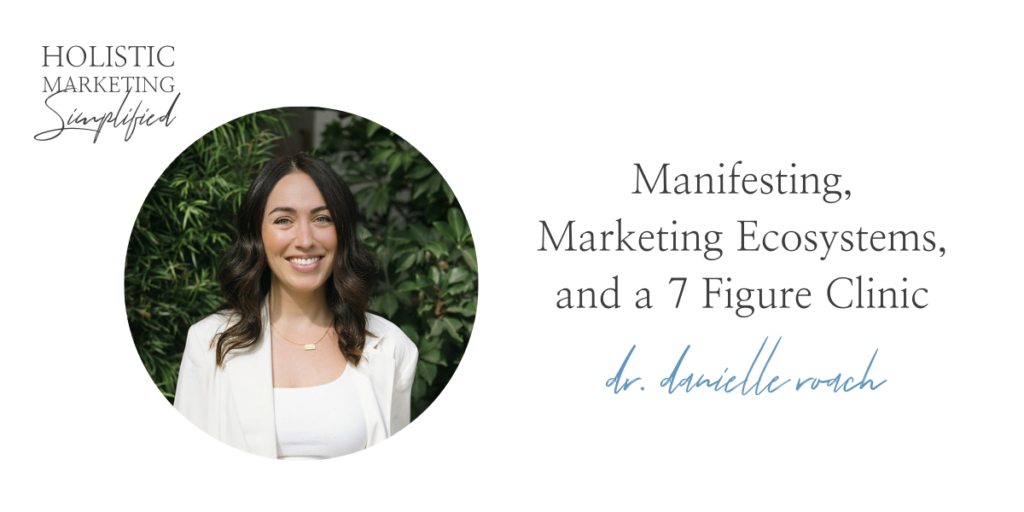
Manifesting, Marketing Ecosystems, and a 7 Figure Clinic with Dr. Danielle Roach [Episode 148]
Subscribe on Your Favorite Podcast Player
Apple Podcast App | Spotify | Stitcher
There are episodes that feel tactical and practical… and then there are episodes that shift how you think about your business, your capacity, and what’s actually possible.
This conversation falls squarely into the second category.
In this episode of Holistic Marketing Simplified, I’m joined by Dr. Danielle Roach, chiropractor, entrepreneur, and co-founder of The Expanded Collective. Dr. Danielle and her husband scaled a prenatal and pediatric chiropractic practice in Southern California to a seven-figure brand in just two years, then expanded to multiple locations while building an entirely new business focused on helping clinic owners grow sustainably.
What makes this conversation special isn’t just the growth story. It’s how mindset, identity, marketing ecosystems, and practical decision-making all intersect in real life.
If you’ve ever felt stuck between wanting more impact and not wanting to burn out, this episode will meet you exactly where you are.
From burnout to alignment
Dr. Danielle didn’t start out with a perfectly niched practice or a crystal-clear vision. Like many practitioners, she began as a generalist, seeing everyone and slowly falling out of love with the work. It wasn’t until personal experiences — infertility, pregnancy, motherhood — forced her to reevaluate her time, energy, and priorities that things began to change.
That moment of reassessment led to a decisive pivot. Instead of trying to serve everyone, she leaned fully into serving families, pregnant moms, and babies — the people she genuinely loved working with. From there, marketing became clearer, growth accelerated, and the practice transformed.
The takeaway here isn’t just “niche down.” It’s that clarity creates momentum. When your work aligns with what actually lights you up, everything else gets easier to build.
Manifestation without the fluff
Manifestation gets a bad rap, and Dr. Danielle is refreshingly honest about why. This isn’t about vision boards alone or “thinking positively” and waiting for results. It’s about identity, neuroscience, and aligned action.
She explains how your brain doesn’t distinguish between perceived reality and lived reality, which means the version of yourself you consistently visualize and act from eventually becomes your baseline. Growth happens when you decide who you’re becoming first, then take action before you have proof.
That identity shift is what allows practitioners to sign bigger leases, invest in teams, launch programs, or make bold marketing decisions without waiting for perfect certainty.
Push seasons are real (and necessary)
One of the most honest parts of this conversation is the acknowledgment that balance isn’t static — and sometimes it doesn’t exist at all.
There are seasons where you push. Seasons where you work more than you want to. Seasons where growth requires sacrifice. What matters is that those seasons are intentional and temporary, not endless cycles of burnout.
Dr. Danielle shares how she structures her days, her energy, and her boundaries so that even in a push season, the work feels purposeful instead of draining. The goal isn’t avoiding effort — it’s ensuring the effort is building toward a future you actually want.
Marketing as an ecosystem, not a single channel
This episode is a masterclass in why marketing can’t live on one platform alone.
Instagram matters — but it works best when it supports everything else. Google search, SEO, email lists, referral partnerships, and in-person relationships all feed into one another. When one channel dips, the others carry the weight.
Dr. Danielle breaks down how her clinics grew without paid ads initially by focusing on local authority, SEO, and real community connections. Instagram became a way for people to feel the brand — not the only way people found it.
That ecosystem approach is what creates long-term stability instead of constant scrambling.
The real reason people don’t scale
A recurring theme in this conversation is guilt — guilt around not wanting to see more patients, guilt around stepping into leadership, guilt around wanting something different than what you originally imagined.
Letting go of that guilt is often the first step toward growth.
Scaling doesn’t always mean seeing more patients. Sometimes it means bringing in help, redefining your role, or building systems that allow your practice to work without everything depending on you.
When you detach your identity from doing everything yourself, you open the door to impact that goes far beyond your own hands.
Wrapping It Up
This episode isn’t about choosing between mindset or strategy — it’s about recognizing that the two are inseparable.
When you decide who you’re becoming, align your marketing with that identity, and build systems that support your energy instead of draining it, growth becomes sustainable.
Not perfect. Not effortless. But deeply fulfilling.
If you’re ready to think bigger without burning out, this conversation will stay with you long after it ends.
Connect with Dr. Danielle Roach
Connect with Molly
Instagram | Facebook | Youtube | Holistic Marketing Hub
The Holistic Marketing Simplified Podcast is brought to you by Holistic Marketing Hub, our hybrid program that supports you with personalized coaching, caption templates, and virtual classrooms. In this program, we teach health and wellness professionals how to fish, but also bait their hook!
Make sure you’ve hit that follow or subscribe button on on your favorite podcast player to get notified each week as we air new episodes!
Episode Transcript
Molly: Hello my friends. Welcome back to the show. This is gonna be one of the last episodes before the holidays and then the new year, which is absolutely bananas. I know everybody always says that it's like broken record, but it's true. So, um, before we dive into the episode, 'cause I can't wait for y'all to meet my, like, legit.
I hope she, I don't know if she knows it yet, but she's my new bestie. Danielle, I wanted to let you know that I only have one spot left in my group coaching program and I would love for you Yes, you to fill it so we can hang out for 10 weeks. Also, I just know it would feel really good for you to go into the holidays knowing that you already have a plan for your clinic's marketing for 2026.
Uh, this group coaching program is a 10 week live cohort with me. We kick off on Wednesday, January 14th. And I am walking you through step by step, the exact process that my Instagram management agency, we manage over 32 clinics accounts. It's the exact process we use to help our clients become the go-to practitioner in their area.
It really is designed for like Me too. I keep using the word install just 'cause I like, feel like you can really visualize this, install your own in-house content creator into your practice. So if you've got staff or front desk or you have like a patient who's been wanting to help out who you wanna hire, that's how I got my start.
Seven years ago, I was a patient and my chiropractor asked me to help her with her Instagram. Or if you as the practitioner want to uplevel yourself, this is the perfect program for you. I'm quite literally holding your hand. So if you're someone who you know learns better by like, okay, I know I paid for this.
I need to be on live. I don't do as well with prerecorded videos. This is the program for you. I also give really specific homework. I hate to use the word homework, but I don't know what else to call it. Assignments each week that you can implement so you can see progress as you go. We all know we love that little dopamine hicks.
I don't want you get into week 10 and then being like, well, shit, where do I start? I don't know what to do. So we start out by like really, really dialing in your messaging, setting up a killer AI project that will be like the hub that you work off of for the duration of the program. We are not like, this isn't.
The first part of my program is not me asking you what your niche is. Okay? So if you're worried about that or I'm not asking you who is your ideal client, okay? Or your ideal patient. We are actually mining the data from your electronic health records that teach you how to do that and inputting that into an AI project so that it is crystal clear who your ideal patients are without you having to be like.
A mom of two who's 35 and has this many, you know, it's just like a different way of going about it that I find just stresses people out a lot less. Uh, we also leverage your Google reviews so that your content is using, using your own patient's words reflected back. Oh my gosh. Just so I love it. Sorry. I get really excited.
We spend a whole week. On my content ecosystem, guys, this is always the thing. Always, always, always. Anytime I audit clinics accounts, there's always something for my content ecosystem missing. If you're wondering why, like, oh, why is nobody actually booking? This is why we spend a whole week on stories, on reels, on Instagram, carousels, on building community, and increasing engagement and networking locally.
Um, let's see, what else? Oh, the best part is we actually spend a whole week just on hooks and getting people to like stop their scroll and headlines. We have a integration week midway through, and then the whole thing culminates with me teaching you how to very, very simply batch create two weeks worth of content.
It's gonna blow your mind how simple it is. Every single time I teach it live, people are like, oh, like that's all had to be doing all along. I'm like, yeah, it's not, it's not as hard as we all make it out to be. Not, I'm not that I'm saying like, you're doing anything wrong, like, I get it. Like that's how I feel.
I just told a story in my emails about I've saved like a million GUHA tutorial videos, but I've never done it 'cause I'm still confused. And then my acupuncturist like actually showed me one-on-one how to do it, and now I'm like, oh, that's not that hard. So let me do that for your clinic's Instagram, where you're like, oh, that's like way easier than I was making it out to be.
The information from that, just go to molly cahill.com/sprint and at the time you're listening to this, like I said, there is one spot left. I would love for you to be the person who snags it. Use the code sprint and it'll take a thousand dollars off the pay in full or the payment plan. Sorry, one other thing I was gonna say is if you have any questions about it, you can just DM me.
I am, uh, going, going dark, going, uh, offline, probably around like December 23rd. December 24th. But yeah, before then, like please DM me. I would be happy to have you. If it's after that and you still wanna chat with me, I do check my email some. You can email me at contact@mollykhill.com. But all the information is on that page that I just mentioned and it'll also be linked in the show notes.
So my guest today, I kind of had been like Instagram stalking her and messaging her and then like once we got on a call, I'm just kind of obsessed with her, like being in her energy is so, you'll see it, you'll pick up on it. We talk about manifesting and marketing for your clinic, and my guest today is this was not a really like flawless, uh, delivery that I'm giving here, but Dr.
Danielle is a chiropractor and entrepreneur. She, her and her husband Kyle, co-founded the expanded collective. But she also scaled her prenatal and pediatric practices in Southern California to a seven figure brand in just two years. She taught me some really cool things that I didn't know about, like marketing ecosystems.
She blew my mind with some stuff about chat GPTs agent mode. Like, like literally I told my team, I was like, please go listen to this episode. Like I need to hear about this. Um, I think we talk about that more in the episode I did with her over on her podcast. We'll link that. Like I said, her podcast is called The Expanded Collective.
Yeah, we talk about, like I said, the manifesting stuff that she gave, I just thought was like super duper interesting. So I think you are going to absolutely love this episode. And, um, Danielle doesn't just work with chiropractors. She, um, has like some therapists and lactation consultants and acupuncturists, all kinds of different people in her world.
So's mostly just like all clinic owners. So yeah, it's this episode's not just for chiropractors and I hope you love it.
Hey, welcome to Holistic Marketing Simplified. This podcast boils down to the fact that we wholeheartedly believe that more humans need to know about holistic health solutions, and you didn't go to school to learn how to be a. Full-time content creator and show up on Instagram and do all of this marketing stuff all day, every day.
So let's come hanging out while we chat. All things ease in your marketing and my goal is that you shift your mindset around your marketing from a quote should to a, I get to more dream patients and clients. Yes, please.
Hi, I'm Dawn Wiggins and I'm an integrative healer, and I listen to the Holistic Marketing Simplified podcast.
All right, Danielle, thank you so much for being on today. I'm so happy to chat with you again. We just had a little like virtual coffee where we just got to chat last week. Now we're getting to. Put all the goodness in recording.
Dr. Danielle Roach: Yeah. Thank you for having me. It was nice to get to know you a little bit better before we got on here.
I feel like now we're girlfriends, you know?
Molly: Yeah, for sure. And I used to live so close to you for five years. I definitely miss. I miss California. It's just wild. It's like, oh my God, how you, it's like impossible. It's like so expensive to live there. I
Dr. Danielle Roach: know. It's a wild place. And honestly, if we hadn't started here, I think it would be unfathomable.
But because we've been here this whole time, it's right. It's what we know. I, you showed me your backyard and I can't imagine snow right now because it is a, a fri a day here in Southern California at a high of 62.
Molly: Well, it's actually colder than people think in southern California though. 'cause living in, well, I don't know, orange County, I don't think as bad as San Diego.
But like when you get that June gloom that comes in, it's like guys, like, you're gonna think San Diego and I need you to not think Southern California. It's actually cold. It's like chilly.
Dr. Danielle Roach: It's true. It's true. Especially, especially with that Jing gloom.
Molly: Yeah, it's, it's crazy. But anyway. Okay. Enough small Talk about the fricking weather.
Here we go. Sorry about that. Alright, Danielle, tell us a little bit for people who don't know you, tell us a little bit about you. The like stereotypical first question.
Dr. Danielle Roach: So, I am a chiropractor by trade. I got licensed back in 2017. And like most people, I started practice not really knowing what I wanted to specialize in or even how to specialize or how to practice.
Like nobody taught me how to own a business. And so I spent the first few years in practice just kind of seeing everybody and falling out of love with the profession. Honestly, found myself in a place in 2020 like most of us did, analyzing my life and kind of what we had built. And so my husband Kyle and I moved from our practice and our home in Seattle back down to Southern California.
So we had lived in Seattle for a few years. That's where my first practice was, and okay. When we moved back down to Southern California, we ultimately opened our practice that we have now called Verve. And at first, just like in Seattle, I started seeing all the pickleball, pickleball folks, like my husband's dad plays pickleball competitively.
Oh, did you know that there are competitive old man pickleball leagues?
Molly: I do now. There are. That's great. That's amazing.
Dr. Danielle Roach: So Molly, I was like doing Graston on 70-year-old men's feet because they had plantar fasciitis. And I looked around and I'm like, what have I done here? Like, this is not what I wanna do.
And at the same time, we were navigating. IVF and infertility. And so we got pregnant with my son and I got the opportunity to kind of look around like really critically because now all of a sudden I was gonna have a kid and less time and all the things, you know, that motherhood really makes us evaluate.
And fast forward, my son is born and so I actually have the child and I'm looking around asking the same question, going back into practice and it's like, this is not. What I wanna do anymore. And then my son, of course had all of the things. He had a tongue tie. He had, you know, tension in his body. He had difficulty breastfeeding.
We couldn't breastfeed without a nipple shield. So again, kind of the story that all of us have when we end up finding ourselves in healthcare or in a specialty, it's like we've gone through it ourselves. So I navigated being that mom who had a kid who had all the issues. When I came back from my maternity leave with kind of those two factors at play, I was like, I have to go all in.
I have to niche down. And so we ended up highly specializing in pregnancy and pediatrics. And really optimized all of our marketing for that. And we were able to go from like a somewhat self-sustaining business to like, we got on the rocket ship and we took off. We were able to get a bigger space. We brought in other providers who serve the same population and we just continued to grow from there.
So, you know, flash forward to today, we have three clinics in Southern California. We're in Orange, Costa Mesa, and Long Beach. We only serve families. We see moms babies primarily. And you know, sometimes dads when they come in too, it's really fun. And so we've grown the three clinics. We have seven doctors that work for us, and we just started a company this summer called the Expanded Collective.
And so when I say we, I'm talking about my husband Kyle, who comes from digital advertising, corporate tech, and we are helping other service-based entrepreneurs grow their businesses to whatever scale. Lights them up and it's been really fun.
Molly: That's incredible. So I've got these like questions that you had given and I wanna, I wanna get to them, but I kind of wanna be, I'm gonna throw you a curve ball here Please, because I am in the throws of launching my group coaching program again, and it's so funny to me.
I wanna talk mindset because it is so funny to me how much I have zero proof, zero that it won't sell out. It always, it has before all my programs sell. I know it's a good product and yet. You get that gremlin, that's like, and I consider myself like a pretty confident business owner. You know what I mean?
Like I don't, I feel like I've done a lot of things right, and I still get those like, oh, what if, what if, what if? So do you feel now that you've kind of transitioned into the coaching world and that you're surrounding yourself with so many brilliant mentors like Steph Wegner, and I know you've got some other people you've worked with.
If you were to gifts, like I, I see so many people in my program. I just wanna like squeeze 'em and hug 'em and be like, you're getting in your own way. I mean, I literally had someone at one point be like, oh my gosh, my, I have patients following me, but like, I don't wanna follow them back because that's weird.
I'm like. Why would that be weird? Like they're following you. You know, just, I know that's like a little tiny example, but just, you know what I mean, of just like second guessing and questioning. I would just love, I don't even have a question. I would just love to hear you riff on like all these downloads and mindsets and manifesting and things that you didn't even put on your form.
'cause this is just what came to me that I wanted to ask you. I love it. I'm like, where do I even start?
Dr. Danielle Roach: I know, I know. So I have a lot of thoughts here. I started manifesting a couple years ago and I didn't really know what it was before that point, but I think that I've always done things that led me to, to manifesting, right?
But then I put a, I put a label on it. I was able to figure out exactly what it meant and it was kind of a rocky start. But what I, what I gleaned in the beginning, I still like, it still rings true today. And that is you have to decide who you wanna be. Like start with the end in mind. Putting all the logistics aside, the self-doubt, the, you know, the details to will the program work?
Will it sell out? How many spots? How much do I charge? Should I follow the patient back? What kind of person are you gonna show up as? And what kind of life do you want? And so if you want to be the person who makes you know just enough and has a comfortable life and you know, has some impact, then you're gonna show up as the person who does those things.
But if you're like, can I cuss?
Molly: Of
Dr. Danielle Roach: course I have the
Molly: E on every one of my episodes. Okay, fabulous.
Dr. Danielle Roach: But if you wanna fucking blow that shit up. Yeah. Like if, if you wanna have a life of like massive impact, build a legacy for your family, for the generations to come, you wanna make millions, why not billions of dollars, right?
Like if we wanna have that kind of impact. Then we're gonna have to shed the identity that makes us ask those little questions. Right? And they feel really big in the moment. But I think that just having the confidence that before you have evidence, right? You said, I've got evidence that it will sell out Well even if you didn't.
Right? Right. Act as if, show up as if, take the massive action as if, and so I remember when I really first started scaling my practice. I had the identity of a person who had like a brick and mortar tiny thing, right? I remember the first time we got a commercial lease, it was I think $1,600 and it was so expansive in that moment, you know, it was so scary.
And then from there we got our next building and that was $6,000. And it was like, holy shit. But you know, Danielle, who got that space? Was not just the solopreneur who rented a room from someone. Danielle who got that space was somebody who was, without a doubt going to have the success in her business and in her life.
And so each step of the way, right? I just like stepped into the next version or stepped into the version of me that could create that life, even though I didn't have evidence of it in the moment. Yeah, so I think it's so important and like going kind of back to your question or your thought around, you know, the patients following you.
I think first of all, it's only weird if you make it weird.
Molly: I mean, that's how I think. But I'm also just like a social butterfly who like overshare and is just kind of awkward as part of my identity and I don't care.
Dr. Danielle Roach: Right? And like, here's the thing, you're allowed to have a private life if you don't wanna share your personal stuff.
Keep that profile on private and share some tidbits of who you are on your practice account. Right. Like we can let people in as much as we want to.
Molly: Mm-hmm. But,
Dr. Danielle Roach: but also, like, I think the more authentic we are, like connect and align with the future version, but then also figure out like who makes you feel good to be, and then be that person and you're gonna attract and be magnetic for the people that you want around you.
When you show up as this curated version of yourself, or you show up in fear or holding back, you're gonna attract people that are attracted to that energy and that's not gonna feel good because you're not aligned with that person. So I think showing up as the future version of yourself and the one who makes you feel good is gonna not just bring you success, but it's gonna bring you that fulfillment and that happiness.
Molly: A hundred percent. As I was telling my business coach, I was like, I'm just picturing myself being like, oh, telling my husband in the kitchen casually like, oh yeah, it's sold out again. You know what I mean? Like just like we're already having that conversation, but it's just so funny to me. How, these are things I know, and these are people I surround myself, and yet it still like somehow makes its way in sometimes.
Oh yeah. And so I'm just thinking about you and just the sheer logistics of owning physical space in Southern California. And I'm just like, good for you. Like you just like, I know you had to push through some of those gremlins to be like, no, like this is what, this is what we want.
Dr. Danielle Roach: Listen, you have to be a little bit of a psychopath uhhuh to do the things that we
Molly: do.
Uhhuh, Uhhuh, do y'all have those like pottery painting places? Yeah, I'm sure. I'm sure you do. Like everywhere it does. My daughter loves it. So it's like we just went on Sunday and Did you ever see that meme that was like, it was like a viral like reel that was like something about manifesting, I'm delusional or something like that, and I'm like.
That is me. Like I'm just delusional. I'm just like, yeah, whatever. I'll make this much money. Like it won't be a big deal. And my husband's always like, your ability to manifest money is great. I'm like, yeah, whatever. But I put on the coaster like I did. I painted a coaster at the thing that just said like, delusion, delusional.
It's like this, I love live on my, it's gonna live on my desk. But yeah, I love that you said you have to be a little bit of a psychopath to just be like, no, I'm gonna do this, but like, I commend you because like I said, I've got this online business, right. That's like, I'm not actually like going out and having to rent a space and buy the tables and, you know, furnish it and, and not just furnish it, but like what you've done with your spaces is stunning.
Thank you. That's your vibe. You are, you and your brand and all of, it's just such a vibe. I wanna stop.
Dr. Danielle Roach: Can we talk every day? Molly? Love you. Yeah, no, I
Molly: wanna come vibe there. I wanna vibe. I wanna vibe with the verb vibe. With the verb verb vibes. Yeah. There. Hey, there's your next post. No, I love it. Any other thoughts on manifestation for people who are kind of like.
Is this writing a letter to Santa Claus? Like I always think of it as like the next most believable thing. That's how I do things, but that might not be right,
Dr. Danielle Roach: man. Molly, I have so many thoughts because this is something that I've. Studied so much myself, and first of all, I understand why people think it's writing letters to Santa because that's how a lot of the like woo girls out there are talking about it.
It's like, oh, just create your vision board and think about it enough and it will come into reality. And it's like, yeah, no, that's, that's like part of the equation, right? That's like the first 1%. Is dreaming up the thing. But neural manifestation is science. It is the way that our brains work. And then if you wanna talk quantum physics, that's a whole other conversation that I don't think we have.
Oh please, let's do it. But like we are, we are just energy, right in the quantum field and we attract like energy. So if we are putting out positive energy, if we are putting out the high vibrations, we're going to attract that back to us. If we're sitting here and we're thinking all of the negative things, everything that could go wrong, what if nobody joins my course?
What if nobody wants to be in my group? The IOR stuff? Of course that shit's gonna be attracted to us. Of course, that's what we're bringing back because energy matches energy. But when we think about manifestation. Ultimately it is the process of bringing a vision into our mind. That's why I said think about what the end result is in terms of who you want to become in terms of what you want to have in your life, and then work backwards from that.
And the more you think that the more you journal that, the more you create your vision board and can bring that image to mind. Our brains don't know the difference between perceived reality and reality that we're living, and so our brain is gonna find a solution. It's gonna find a way to get there. It's like Parkinson's law.
Have you ever given yourself like three weeks to accomplish a task? How long does it take? Three weeks. Three weeks. But if you give yourself that same task and you're like, tomorrow by 3:00 PM it has to be done, you are gonna get that shit done because our, our tasks will fill the time that we give them.
Right? And so it's the same concept. Our brain is going to figure out a way. So if we can think of the pictures that we want to create, then we're gonna start taking aligned action. So it's not just visualizing, it's not just hoping, wishing dreaming. It is taking the aligned action that matches who the person is that achieves those things.
And then in by that, you become the person who achieves those things. And then all of a sudden, the achievement is easy. The thing is easy. And I think that there, I, I live on both sides of that. Sometimes I'm like, oh, it's just about taking action. And other times I'm like, no, you can literally think about it.
And it appears like, remember the first time that we started manifesting, Kyle and I were on an airplane going to Seattle. We had our son with us. He was 12 months. And if, you know, 12 month babies, like they're psychopaths, right? We're psychopaths. He's our mini psychopath. So he wants to, to run around.
We're like, this kid can sit on our lap for free, but like, no, we're paying for a seat.
Molly: So, yeah, I always paid for a seat. It was not worth the free. Yeah.
Dr. Danielle Roach: Heck, absolutely not. But we were like, we can get three seats in coach, or we can get the same row to ourselves in first class. So we, we flew first class and from that moment on we're like, okay, how do we create this life because this life feels good.
We wanna have this, we wanna skip the line, we want the champagne. You know, like this is just, this feels good for us. From that moment, I started doing the manifesting, the journaling. I, I was like, you know, money is so easy to make. I am magnetic. Money comes to me. You know, I get large sums of money in the mail, and wouldn't you fucking believe it, Molly, when I got home from that trip, I got a check for $10,000 in the mail.
And it's not like I, I bill insurance and this happens to me all the time. Like, this was actually money that we had paid into our, uh, property taxes. We overpaid, but still, I was not expecting it. It did not exist right before that moment. And so I think that there's an element of magic and like you have to kind of believe and trust the magic, right?
Because like it's all about that authenticity, that alignment. Yeah. If you feel aligned to it, if you believe it, if you like lean in fully, energetically, you're gonna attract it. And then also like. Take the action. Be the person, and be the person before you have the evidence that it's gonna work.
Molly: I love that.
Oh, that was good. I got chills when you said all that, so that was good. I, I'm the same way. I just, I, I feel like the people who come in, and you probably see this with your program too. It's like the people who come into my program, like, Ugh, this is hard. I hate this. I don't like the way I sound, I don't like the way I look.
I'm not gonna show like this is gonna be, I'm like, I kind of have to like do my own little, like, all right, this is gonna be so much work. Versus people who are like, oh yeah, I'll, I'll try it. Like sure, I'll post it. Like I'll, like, I have this one, um, student who I'm thinking about right now. The videos are always blurry.
They're never the right format. And like I freaking cheer her on every day because you know what? She does it and she's like, oh my gosh, look, I got like 250 views. And she was pumped. She was like, this is more than I've ever gotten. I'm like, I love you. Like, you know, I'm not saying you should ever like set your goal, but I'm just saying the fact that she was like showing up and celebrating a success and a win for her, I'm like, hell yeah,
Dr. Danielle Roach: but that's truly gonna turn into so much more success for her, for someone like that.
Right? Because every video she posts, every time she gets that affirmation that it works. Right? 250 views and her nervous system is like, hell yes. Celebration. She's attracting more of that to her and it compounds and it builds. I feel you, man. I've got some clients right now that I'm like, please, please just choose someone else.
'cause yeah, you know, it's like over and over and over again. You're trying to help lift them up and coach and some people just are not ready for it. But the ones who are the ones who come into your world and they're like, tell me what to do and I'm gonna do it right. Like they're setting the goals with you.
They're taking that aligned action. They're showing up even when it feels uncomfortable, those people are getting massive results. Massive results. We've got you. Exactly. You know, we've got people in our groups that are like, yeah, we're doing everything. And it's like, okay, I hear you. I hear that you feel that way, and also here's some other things you can do.
And they're like, cool. Say less coach. And they do it. Yeah. And they're like literally doubling their new patients in a month. Anything is possible.
Molly: Amazing. Yeah. And here's the key piece that I want to really, 'cause this is what, um, when I was listening to your podcast, and I don't know, I think you're a good bit younger than me.
I'm almost 40, but I'm like in that recovering like I was in corporate before this. I was in medical sales. I led a team of 17. I worked nights, weekends, lived in hotels, and I was so burnt out that when I first started, like learning about the online world and this like anti burnout, anti hussle culture, of course I was like, fricking, what do they say?
Fly on. What is it? What's the saying? A fly to honey. What's the saying?
Dr. Danielle Roach: I think it's on shit.
Molly: Well, that's what I was, I think I'm thinking of the saying, you can attract more. Whatever the saying is with
Dr. Danielle Roach: more, more honey than vinegar or something.
Molly: Yeah, yeah, yeah, yeah, yeah. Yeah. That's it. That's it. Um, of course, like I said, I was like, oh, this anti hussle stuff is great.
Right. And I do think everything comes to us in a time that we need, and that's what I needed right then was it's like this overachieving woman to be like, oh, I can chill out. But then. What happened was like, you get into that, and this is why I love the coach that I'm working with now. It's like you see all this messaging from, you know, that was really big in 2020 and 2021.
It's like passive income. It doesn't have to be hard. I, I have seven children and work two hours a week. You know what I mean? It is just like, oh. Okay. And then you think that that's, that's the goal, right? And then you get into it and you're like, oh, that's all, that's all bullshit. Like, you know what I mean?
Like that's actually not a thing either. But it also makes you not afraid to work, but you're like, oh no, I don't wanna burn out again. Does this resonate with you where I'm going with this like, oh, a thousand percent almost that balance of like, I've almost looked at it now for me of like seasons, but it's like.
Like I said, the coach I'm working with now, it's like, okay, I'm happy to set an income goal, but I have like, not parameters, but like terms. Okay. Yeah. It's like, yes, I would love, you know, like this is my income goal, but I'm not willing to give up certain things. Like I don't wanna be working late at night.
I really don't love working on the weekends. I don't know. I guess my point is, do you think you can create that dream revenue level you want without like burning out and working nonstop?
Dr. Danielle Roach: Yes. Yes I do. I also think that balance is bullshit and that's not a real thing. I don't think anybody ever has full balance.
No. Right. This whole work life balance, like go be an employee, don't own your own company, because you're right, it is seasons and there are seasons of slowing down. Prior to two years ago, my whole life was trying to find balance and never achieving anything that really fulfilled me or made me as happy as I am now.
And I am busier than I have ever been. I am working more than I have ever worked. And I'm fucking fulfilled and I have two beautiful children and I have an amazing marriage. And again, figuring out what kind of life you want, who you wanna be in that life, and then knowing that to get there, you're probably gonna have to make some sacrifices, but you also need to take care of yourself, and you also need to push in seasons.
Right as much as we want, we need to push, like I am up at 4:00 AM I am working till 7:00 AM then I am intentional with my kids from 7:00 AM until 8, 8 30, and then I work my ass off during the day so that I can be present with my kids at night. And then I don't work at night 'cause I'm asleep by seven 30.
You should know that about me. Don't text me past seven 30 PST. I will not, I will not answer. Is that my dream life? Is that what I'm aiming for in the future? No, absolutely not. The life that I'm dreaming for has me not having to work every day or at least choosing to work every day. Right. Choosing to work on the things that I want to.
Kyle and I were talking about this this morning when I was in practice and I've had to do this recently covering for a doc. 'cause we had four doctors go out on either maternity or disability leave in the past couple months. Wow. But being in practice, it's like, oh, I remember why I, I got out of this.
It's physically exhausting. I bring less of myself home to my family, and I have no choice. I have no freedom. I wake up and it's like my day is already predetermined for me. I love the opportunity to wake up and do the things that light me up to do the things that feel important, and I am sacrificing now to build the life that I want to create, to be present with my kids when they're at an age where they're gonna need more of me.
Right. I have young children now and so am I there intentionally with them every single day. Yes. Am I with them as much as I would like to be? No. But again, it's a push season. It is a sacrificial season for a reason. And I think that we don't all want the same things. I don't think, Molly, that everybody is at quite as psychopathic as I am.
Right. And like as my husband is, we are both like on the same level. We have the same dreams and that's exciting to us. But I think other people listen to us. Look at our ambition and they're like, Ooh. Like I don't, they don't want that. Right? And I don't expect everybody to. And so I think it's figuring out what the dream life is for you.
Like you said, you don't wanna work on weekends. I don't mind waking up at 4:00 AM and working on a weekend. 'cause I get the rest of the day because. Again, like we, we have, we all have different things that make us feel good or not. And so I think you just have to again, start with the end of mind and work backwards knowing that some seasons aren't gonna be the ideal.
Some seasons are gonna be that, that push and that sacrifice, and I think if you're not where you wanna be, then you need to work harder.
Molly: I just came out of like a really big sprint season. I like completely redid my curriculum. I did a new webinar, I launched two different program, and so I'm kind of, you know, and you know, we had some big losses in our family as well.
So I'm kind of in, like I said, going into this launch. I think that's why I'm having a little bit of that residual, like, is this gonna work energy because I'm, I think I'm still kind of coming down from that. I'm like catching my breath a little. That's one thing going into the, the new year is like, I need, I really need to like revisit what all of that looks like for me.
So this is helpful. I feel like I'm getting like, free coaching from Danielle on the, on the podcast. So, so this is actually a perfect segue into, you're talking about, you know, seeing patients all day and the day is predetermined for you. What do you recommend to your clients who are like, okay, I would like to, it's not like I don't wanna see patients at all, but I would like to.
My goal is not, oh, I wanna make more money. Let me see more patients necessarily. Like what is something you kind of walk through your, um, clients in your mastermind when that's their situation?
Dr. Danielle Roach: Yeah. I think first of all, it's removing some of the guilt that people feel with not wanting to see more patients.
And I think that's a really big limiting factor for a lot of folks because we come into chiropractic or. Into whatever our service or our, you know what it, the thing is that we got into in the first place to help people. We got into that because we wanted to help people because we had a challenge, whatever it is.
And so a lot of times we're having to coach folks through that guilt and help them understand that by bringing in other practitioners, they get to have even greater impact. Like I have seven times the impact. Having seven doctors than I could practicing myself. And honestly that's a bigger, we talked about mindset a lot on this and, and I don't think it's actually that much different than talking about business because I think if you don't have the right mindset, you can't make the moves in business that you need to, to have the success that you want.
And so honestly, that's step one, is detaching the identity. Being okay with stepping into a leadership or A-C-E-O-C-E-O role or whatever it is that you're aiming for, and figuring out why you want that and what you want your schedule to look like. Because not everybody wants to be fully out of patient care.
That's what works for me. But maybe that's, that's not right for you. I have somebody, you know, I, that I was with on this retreat last weekend, who's like, it lights me up. It brings me my purpose. If I don't do that, then business doesn't feel worth it. I'm kind of the opposite. I'm like, I'll do the chiropractic because it pushes my business forward.
But I'm really in love with business growth. I'm really in love with mindset work. It doesn't mean that I don't see the benefits of chiropractic and love that we get to serve so many families through our practices, but it's not the thing for me. And so I think working backwards from that, it's like, okay, well how many days do we wanna be in?
What? What does the revenue need to be for that? And then, is that enough for us? Do we want to, you know, just scale back? And if we're like, no, we still wanna have the growth, then we need to figure out what butts to put in the seats, right? Maybe it's bringing in an office manager or somebody, an admin assistant, who can help you be more productive in the patient hours that you have.
Maybe it's bringing in another service provider who can then deliver the service. But then you gotta figure out, do you want that person to just relieve you so that you can have time off, or you can go market or do other things, or do you want that person to grow with you? We've got a client right now who really wants to not be in practice at all, but she's not in a place with her revenue where she can just totally bring somebody in and replace her.
That's not gonna get her to the next level. So she's got the push season of having to be in practice longer than she wants to be, but if she can push forward, get this person to push forward, and then all of a sudden she's got the capacity from a revenue perspective to bring in another doc and then replace her.
I think what we do with people is highly. Customized based on where they're at, but it's ultimately asking those questions. What are we trying to build? And then stepwise, how can we work backwards to get there?
Molly: No, and I, I think I see so many, I know I have a very different business, but it's like I see so many parallels because there are days, and it's usually like a day or two before I start my period, uh, without fail.
I'm like, okay, don't make any major, major business decisions. I'm like, why am I doing all of this? I could make the same revenue. If I just paired down had like five or six one-on-one clients, I'd be paying myself the same amount. Wouldn't things be so much easier? I'm like, oh, Molly, you're so cute. You wouldn't be happy with that.
Right. You know? Right. But, but I'm not saying that's wrong. Right. There would be people who'd be very happy with that, and that's the season of life they're in. And they, my, my friend Sabrina, she's hilarious. She's like, I love being a kept woman. I'm a terrible housewife, so you'd think I'd be better at it, but I don't like to work.
I don't wanna, you know, I'm like, good for you. Like, that's cool. Like, I wish I had, you know, sometimes I wish I had that, like, you know, I just wanna go buy a goat and make soap and be Cheeto. I mean, like, I don't have that, you know? Mm-hmm. So it's like I have built this big behemoth of a business and a team because it's in a place to scale.
Like you said, neither one is right or wrong. You're not more worthy if you're more or less ambitious. I think the people who are the most successful are the people who like, just exactly what you said. You're like, I'm happy and I'm fulfilled. Like that's success. Bottom line,
Dr. Danielle Roach: thousand percent. I, I think it's asking those hard questions and actually intro expecting.
I think so many of us get caught kind of in this. Race of trying to achieve because somebody else is achieving. Mm-hmm. And if you're not asking yourself what you actually want, you're gonna end up really successful and really unhappy. And that's like, what's the point? You know? So,
Molly: oh my gosh. Exactly. It's like, yeah.
It's like if you're constantly, you know, you get on that hedonic treadmill of like. Okay, if I just get to this much revenue, like, and then I get to this much revenue and then this much revenue, and it's like, it's like you're working toward, you keep mo moving the goalpost and like you keep working towards this thing and you're never actually satisfied with where you are.
It's like, well, what's the point?
Dr. Danielle Roach: Um, ed Millet has this phrase, blissful dissatisfaction. I think it's so perfect because you have to find the bliss, you have to find the gratitude and. The peace honestly, with the life that you're living and be dissatisfied because like you said earlier, right, that like just being a kept woman, being Suzy homemaker, like that is, that is not for us.
That's for other people and that's awesome. But if I'm not always chasing something, I'm not living in some state of dissatisfaction, wanting more, I'm not gonna be happy. I'm gonna be bored looking around what is the point of life that is my personality. So I think for everybody having elements of that, but like maybe we turn the lever up or down on one side versus the other, right?
Like maybe somebody has a bigger, dissatisfied lever, meaning that they want to push for more. They have, you know, bigger goals where somebody else has a higher gratitude lever like that, that bliss lever where they're like, you know, my life is so good. I've got my home, I've got my children, I've got my goat.
You know, I think it making my soap. Making soap. I do make sourdough. I do make sourdough. I know you. It's the one thing I've got.
Molly: I'm a trad wife, right? No, yeah. No, we, uh, we watercolor. Okay. My daughter and I, that's our thing. Yeah. We're like a. I love like home decor, you know, like that's my,
Dr. Danielle Roach: listen. I love to decorate, although I will say my offices are always more beautiful than my home.
Always.
Molly: Well, your background backdrop there is beautiful. So I'm in, I'm in my
Dr. Danielle Roach: corporate
Molly: office. I am not at my home. See, oh my God. Can we talk about that for a second? I have so many times thought about renting an office space because I just feel like it would change my brain.
Dr. Danielle Roach: So you remember how we talked about living in California?
Our home is 1400 square feet and we now have two children. If I wanted an office in my home, it would either be in the nursery or in the garage, and our garage has like a a little whirly gig thing with a wind. Not really great for podcasting or Zoom calls, so. We were kind of forced to get this office and honestly, I, I do think that it makes a big difference.
I think being able to leave your home space till you take off that hat and you go into your workspace and it's like, okay, we're here. We're gonna get business done, and then you get to take that hat off and go back and be fully present. I think that it does something to your. Neurology a little bit to be able to get into a different space, but I also think if you have that in your home, you know, like a beautiful office like you have there.
I don't know where you're at, but it looks like an office.
Molly: Yeah.
Dr. Danielle Roach: Yeah.
Molly: Our house was built in 1987, so it's one of those that when you open the front door, there was like a formal living room off the thing. So there's no doors. So I told my husband that's, it's like, I need doors. You know, when, when my daughter's in school, it's not a big deal, but in the summer it's like, that's tough.
And yeah, and I love gonna the coffee shop, but you can't do everything. You know, you, like you said, zoom calls and podcasting and stuff. So every year I get this itch to be like, do I go find an office space? So I'm like, I just, I actually toured some last year and I was like, Ugh, this is not the vibe. So maybe I'll just, I'll manifest that.
I'll put that out. Come to me. Perfect office space. I'll find it. His coming already on its way. What I was gonna, I'll, let me get a little bit back just to like to the clinic stuff, but I'm so happy with where this conversation went. If you do this well, this isn't one of the questions. If you do have clients who come to you who have kind of a, like you said, fallen out of love with their profession a little bit, whether it's chiropractor, you know, I have a lot of acupuncturists, whatever.
What is like a typical exercise that you might help them walk through? I put you on the spot 'cause I didn't tell you I was gonna ask you this.
Dr. Danielle Roach: No, that's fair. It depends. In our group, we focus more on marketing, but we give them, you know, mindset and systems as those questions come up in our weekly calls.
Our private clients have a little more structure mm-hmm. In terms of how their onboarding looks. And so we have a questionnaire in the beginning that basically asks them all the things we wanna know, all the practice stats, but we also wanna know like their hopes and dreams and where they're at and what's working and what's not working.
And then we do a 90 minute deep dive with them and essentially. Pick apart all the things that are bringing them joy and all the things that aren't. And then we try to help them set their goals around that. And so our 30, 60, 90, and then six month goals, 'cause we start in a six month container, are all based around what they're trying to achieve in that practice.
So for a lot of people it's increased revenue. You know, but some that are, you know, at that increased revenue level, they want more freedom. Those people were talking about how to get outta practice, not how to put, you know, pull the throttle up. So it just really depends on where they're at. But I think really getting clear on what do you want, what would you, what would light you up, right?
Like for example, I have this client that I was talking about earlier, who wants to be outta patient care. It's like, well, okay, what's the next chapter look like? Why do you wanna be outta patient care? Well, she would love to have a baby, but even more than that, she would love to open multiple clinics, which is ultimately what led her, you know, to working with us in the first place.
And so we are now creating momentum in her practice, having her be in a push season. So she can bring on her first associate who is coming on next month, which is super exciting. And then from there it's like, okay, how do we then scale back your days so you can push more as a CEO and a leader? And so it's, it really just depends, right?
We have some that they're like, we don't really wanna get out of practice, but it would be nice someday to maybe have a supplement company and, you know, they wanna start a family. And so ultimately it's like you don't have to do the thing forever and it's okay to not want to do the thing, but it doesn't mean that that that main thing.
Can't still be a revenue generator in your life.
Molly: Right. Well,
Dr. Danielle Roach: and
Molly: it could be as simple as even too, like what you said, just shifting the types of patients that you see, even I feel like could be super helpful. True. You know, you were like, what? These aren't, this isn't what I wanna do. This isn't what I wanna be doing.
I wanna see, I love the babies and the pregnancy, and that's really what lights me up. And I'm saying that might not be a long-term fix, but it could definitely. I'm guessing is something that you probably help people navigate as well.
Dr. Danielle Roach: Yeah. The one that came to mind, she already specializes, but we, we, you're right, we have other people who are generalists that come in and they're like, man, I'm just burned out.
I don't love seeing these people. They don't, you know, do the things I tell them to. And for those it's like, who do you love seeing? Who lights you up? If you walked into your, your office and saw a schedule with 10 names, what are the 10 names you'd wanna see? And let's only talk to them in our marketing.
Let's only speak to those people and their challenges and their hopes and their dreams, because then we're gonna attract more of them to us.
Molly: I think so many people get stressed out and hung up on their niche and it's not that hard. I think people try to like figure out what it is and I'm like. You don't have to figure it out.
You just look at your exactly what you just said. You already know what it is. You don't have to figure it out. You just, I always, uh, I've told people before, I'm like, pull your last 50 new patients from your EHR if you want, and put 'em into three buckets. And then the people who don't make it to bucket one, like, then that's, that's not your niche.
This is your niche bucket. One of like these people, like it's done for you. You don't have totally to figure it out, and you just speak to those people. So if you were starting over today. What would you, uh, focus on and, 'cause like I said, you probably tend to attract to more. Do you have any many beginners in your mastermind?
Not, not a ton. Yeah. But I, for the people maybe who do, 'cause I have a, I have a variety. Yeah. Even if you're not starting over, like literally. But it's like the proverbial starting over because you're like, sure, I'm not loving this. What would you focus on to attract those like first right fit patients, clients, whatever word do you wanna use?
Dr. Danielle Roach: So I like to think of kind of our starting point as Danielle who had the practice who was generalized. I had been in practice for, you know, five years, but I didn't, I wasn't niched down yet. I, I didn't, my marketing wasn't dialed in. I was seeing just enough patients to take a little bit of money home.
That's kind of my beginner. That's who typically is like the very first person who will work with us or who we'll work with. For that person and for Danielle in the past. Right? 'cause a lot of times we're talking to ourselves in our marketing, right? Especially, you know, our clients. If we're, if we're helping those folks, because we've been there, we've navigated it, we're, we're steps ahead and we can pull people up.
So I would tell you to just like our, this is a good segue because I would say first you need to figure out who you wanna serve. When we're marketing here, we gotta be crystal clear on who we help and how we help them, and why we're the best fit for them. We can't do that if we don't know who we're talking to or if we're trying to talk to everybody.
So I think you probably would say the same, right? Is like, yeah, niche down. Figure out this person. And like you said, it doesn't have to be complicated. Just figure out who lights you up and who makes you happy, who you wanna see more of and spend more time with. And then let's start talking to them.
Molly: One thing about niching that I think a lot of people is a misconception.
When it's the who, they think that it's a hard demographic. They're like, well, I really do like seeing babies and I really do like seeing 80 year olds. I'm like, and that can be your niche if you, it's a certain Who was it that I was talking to? They were like, yeah, our niche is just people who are fed up with conventional healthcare and know that there's better solutions.
I'm like, that's an amazing niche. Like I think people get stuck on it. It has to be 30 5-year-old woman with 2.5 kids and this much, I mean, that's a good starting point sometimes, but it doesn't necessarily have to be that. It can be like a personality trait and an a feeling, I think.
Dr. Danielle Roach: Absolutely. Yeah. I know for us at Verve, we don't see just one patient type.
Mm-hmm. We see babies, we see toddlers, we see school age kids, we see moms, we see pregnant moms, you know, and then we see full families. The people that we want in our practice, our ideal folks are families of any of any of those iterations, and they are families who want community because our brand is really built on community.
We are building that for our people. When they come into our space, even if they're not at an event, they're just there for an appointment, we want them to want to be in community because that's the environment that is the magic that we're creating. So I, I totally agree with you there, and I think to that.
The next thing I would do is I would start building out my social media as a peek inside that community or in a peek inside to the, the thing that I'm trying to create. We want people to feel something. We want people to feel like they know us. So I would say stop using the stock photos. And this is like not just, oh yeah.
This is not just social media, right? This is on our website. This is on our Google My Business profile. Anywhere on the internet where people are going to find us. Show your face, show who you are, and give them a peek inside your practice and your personality. We talk a ton over at the expanded collective about transparency because people want transparency.
We live in a world that is more transparent than ever. We have a peek inside people's literal homes. Their morning routines, what they do with their kids, where they go grocery shopping. People wanna know this stuff. People are curious. They're nosy. So give them that. You don't need to give them everything, but we want them to know exactly what it's gonna look like and feel like to work with us and get them excited for that.
So I would say that would be, step two is start building out that social media, almost like a landing page, right? If somebody comes back and we're lucky enough for them to find us, we want them to be able to binge that content and by the end of that binge to feel like we're besties. Then from there I would say get on your SEO.
Like this is such an underutilized tool because I think people think it's so technical and it's not that hard and it, it has such a big impact and it can start working from the moment that you employ these strategies. So we talk all the time about Google My Business, we have a free Google My Business kind of optimization training and that maybe that's something we can give your listeners.
It makes it a bigger impact than you think. And I know when I was starting out at this point where I was kind of figuring out how to market myself, I just thought Google my business was something that kind of naturally happened. I didn't realize that I had as much control over it as I did. You can upload photos, you can create posts, you can optimize it with keywords you like.
There's just so much you can do. And that's the starting point, right? Then we wanna optimize our website so that Google reads it and sees us as a, as an authority, right? And so that's. A really big thing, and you guys, if I, you leave, take one thing from this, like, SEO is not sexy, but it is impactful. Please, please, please optimize your SEO and learn how to do it yourself because most SEO agencies are garbage and you're gonna pay $2,000 a month and you're not gonna get anything from it.
A blog post is not SEO. So that's, that's huge. And then, you know, while we're talking about local authority, I would then start figuring out how I could position myself as the local authority in whatever my niche is, right? So if it's people who are fed up with the conventional healthcare system, like that doc that you talked to.
I would start potentially reaching out to other people in my community, other providers who serve those same people. Who would that be? Maybe that's a functional medicine provider. Maybe that's a hypnotist, right? Maybe. Who knows? Right. For us, it's lactation consultants. It's doulas, it's midwives. It's the people that are working with those, with our ICA with our prime ideal patient.
And we are then asking them questions. We're showing up in service. We talk all about this, like, serve first networking is so important because you are just gonna repel people if you try to like take from them. Right? And most of us are, come on, like you don't have to raise your hand in front of everyone, but like most of us are showing up and we're like, Hey, will you hold my, have my brochure in your office?
Why would they do that for you? They don't owe you. They don't owe you anything. Show up in service first. And then once you build relationship, then you can show how you are a local authority. Then you can help them by maybe doing a workshop or a talk, providing value for their community. And all of a sudden, when you build these relationships, this network kind of army of referral partners, you've got the local authority with the people who matter.
Really we talk about the local authority funnel or like the local authority build as being the most important thing. So it's not one thing, right? And, and nowhere in there did I talk about ads? Love it. Because ads should be the very last thing. Do we run ads at ve? Absolutely. We spend a lot of money on ads, but it's because of the scale that we're at.
We got our clinic from zero to $70,000 every month with zero ads, no paid marketing. If you are able to be holistic in this approach, you are very clear about your brand voice, who you serve, how you serve them, you communicate that well, you optimize your social media with somebody like Molly Cahill. You go in and work on your SEO and make sure that you're actually showing up when people are doing these Google searches.
And then you build your army of referral partners. You're gonna be off to the races and it's gonna be really hard for people not to find you.
Molly: And I just like, as someone who teaches Instagram specifically. I hate, hate it when people come to me. Expecting to put all their eggs in my basket. 'cause I'm like, oh, please don't.
But I, I see, like what you said, I, I mean, I, if you've, you've followed me for a while, but like I teach a ton exactly what you said about the collaboration piece and the community building piece. I'm like, yeah, good content is great, don't get me wrong. But like, you've gotta treat Instagram like you would treat our in-person networking event.
It's not just this passive billboard. Like so many people call Instagram a billboard and I'm like. I mean, yeah, in way certain ways it is, but it's. I look at it as so much more than that. And then it's like they might not ever even get to your Instagram if your Google is not where it's like, it's like they Google first they find you and they're like, mm, okay, let me check out their vibe.
'cause your website, even if your website doesn't have stock images, it's like, it's not updated like every day, you know? So it's like, Hey, let me go check out their vibe a little more on their Instagram. It's this multi-layered, multi-touch point approach. It's like, oh, and my doula recommended them. It's like all three of those things together, like you said, working holistically, it's like, ah, Danielle, booking it done.
They all make each other work better. Yeah. It's like this beautiful little ecosystem. So I'm like, please don't put all your eggs in my basket. I do have one. Um, I have one student who's getting like 90% of her new patients from Instagram, but she also has created this like. FOMO type environment where like all her patients are always post, you know what I mean?
So like it can be done, but it's like you still have to be, you gotta show up on Google. Like people are typically going there first.
Dr. Danielle Roach: And I think we have to remember that like things, the algorithm can change, right? Google or Instagram. Instagram is not guaranteed forever. We don't own it. Right? That's the other thing.
I would build an email list and I would be nurturing that list. I think it's, it's just so easy to. Here's the thing. We are all busy and we don't have a ton of time, so I feel like it's easy to say, oh, well I'm gonna focus on this thing because I can make that thing the best. And it's like, yes, you need to do that.
And. Like seasons, right? We have push seasons. Let's push over here on Instagram for a little bit. Create a system, right? Because we don't wanna feel like we're working hard every day on something because then it does feel like hard work and we're spending more time than we should. But if we can systematize that and then fit that in, now all of a sudden something that took us two hours is gonna take us 30 minutes.
Then we create the system for the next thing. And ai, like we are living in a time that makes work so much easier than it has ever been because AI can help us. We don't even have to pay an employee. And then once we get to a place where we have enough leverage to pay an employee, then that employee uses ai.
It's like we just have to really be smart about how we're spending our time. And if we do that and tap into all these systems, not only do we have that robust system of, you know, lead generation, but if something happens, we're covered. There was one year where Google changed their algorithm. We were getting a ton of Google patients because Kyle had optimized it so well, and all of a sudden it turned off and we were like, our new patients are cut in half.
What is happening? And we figured out it was the algorithm and it's like, oh shit, it's time to start emailing our list. It's time to get back and be active on Instagram. You know, so it's, we have not always been perfect with this, but we've learned through so many trials and tribulations of like the need to have a robust system for that.
Referral and that lead generation system to work even when you are not working. And that's, that's really what it is. So you're not on the treadmill constantly of trying to bring in new patients every single month. Right. It should work for you.
Molly: Yeah. And like you said, when you have, I feel like those things doubt and it does create this little ecosystem and, but, so okay.
Your three locations, because I'm pretty familiar with Southern California geography, but I'm guessing you don't have many patients who overlap to the different. Locations, or do you?
Dr. Danielle Roach: No, and we let that be an option for people, and I think we've probably had one or two that have ever utilized multiple offices for the most part.
The only reason that happens if is if somebody wants to get in sooner and one office has a new patient appointment before another, but then they'll still transfer to their primary office. So our locations are about eight miles apart. We don't do less than that because when we do paid advertising, we don't wanna, you know, cannibalize our results from one campaign with another.
And so we have our primary or our flagship office in Orange, which is in North Orange County. And then south of that we're in Costa Mesa, which is close to Newport Beach, which I think is more familiar for people who aren't living here. And then we have a Long Beach location, which is in LA County. It's in like a really nice area called Naples.
So yeah, each one is at least eight miles apart and most patients are kind of finding their home. But we do have one social media. We have one kind of branded hub and then we help to direct people to the office that's closest to them.
Molly: That was actually gonna be my next question. That, or that's why where I was going with that question.
You, you took the words outta my. I do have several clients who have asked me should I have two different accounts, and I think either way could be right, right? Like you could have, you could do it either way. But my first question is usually will people drive? Is their ability to share? And then two, like if it's close enough, I feel like if you build up the brand in your area, like people are gonna drive, I pass.
I can't tell you how many chiropractors I drive past to go to mine 'cause I go to an upper cervical specialist. So I drive almost 30 minutes and I live in a pretty urban area. Like I, I think that it's sometimes just easier just to have one account. But that's,
Dr. Danielle Roach: well, here's the thing, like if we're branding, well, we are a destination.
Yeah. People are not coming to us because of proximity alone. Right. Right. They'll choose which one of our offices is closest to them. We actually started with multiple Instagram accounts and it was such a headache to try to manage three accounts. And so we found that simplifying and creating the one account is just so much easier.
And we showcase each of our offices and we talk about the Long Beach team, the Costa Mesa team. You know, we really try to get the personality of all three in there.
Molly: I'm so glad we, I didn't even think about asking you that, but that's so great. 'cause like I said, I, I wanted proof that I wasn't te steering people wrong.
Like you've actually done it. I'm like, I usually encourage people like. Why you can't keep up with the one you have and now you're wanting to,
Dr. Danielle Roach: I mean, if you're, if you're planning on like growing these clinics to sell them. Yeah. I think that Instagram can be an asset, so that would be something to consider.
But if, if that's not your intention, then just have one centralize the brand. Yeah. Okay. Cool.
Molly: Just making sure, like I said, I don't think there's a wrong answer. Do you want to, great. Same you two, but. Man, I don't want, I don't even have two, I just have one account. Yeah, it's, it's a lot. Yeah. It's just too much.
But Danielle, this conversation turned into, I was already looking forward to it, but it turned into so much more than I could even have imagined. So thank you so much. Um, how can people like soak in your goodness, and you don't just work with chiropractors, so I wanna, I wanna make sure that's clear.
Dr. Danielle Roach: Yeah, absolutely.
We, we are currently working with an acupuncturist. We've got an ot, we have a mental health therapist, so. We help a lot of folks in the service based kind of healthcare space, and we've got Instagram, they can come find us over at the expanded collective. We also have a podcast. I'm excited for you to come on this Friday.
Yes. Um, not that we would release it on Friday, but soon. Soon, yeah. Um. That is called the expanded life. And so the expanded collective, the expanded life. Um, and then if you want to come, you know, hang out with me personally. My personal Instagram is Dr. Danielle Roach, like the bug.
Molly: Do you love, what was your maiden name?
Or is that your maiden name?
Dr. Danielle Roach: No, my maiden name is Lamerand, which was a mouthful. So. My husband was like, you really love me to take my name? I'm like, yeah, babe. I'm in it for it. I'm in it for the long run, so
Molly: I know so many doctors with your professional licensing and stuff, it's a pain in the ass when you get married.
So I never know if people go by their maiden name or
Dr. Danielle Roach: No, I go by Dr. Danielle.
Molly: Oh, yeah. There's
Dr. Danielle Roach: no, there's no Dr. Roach, but Dr. Dot, Danielle Roach for Instagram.
Molly: My, one of my first chiropractors, Chrissy, well, she'll, she's like my og. She's how I started my business, but her last name is Bender or was, and I always just thought it was funny that I had a chiropractor named Dr.
Bender.
Dr. Danielle Roach: That's hilarious.
Molly: Since then, I'm a, since then I have met another Dr. Bender who's a chiropractor. So I just think that's hilarious. But
Dr. Danielle Roach: they had to be chiropractors.
Molly: I know. Right. Okay. Again, thank you so much and, um, we will put any relevant links or freebies or anything in the show notes and I appreciate you spending a whole hour with me on your busy day.
It was so fun. Thanks, Molly. Thank you for listening to Holistic Marketing Simplified, and hey, you know how every podcaster at the very end of their episode asks you to rate and review their podcast? Well, that's because it's super important. These podcasts take a lot of time and heart and effort to produce, to bring you free information.
So in order for me to be able to continue doing that, we need more people to find out about the show. So if you could please just take like two minutes out of your very busy day to leave me a rating and share this on your Instagram Stories and tag at Molly a Cahill, that's C-A-H-I-L-L. I would greatly, greatly appreciate your support.
I know your time is valuable and I can't wait to see you in the next episode.
![Case Studies: How to Turn Silent Lurkers into Paying Patients [Episode 136]](https://mollycahill.com/wp-content/uploads/2025/09/Case-Studies-How-to-Turn-Silent-Lurkers-into-Paying-Patients-Ep-136.png)

![A Bare Minimum Instagram Marketing Strategy for Busy Seasons of Life [Episode 110]](https://mollycahill.com/wp-content/uploads/2025/03/A-Bare-Minimum-Instagram-Marketing-Strategy-for-Busy-Seasons-of-Life-Ep-110.png)