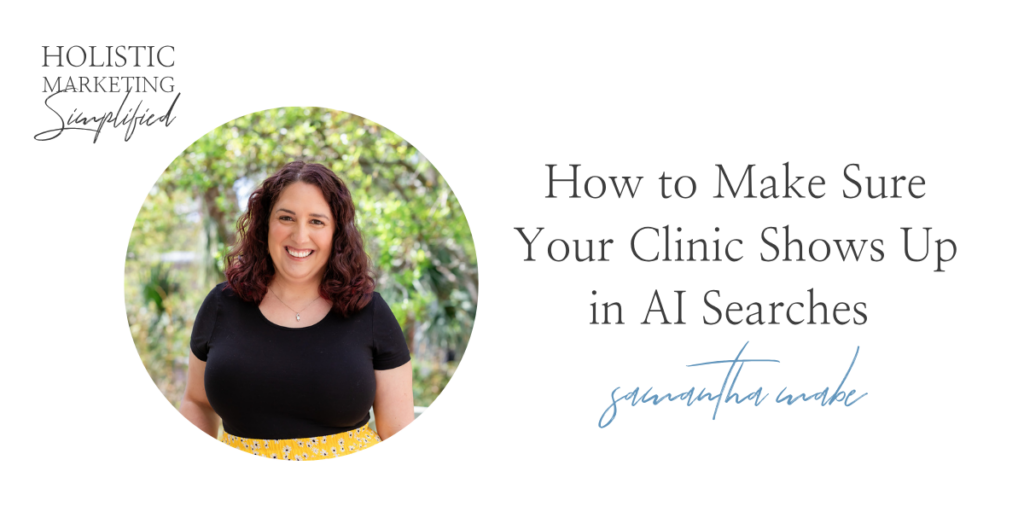
How to Make Sure Your Clinic Shows Up in AI Searches with Samantha Mabe [Episode 175]
Subscribe on Your Favorite Podcast Player
Apple Podcast App | Spotify | Stitcher
Over the past year, I’ve started getting a new question from practitioners.
Not just, “How do I show up on Google?”
Now it’s: “How do I make sure my website shows up when someone asks ChatGPT, Claude, or Perplexity for a recommendation?”
It’s wild how quickly things have changed.
The good news? You don’t need to throw out everything you’ve learned about SEO. In fact, most of the work you’ve already been doing is still the foundation for showing up in AI search results.
That’s why I invited my friend Samantha Mabe, founder of Lemon and the Sea, back to the podcast. She designs websites for holistic health practitioners and local businesses, and she’s been getting this question from her clients just as often as I have.
SEO Isn’t Dead. It’s Still the Foundation.
One of the biggest myths floating around right now is that SEO doesn’t matter anymore because AI is taking over.
Samantha was quick to shut that down.
Search engines and AI tools are trying to do the same thing they’ve always done: give people the best answer to their question. That means they still need clear, accurate information about who you help, what you do, and where you’re located.
If your website clearly says you’re a pediatric chiropractor in Richmond who specializes in scoliosis, that’s much more helpful than vague messaging like, “Helping families live their healthiest lives.”
This isn’t just good for AI. It’s good marketing.
Consistency Matters More Than Ever
One thing that really stood out during our conversation was how important consistency has become.
When AI recommends a practitioner, it’s looking for repeated signals across your website, your Google Business Profile, and your social media.
The messaging doesn’t have to be identical everywhere, but it should consistently communicate:
- who you help
- what conditions you treat
- where you’re located
- what services you offer
The clearer those signals are, the easier it is for AI to understand when you’re the right recommendation.
Honestly, this sounded so familiar because it’s exactly how I think about Instagram. The more consistently you talk about the same problems and the same audience, the easier it is for both humans and algorithms to understand what you’re known for.
Stop Writing for Algorithms. Start Using Patient Language.
One of my favorite parts of the conversation was hearing how Samantha approaches website strategy.
When she starts working with a client, she doesn’t ask them to impress search engines.
She asks questions like:
- What do your patients say they’re struggling with?
- How do they describe the results they get?
- What words would they actually use?
That’s the language your website should reflect.
I talk about this all the time with Instagram too.
Your intake forms, patient conversations, and reviews are full of marketing gold. If your patients keep describing the same problem in the same words, pay attention. That’s probably the language your future patients are using too.
Blogging Still Works
If you’ve been wondering whether blogging is still worth your time, Samantha’s answer was a very clear yes.
The difference is that blogs shouldn’t be generic.
Instead of writing broad overviews that AI could generate in a few seconds, write about your real experiences helping real patients. Explain specific conditions, answer common questions, and share your expertise.
That’s what helps search engines and AI understand that you’re knowledgeable about a particular topic.
It’s also why I continue turning every podcast episode into a blog post.
Long-form content gives you room to demonstrate your expertise in a way social media simply can’t.
One Exercise Every Practice Should Try
This was probably my favorite practical takeaway from the episode.
Open ChatGPT, Claude, or another AI tool, but log out first. Then ask: “What can you tell me about my business?” Read the response carefully.
Is it accurate? Does it list the right services? The right location? The right specialties?
If something is wrong, you’ve just identified information that needs to be updated somewhere online.
Samantha also suggested asking AI to recommend practitioners in your area.
For example: “Help me find a chiropractor in Richmond, Virginia.”
If you don’t appear in the results, look at who does. What are they communicating consistently that you aren’t?
Small Website Updates That Make a Big Difference
If you’re not ready for a full website redesign, Samantha shared a few places to start.
First, make sure your SEO titles and descriptions are filled in for your core pages using keywords related to your services and location.
Second, list your credentials on your About page. AI and search engines want to understand why you’re qualified to help people.
And finally, make it incredibly easy for someone to book an appointment.
This is one of my biggest pet peeves.
If someone has decided they want to work with you, don’t make them hunt for the next step. Include a clear booking button in your navigation, throughout the page, and near the footer.
The easier it is to become a patient, the more likely people are to do it.
Don’t Forget to Check Your Website
Toward the end of our conversation, we also talked about something that’s surprisingly easy to overlook. Actually using your website.
When was the last time you opened it on your phone and clicked every button? Checked every link? Made sure everything still worked?
Sometimes the biggest issues aren’t complicated SEO problems. They’re broken links, outdated information, or booking buttons that don’t go anywhere.
Wrapping It Up
AI search is changing how people discover businesses, but the fundamentals really haven’t changed.
Be clear. Be specific. Use your patients’ language. Stay consistent across your website, Google Business Profile, and social media.
And if you want one simple place to start, take Samantha’s advice: Log out of ChatGPT and ask it what it knows about your business.
The answer might surprise you.
Connect with Samantha
Connect with Molly
Instagram | Facebook | Youtube | Holistic Marketing Hub
The Holistic Marketing Simplified Podcast is brought to you by Holistic Marketing Hub, our hybrid program that supports you with personalized coaching, caption templates, and virtual classrooms. In this program, we teach health and wellness professionals how to fish, but also bait their hook!
Make sure you’ve hit that follow or subscribe button on your favorite podcast player to get notified each week as we air new episodes!
Episode Transcript
Molly: I feel like I've said this a lot on my intros lately of this is a question y'all ask me all the time.
But again, this is another one I get all the time,
and it is website/SEO/how do I make sure that my website is optimized so that I'm actually showing up in AI searches? Isn't it wild that that's the question we're asking now?
It's like somebody's asking Claude or Perplexity or ChatGPT about me, like how do I make sure that my website is actually optimized to show up? So that is exactly what we're talking about today on the show with my friend Samantha. She owns Lemon in the Sea, and she is-- I have a couple of different companies or people that I recommend for websites.
She is just one of my go-tos that I just know will always do a good job. I know her personally, like as humans, and I know that she's a good person. She's not gonna scam people. I like how she builds her websites because she doesn't own it. Like, you own the website, so if you ever wanna change or do anything, like you don't have to go to her.
Like, so you know, like, if you've run into that before, how important that is. And yeah, I just think you're gonna find this conversation really, really interesting, and she also has a free offer for you so that she can take a quick look at your website. So here we go.
Hey, welcome to Holistic Marketing Simplified. This podcast boils down to the fact that we wholeheartedly believe that more humans need to know about holistic health solutions, and you didn't go to school to learn how to be a full-time content creator and show up on Instagram and do all of this marketing stuff all day, every day.
So let's come hang out while we chat all things easing your marketing, and my goal is that you shift your mindset around your marketing from a, quote, "should" to a, "I get to." More dream patients and clients? Yes, please.
Dr. Kimmy: My name is Dr. Kimi, and I'm a pediatric and prenatal chiropractor in Virginia, and I listen to Holistic Marketing Simplified.
Molly: Okay, welcome back, Samantha, to the show. Um, I've had Samantha on before, and we've actually gotten to hang out in real life at my retreat that I had in Folly Beach. When was that? Was that 20-
Samantha: I think it was over a year ago ...
Molly: yeah, people have asked me about, um, are you doing another retreat? And I'm like, I gotta...
It's so great, but it's also, like, so much work even if you, even if you have help. And then you're just, like, holding the synergy for people for, like, 72 hours. Just like, I n- I, I will, but I need a recovery. I need to take a recovery. But welcome to the show. Um, today we're gonna talk about... Well, we were joking.
We don't know the acronyms. It's not SEO anymore. Is it AEO? Is it GEO? It's making sure your website shows up on AI.
Samantha: Yes.
Molly: Yes.
Samantha: That's... I think all the acronyms are made up, so- ... it doesn't matter what you call it.
Molly: Yeah, yeah. It's like, let's just make sure that if someone's asking an AI engine, ChatGPT, Perplexity, Claude, Grok, Google, Gemini, all those things, like, how, how has SEO changed to get your, like, serve up your website essentially.
So before we dive into that, though, tell everybody a little bit about, like, who you are and what you do so they know, like, you are qualified to talk about this.
Samantha: So I'm Samantha. Uh, I do website design and strategy at Lemon and the Sea, mostly for holistic health practitioners and local businesses, and I've expanded that to include SEO strategy, like conversion optimization, so that when we launch your website, it's actually designed to work and not just look pretty.
Molly: Yeah, that's what I feel like a lot of, like... We weren't even planning to talk about this. Um, Samantha actually just did my hair salon's website. We were- Yeah ... I was sitting in the chair getting my hair done, and I was like, "Hey, I have a suggestion for your website," 'cause she didn't have enough contrast on her text.
I was like, "Hey, you can't read this text." She goes, "Oh my gosh, I've been meaning to get my website redone." And I was like, "Ah, let me hook you up with my friend Samantha," 'cause I didn't know if you would do hair salons, but I figured you would since they're local, and she's been super pumped, so thank you for that.
Yeah, sh-
Samantha: I like when people have pictures that I can use that aren't stock photos.
Molly: Yeah, well, okay. Let's actually, let's, let's talk about that first. We did talk about obviously you don't just want your website to be pretty. That's probably a misconception that you get from a lot of people who try to DIY it.
Is that what you find, like, oh, you might can make it look good, but it's not actually, like, working?
Samantha: Yeah, I think a lot of people try to kind of follow a template, or they buy a template and they install it, and they're like, "That's good enough. It looks nice, like, it's working," but usually it's not optimized to actually get patients to book, which is kind of how you have to run a business.
And then- The other thing is, and you talk about this with Instagram, is it looks like everybody else's. Mm. Like, everybody's using the same color palettes and the same images and the same, like, layout. And with website design, like, you can't go too unique or nobody'll know how to use your website, but you also want to be able to stand out
Molly: If you hear nothing...
No, I'm just kidding. This is not the point of this episode. But like Samantha and I are both like, "Please hire a freaking photographer, even if it's like once every two years. I don't care." Like, and that's a perfect opportunity to let the camera roll and get some video while you have a photographer in the office.
Samantha: Yeah. And more and more people, because we can do so much with AI, and like it's a whole conversation of showing up on AI and then people not trusting AI, like there's so much to this. But they want to see you and working with clients and what it's actually gonna look like when they come into your office.
Not, I don't wanna go back to like the galleries of here is my table and here is like this machine and here is -
Dr. Kimmy: Yeah ...
Samantha: this pretty table with a glass of water on it, but like they still wanna see you and your team and what you're doing, and that's gonna be so much more impactful than like the same couple stock images that somebody else has.
Molly: Yeah. And you, we didn't talk about this before, so if you disagree with me, that's okay. You can say you disagree with me, but I am team anti-AI images of you, period. I don't care. A- and I even had somebody argue with me like, "Well, I think headshots are okay." I don't even like AI headshots, but like if you're gonna do something, okay, maybe.
But we are in what everyone is calling a trust recession right now, and- Yes ... yeah, you can't... I literally had somebody say, "Well, just AI you into your clinic working." I'm like, "Oh, absolutely not. Do not do that under any circumstance." Do you wanna talk about- No ... that at all for a minute, and then we can move on to our topic at hand?
Samantha: Yeah. I think we are definitely in a trust recession. I was just listening to another podcast, I don't remember which one it was, and they were talking about like the younger generations are... Oh, it was Pantsuit Politics was talking about their kids talking about generative AI, and they don't trust like anything AI.
They don't want anything to do with it.
Molly: Yeah.
Samantha: Um, and those aren't necessarily the people making decisions right now, but they are going to be very shortly. So I don't like using AI images. Like if you have to, if you can't take your own, find some actual stock images from a photographer of real people. I don't like using it to write all of your copy and then not review it, 'cause it makes stuff up.
Molly: Mm-hmm.
Samantha: Mm-hmm. Um, even testimonials now, like it'll write testimonials for you, and so people have learned not to trust those unless there's an actual name or a face or a Google Review that they can go check.
Molly: Do you know, oh my God, I don't even wanna get started down this rabbit hole. But like I literally was talking to some of the, somebody the other day.
They're like, "Oh yeah, you like my website? AI made it in like 10 minutes. I need to go, um, update those testimonials to be real people." I'm like, "You mean this is live on the we- this is live on the internet, and there are fake testimonials?" Like, get outta town. Like no, I have no patience for that. I even have unsubscribed from people's email li- email lists when I feel like they are emailing me using AI, 'cause I'm like, I don't have ti- like, and again, like please don't take this as a anti-AI podcast, because it's not, because I use it every single day.
I'm actually about to do a very expensive VIP day with my friend who's gonna install a bunch of Claude skills into my business. But I, I think Samantha and I would agree, like we're making a prediction right now, like the people who still have a pulse on their content and marketing and have like their own thought leadership woven into it are the people who are gonna win.
I think you should use AI as a tool to like polish your thoughts, you know, maybe put it into... Like I'll just like word vomit to it all the time, and I'm like, "Okay, make sense of this." But yeah, sorry, Samantha's dog is like shaking in the background, but I don't-
Samantha: I know. He never wakes up.
Molly: I don't hear him. I don't hear it at all.
Zoom like filters everything out. My dog's right here asleep on my feet, so all the, uh, working parents will get this. It's summertime, and Samantha's kid's not out yet, but mine is, so she's ... I'm, I'm holed up in the guest room.
Samantha: I guess, 'cause--
Molly: But anyway, yeah, I didn't mean to-- Like I said, I'm, I don't wanna be one of those people, you know, the people in the '90s who were like, "This internet thing will never take off."
Like, that's, this is not what Samantha and I are saying. Like, but, uh, you mark, mark our words, the people who still put in that human touch, that relationship, and that thought leadership are gonna be the people who, who rise to the top.
Samantha: Yeah. I do not like when people, especially now, and I've seen it a lot more on Threads when I go over there, and- Ugh, I hate it over there.
they're like, "Oh, AI can design your website now in like five minutes." And I've seen some of them, and I'm like, but it, it doesn't take into consideration, like, anything, right? Everything looks the same. I had a client who did a mock-up in one, and, and that was fine, right? She was able to say, like, "This is kind of the layout that I'm thinking."
But if she had used it, like, the color contrast isn't right. It's not even using her brand colors even though she told it to. Like, the spacing is weird. There's no consideration for that. It's just kind of spitting something out based on what it thinks that you want, and it's not going to feel like your practice, and people recognize that.
More and more, I think we're really looking for-- It used to be we're looking for, are you still in business? Are you actually gonna be able to help me? And now it's like, are you a real person? Are you-- Do you know what you're talking about?
Molly: That's a good point. I never thought about that before. But yeah, even like my nine-year-old sometimes is like, "Oh, that's AI."
I'm like, "Oh my gosh, she's nine and she knows this." Okay, this isn't Samantha and I, like, dogging on AI. It's just like, you've got to learn how to use it. I would just say, like, use it in a way, like, as a tool to sure help you be more efficient. Mm-hmm. Um, help you iterate, help you, you know, collect your thoughts on things, but not as like you're like, "Oh, I just used this and it spit something out for me in five minutes, and here we go."
Because it does lie. Like, I had, um, I was just recently interviewed on a podcast, and the host was like, "Oh, I used AI to research you before you came on." And I was like, "Oh, cool." And then he asked me a couple questions and I was like, "Oh, that's not quite accurate." He's like, "Oh, I hear that you say blah, blah, blah."
I'm like, "Mm, that's not..." And then I felt was like, well, I don't wanna make this person look bad on their show, but I'm like, "That's not actually what I say." So it's like, you know, I think we always, we also put too much stock into it as being like 100% source of truth and accurate when it's, it's really not.
Like, it gets close But okay, so let's pivot to SEO used to be like the currency, right? It's like, is your website ranking on Google? And that's still important, I know, but let's talk about the changes that you're seeing now. 'Cause you said-- you messaged me, you're like, "Hey, I'm getting this question a ton from my clients, like I think we should talk about it on the podcast," and I couldn't agree more.
So I'm just gonna let you like take the floor on what you're seeing now when it comes to these made-up acronyms. SEO, GEO. GEO is generative engine optimization, and there's like AEO, answer engine optimization.
Samantha: Yeah.
Molly: We did- It, it's
Samantha: all kind of the same.
Molly: Did I tell you this? We had our first client show up on a ChatGPT query.
Samantha: Oh.
Molly: Yeah. She's been- Good ... an Instagram management client for like five years, and she's like, "Hey team, do y'all know how this happened?" And I was-- this was, this was probably almost a year ago s- actually at this point. So of course, it was like very new to me then. I was like... She was like, "Yeah, we had a new patient come in.
Her 13-year-old daughter," she's a chiropractor in Houston. Her 13-year-old daughter had scoliosis, and so she was talking with ChatGPT, and ChatGPT served up our client. And so I looked it up, and it's like, okay, they need to be consistent messaging on social, website, and Google Business Profile basically, right?
Samantha: Yes.
Molly: Okay. So I'm gonna let you- Yes ... like, like I said, take the lead. T- here we go. Yeah. Take it away, Samantha.
Samantha: The first thing I like t- tell people is don't panic when you hear people say SEO is dead, or Google just changed how search works in May of 2026, and now your website doesn't matter 'cause it's not showing websites anymore.
None of that is actually true, right? The same information that you have been working on for AI and your-- or for SEO and your messaging is the same stuff that AI is looking at. It's trying to answer the questions that people are asking it with the best recommendations that it can. Uh, that has been Google's goal since the beginning, right?
They make their money on advertisers, and so they want people to come back and use them, which means they want the results to, whatever you type in, to be accurate. 'Cause if it doesn't give you good results, you're not gonna-- you're gonna go use somebody else. AI is the same. They want to make sure they are giving you the answers that are actually going to be what you want to hear.
And so SEO is still the foundation of everything. So if you've spent a lot of time on it, that's a good thing, and you should still keep working on that as you are putting out more content. You want to be very clear in your website, your social media, Google Business Profile is gonna be big, I think even more now, that you are very consistent in who you work with, the conditions that you see, where you're located, the services that you offer, because that is what AI is gonna look at to then decide who it's gonna recommend you to.
I think it's important to remember that AI knows a lot about the people that it's talking to. If you go to Google now, I might say, like, "Chiropractor in Richmond, Virginia." That's not how people talk to AI, right? They're like, "Oh, my back hurts, and I don't wanna have to take more medication." And it already knows all of this stuff.
It might know your daughter has scoliosis or, like, this and this and this. Okay, it put all-- puts all of that together and it goes, "Well, I already know where you're located. I already know this. Here are some chiropractors that might be a good fit." And then it says, "Here's why they might be a good fit. They see this type of patient," or, "They're really close to you.
They have good reviews on Google," or, "They're an expert in this particular thing." And so what our goal is when we're thinking about our website is to make sure that the robots can have accurate information that then when they share it with people, they're gonna put us in front of the right people, and they're gonna tell it the right thing
Molly: Uh, yes.
Okay. I could not... I'm like, "This is so perfect," 'cause this is so what I teach on Instagram too, right? I'm like, no one knows what it means to help, I help women live their best life. Like, that just doesn't... Or I help fam- families restore their health. Like, A, even if, if we take, you know, if we take AI, take Google completely out of the equation, even if I'm just scrolling, that doesn't stop me because it doesn't speak to my actual problem.
So what is your, what does your intake process look like for people who are coming, like say they hired you to do their website, like, what kind of questions do you ask them to help, like, pull out this really specific language?
Samantha: So I usually ask them things like, "Who is your ideal client?" Uh, I think that's pretty typical.
But then I ask, like, "What would they say they are coming to you for? What do they say about working with you and the results that they get?" I ask, like, "What would you want them, like, how would you want them to describe your practice?" That one helps me more for, like, an aesthetic point of view. Like, do you, is it calm?
Is it fun? I also like to ask for location because we are doing SEO. Like, what do you call your location? What do other people call your location? Like, how far out are people willing to drive, and what are those areas called? So just trying to figure out what is the language of the actual people that are coming to you, thinking about, like, what would they actually call your service?
Are they looking for something That isn't what you would call your modality, but is actually what they need.
Molly: Yeah. No, exactly. I've been working with some myofascial release pe- people recently, and I'm like, "God, that has to be tough for you," because I'm like, it's not common enough where... I mean, yes, some people are searching that specifically, but it's like, are they searching massage?
But then you get served up. Are they searching PT? And then you get se- Like, that's gotta be tough. So do you have any tips for that? Like, like the more, like I said, specific-
Samantha: I think the best thing to do is kind of start broad when you're thinking about your homepage headline of like... I, and I just res- reviewed a massage therapist website, and she does lymphatic drainage, and so that's her headline.
But I'm like, "I don't think very many people are gonna be searching for that." And if somebody comes to your site and they just want a regular massage, you offer that, but they're not gonna know that. Start with, like, kind of a broader overview of what you do, and then use your sub-headlines to kind of list out more specific things.
I think this is still where blogs are really helpful, that you can go in and talk about specific modalities, specific conditions that are bringing people into your clinic, and go in depth about, like, how what you do helps those people without giving, like, the very generic answer. I think that's where we're making mistakes with blogs, is we're being very generic and like, "AI could give me this overview in two minutes."
You want to be specific and like, "This is how I work with this specific type of client doing this. These are the results that people are seeing. Uh, here are some tips for how you can prepare." And that is all gonna go into Search engines as well to help them say, "Oh, you are an expert in this because you talk about it all the time," even if it's not, like, the main headline on your website.
Molly: Okay. Let's talk about blogs because I think the people... A lot of, a lot of people assume blogging is dead.
Samantha: No. Blogging is not dead either.
Molly: Well, and I think the word blog throws a lot of people off.
Samantha: Yeah. It does, um, because we f- I think we still think of it like when we came out and everybody was blogging of, like, "Here's my life story every day."
But really it's just a way for you to have more long form content to answer questions and talk about things that you're an expert in. It is still the best way for Google, search engines, AI chat box, anybody to learn more about you. Because you can't have a homepage that goes into an entire dissertation about this specific thing.
Right. That's not gonna convert. Your blog is where you can really get into the details and showcase your expertise, and that's what AI is looking for right now. They want to give people a result, so especially when we're looking at health. Like, their goal is to say, "This person really knows what they're doing.
They have the certifications. They have knowledge about this thing that you're looking for. You can trust them." So when we write blog posts about that, we can become known for that thing, and then- It's more likely to show up in search results. It is also, it's so funny to me, but AI is prioritizing non-AI written content when it answers questions.
Oh, really? Because it knows that people don't like AI written content. Yeah. So you still want it to sound like you and not like you just popped it into ChatGPT and said, "Write me a very generic blog post about this thing."
Molly: Oh my God, that's so funny. The AI does not prefer themselves. It's funny. Well, it does make sense though.
Okay, so what's something that people can do... Well, hold on, before I go there, let me just touch on something that I, when I, about a year ago, like I said, when our client let us know that someone had found her via ChatGPT, I started doing my own research on it. And it's like, hey, this is not like a 30-day, 60-day, maybe even 90-day thing.
Like, this is like consistent signals, not, we used to say to Google, but consistent sig- signals to everyone, all of the answer-
Dr. Kimmy: Mm-hmm ...
Molly: all of the AI engines, uh, to Google, whatever, consistent signals across, like I said, like you said, website, Google Business Profile, social, consistent, consistent, consistent over time to where it eventually learns, oh, this person is the foremost expert in this area on X, Y, Z.
And so that's why like some of our Instagram content that we have for clients, like some of our best converting content, meaning like it actually gets people to book an appointment, looks the worst on analytics, right? Like we'll do case studies sometimes, and it's like if you look at the case study, it gets like seven likes, zero comments, but we'll have clients tell us, "Oh, s- like people picked up the phone and booked an appointment."
And so, like I said, it's just another one of those signals that's like solidifying. Like you don't wanna confuse any of the algorithms. I always see content, I'm sure you see this, 'cause I don't, I don't watch a lot of website content 'cause I do more social media stuff, right? There's all these social media gurus who's like, "Instagram's algorithm leaked," or like, "Instagram algorithm secrets."
I'm like, there's like no big secret, guys. Like they, they profit off making you think that they have some type of secret that you don't know. Yeah. It's really just as simple as what we just said. It just like they... It's literally like imagine it like a little dog, and you're giving it instructions. You're there like, "Okay, who do you want me to deliver this piece of, this ball to?"
Like, "Okay, deliver it to moms in Richmond, Virginia who have kids who have scoliosis." It's like, "Okay." Like it's, it's that simple, right? Like I don't think I'm oversimplifying it. I don't know if you have anything to add to that.
Samantha: No, I don't. I think it is, especially when, because the people we work with are location-based- Yeah
I think that makes it easier. Like you have a very specific thing that you do, and you have a very specific location in which you work. I think that makes it a lot easier for SEO and AI and all of the pieces because you're not trying to reach everybody. You're trying to reach a very specific group of people.
And I think that is very helpful when you're thinking about your messaging and what you're doing.
Molly: Yeah. Yeah. It doesn't have to be ... Like I said, I always tell people to mine their intake forms. I'm like, "All right. What, what are people writing down on your intake forms as their chief complaint, the reason they booked their appointment?"
Like, that's gold.
Samantha: One of the things people can do if they want to make sure they're starting to show up on AI, and you said this, like, sometimes it lies or it makes stuff up, is go to ChatGPT, Claude, whatever, in a window that is not logged into your account and ask it what it knows about your business and see what it tells you.
And that way you have a starting point to say, "Okay, is this accurate?" Like, is it giving false information? S- I had a client who it, it was like, oh, she's in Florida and Virginia, and she wasn't anymore, but it had been on her Facebook that she hadn't touched in forever. That can really help to just sort of get a baseline of like, what does it even know?
Where is it getting information from? What might I need to go in and fix? And I think that's a good starting point to just make sure, like, things are cleaned up as much as possible.
Molly: Okay, go back. Let's say that one more time, really clear.
Samantha: You need to do this in a chat that is not signed into your account, so it doesn't know anything about you.
Molly: So like a free version or something. Yeah Like log out. Log out of it. Log
Samantha: out.
Molly: Any of them. Yeah. Does it matter which one? ChatGPT, Claude, Perplexity, Google.
Samantha: I don't know that it really- Check them all ... matters. You can check. Um, and then just ask, like, "What can you tell me about my business?" So, "What can you tell me about Lemon in the Sea?"
And it's gonna give you like, "This is where they're located. This is what they do. This is why you might work with them," all kinds of stuff. And you just wanna see if that information is accurate. And if it's not, a lot of times it has a little note in there of, like, where it found that information. Yes. So you can trace it back to say, "Okay, I need to correct this," or, "I need to fix this."
Molly: Perplexity has become one ... Do you use Perplexity very often?
Samantha: No.
Molly: It's become one of my favorites because it's, to me, it is the most like Google and AI had a baby. Like it, so it, it does, it has that little notation. Um, when I'm working with more Obviously, like I'm not a do- I always joke you and I aren't doctors, but we play one on the internet.
We've got I always... Like at, when I was at the ICPA conference, I was like, "Oh, uh, oh..." They'd like, "Oh, where do you pra-?" I'm like, "No, I'm not a doctor, I just play one on Instagram." I like Perplexity when I'm like, "Okay, explain to me what a subluxation is," like an eight-year-old, eighth grader, you know? And then it'll like give me the actual sources where it pulled the information from, which I feel like just gives you more validity too, like when you're instead of like- Mm-hmm
and then you can check that it's not lying to you.
Dr. Kimmy: Yeah. That it's accurate. But
Molly: that's a great tip though, like open up, like I said, sign out, open up a new chat in a free version, "What do you know about, you know, tell me everything there is to know about XYZ chiropractic or XYZ massage or physical therapy or acupuncture or whatever," and see what it pulls.
That's a, that's brilliant.
Samantha: Yeah. The other one I like, same kind of like in your signed out window is like, "Help me find a chiropractor in Richmond, Virginia," and just see who it's recommending. And a lot of times it would tell you why, and see if you can figure out like, "If I'm not showing up on this, why is that?
And can I fill in some gaps that will maybe help AI start to recommend me when somebody is searching?" That's a really like generic prompt. That's probably not what people are typing in, but you can at least see like- Yeah ... does it value me enough? Does it have enough information to start recommending me to people?
Molly: I love that. I wanna get into some actual like tactical things people can look at on their website. But before I do that, I wanted to ask about Google's May 2026 update when it came to... Well, I'll let you talk about it, 'cause I don't even know- Yeah. ... how to ask the question, 'cause I don't know crap about it.
My knowledge is negative 10, so I'm gonna let you go.
Samantha: Yes. So they came out with like a core update. They do this regularly, so the update itself is not new. What is new is that they are now kind of prioritizing basically the AI search function. You've probably already seen it where you get the AI summary at the top of your search before you get the links to the websites, and now it's going to just prioritize doing that for people rather than showing them links.
Some people are worried that that means there are going to be no list of links. We don't know yet what it's gonna look like. It takes them up to two weeks to roll it out. And nobody really knows because Google doesn't tell us what it, it's gonna look like. Again, this is one of those things, don't panic.
If the internet robots know what you do and who you work with, they're going to be able to put you in front of the right people. That's the same stuff you've been doing for SEO the whole time. It's the same stuff you've been sharing on Instagram the whole time. What we need to do is just make sure that our information is very, very clear, like we clearly state, "I am a chiropractor in this area, and I work with this specific group of people or this specific condition."
From what I understand, it is gonna be okay. You will probably see a dip in traffic and a dip in search results for a couple of months as it all adjusts, so just expect that. But it's not like we have to throw out everything we have done.
Molly: And I would say to think about, like, you know, I'm turning 40. By the time this episode airs, I'll be 40.
I still go to Goog- like, Google is still my first thought.
Samantha: Yes.
Molly: And if I'm not real happy with what I get, I'll go to Perplexity, or then I'll go... Like, I never go to ChatGPT or Claude first for, like, a search because I find the quality of the answers, that, like, that's not what those actual AI engines are for.
But then again, I'm not an AI expert, so somebody might be listening to this who is an AI expert rolling their eyes like, "You're misinformed, Molly." But I think it depends on your age range, too. Like, you're still gonna capture people f- depending on their search habits.
Samantha: At least from what I have seen prior to May of 2026, we don't know how things are gonna change, AI traffic is maybe 10% of what people are getting on their websites.
So m- a lot of it- Okay ... is still coming from Google. It, it's not like everything has shifted over. We're just seeing, like, changes over time. I think the big thing with AI is that because it generally gives fewer recommendations than, like, a list of, you know, however many pages, and it tells you why it recommends somebody, people's decision-making is faster because they are like, "Okay-" This AI knows a lot about me.
They told me why they recommended this particular practice. I am going to reach out because I already kind of have built the trust in them, as opposed to them starting with, "I have to open all of these different links and figure out who might be the right fit." They're just going to make a decision faster because they have more information and more trust built in the results that they're getting.
Molly: Yeah, I love... Yeah, that's so true. You can, you get to the answer faster. You're so right. Okay, so you said 10% comes from AI right now. Where does the rest of it come from that you're seeing?
Samantha: There is still a lot from Google, so most of my clients get probably 40 to 50% of their traffic from organic search.
Uh, most of that is on Google. There are other search platforms. You're gonna get a lot of traffic from direct, which means people just typed your URL into the- Mm-hmm ... bar thingy. And then if you-
Molly: Technical term, the bar thingy.
Samantha: Yes. If you are making an effort on email or social media, or you're doing paid marketing, you're gonna see results from that.
If you're not posting, you're not going to get any traffic.
Molly: Right. So I w- I have so many questions I wanna ask you. First, can we talk about what is something like from a data tracking standpoint that all people should be doing every month to see their webs... Like are, are... Is Google Search Console now, are you seeing who's come to you from AI?
Samantha: Yes.
Molly: Oh.
Samantha: Um, you can when you look at, like, the sources of your traffic, it will tell you AI. Sometimes you can get which AI specifically, and sometimes it will just tell you, like, AI generally. I wouldn't worry about, like, the specific- Yeah,
Molly: yeah. Yeah ...
Samantha: place that's sending you, but it does tell you whether it came from AI.
I like to look at overall website, like, visits and see how that is trending. I like to see how long somebody ha- stays on your website can tell you some good information, which pages are the most popular on your website, where people are coming from, and then I also look at which devices they're visiting your website on.
Is it mobile? Is it desktop? Is it tablet? It's probably not tablet. But what that split is, just so you have the information and you know, "Okay, if I'm seeing a dip in traffic, maybe I need to go and check out to make sure my mobile version of my website looks good," 'cause I don't look at it very often. Or maybe I see a dip in traffic 'cause I stopped posting on Instagram, and I need to make sure I'm getting back to that, 'cause I was getting traffic from them.
Molly: Okay, if you don't have a freebie around this yet, I'm gonna need you to create some type of checklist- ... because I... This is so true. The other day, I just so happened to... Who, what? No. Someone told me, they're like, "Hey, I don't know if you know this, but every single one of the links on your main navigation on your website goes to the same link."
And I was like, "Oh, shoot." This is like, when is the last time I logged into my website on mobile and, like, clicked all my links? You know what I mean? Like, I don't... So that should be, like, a monthly thing. It should be like you should go do... Was, it was a Kartra, they were the Kartra pages, so something had updated- Mm
with Kartra, and then it was like literally no matter what service you wanted of mine, it all went to the same page. And I was like, "Dang it," like how long has this been broken? And I had no idea. Do a public service for your friends. If you go to their website- ... and their link is broken, tell them, 'cause they don't know.
So yeah. Yes. So like, I get that, you know, you get that email of your Gir- Google Search Console every month, and- I mean, I always look at it, but I can't say that I really do anything with it, so.
Samantha: Yeah, and Google Search Console is nice. It's easier than Google Analytics, but it doesn't tell you as much. It's gonna tell you, like, what search queries somebody is typing in to come to your website.
Molly: Yeah.
Samantha: You're always gonna have weird ones. Don't worry about those. I like to make sure you are getting things related to your service and your location, and if you are not, then we need to work on SEO.
Molly: I know. I just recently, mine from two or three months ago, one of my podcast guests I had had on forever ago went viral on TikTok and Instagram, and it was a controversial...
'Cause she's an activist, and it was a really controversial reel that went viral, and all of a sudden I got all this web traffic from people searching her name.
Samantha: Yep.
Molly: And I was like, "What is happening?" Yeah. So I, I messaged her. I was like, "Girl, why am I getting all these hits to my website for your name?"
She's like, "Oh, I went viral and it was kind of funny." You know, it was, it was funny.
Samantha: Yeah, and I-
Molly: There's nothing you can do about that ...
Samantha: no, and I worked on SEO for an acupuncturist, and she was getting a lot of traffic because she had some posts about, like, acupuncture points, and I was like, "You are going to see a dip in traffic because we are trying to target people who can actually hire you-" Yeah, not other
Molly: acupuncturists
Samantha: instead of the people, either other acupuncturists or people all around the world who are trying to learn this information. Yes. Um, so I like to see you showing up on queries for service and location, hopefully getting actual clicks to your website from those.
Molly: Okay, so I have two more questions, and we'll wrap up, and people can obviously hire you to do this for th- for them.
Uh, but well, before I get... Do you still do your audits?
Samantha: So I do website reviews- Reviews, okay ... where I'll go in and, like, take a look at the actual design, and then I can do a, a quick SEO audit as well and just tell you, like, "Here are some places you might need some updates."
Molly: Okay, so we'll put the links for that service in the show notes.
So Samantha does offer that. And we'll, we'll talk about more how about how they can find you at the end, but just like I said, two more, two more questions and we'll wrap up. So one, if somebody is, like, either DIYing or they have another website company... S- well, let's, let's, let's talk about the DIY first.
Like, what are some things they can go in on the back end to be like, okay, and I know this is not enough. You can't answer this in a three-minute podcast answer. But if you were to just pick, like, one or two places that they need to make sure they have this stuff optimized, what would you pick?
Samantha: So I would go in and make sure that your SEO titles and descriptions for the core pages of your website are filled in with keywords related to what you do and where you're located.
The other thing that I think I would recommend... Well, two more things. So make sure your credentials are listed out on your About page. I don't care which university you went to, but we do wanna know that you have certifications and credentials and, like, you can do this. And then the last thing is to make sure it's really easy for people to book an appointment or a consultation with you.
So- Oh ... include the button. This
Molly: is my pet peeve,
Samantha: Samantha. Include the button in your main menu, include the button under your headline, have it right before your footer. Like, make it really easy for people to figure out how to hire you.
Molly: Girl, this is my ... I actually have this whole podcast outline scheduled out to, I just haven't sat down to record it yet, about how many appointments you're missing out on by not having online booking.
Samantha: So many.
Molly: So many. I hear all the excuses of why people can't have it. "Well, I can't have it because blah, blah, blah." I'm like, "No, I promise you can. Everyone else has figured it out." That's really mean. That sounds mean, but ... And even if you don't wanna do it for new patients, 'cause I, I do get that, right? Like, if you're a woman and you practice by yourself and you're in this building and you don't want just, like, random people showing up, maybe you just do it for existing.
I mean, but for new, maybe you just have a free call link. Like, "Hey, schedule- Yes ... this 15-minute free call with me."
Samantha: If nothing else, have your free call as an online scheduling option, because people are trying to schedule these things at 11:00 when they think about it. Or when they're- Not when they can call you
Molly: actively hurting, right? Like, I, this is what I was talking about.
Samantha: When they're hurting.
Molly: Yeah.
Samantha: W- when their kid is running around naked and they can't get on a phone call with you.
Molly: Yeah, yeah. Yes, exactly.
Samantha: I have looked for so many people recently for my son, and I'm like, "I don't wanna fill out another contact form and wait three days to see if you- No
even are accepting new patients." No. Like, I just wanna get onto your schedule.
Molly: Yeah, online booking is a absolute must. Do you build that into the sites you build ever? Or are they all through, like, usually, like, their EHR platform?
Samantha: They're all through an EHR 'cause-
Molly: Yeah ...
Samantha: we don't mess with HIPAA. Yeah. Right.
Keep it all- Right ... somewhere that can do that. No, I
Dr. Kimmy: figured,
Molly: but I mean, I figured for a free call thing you could probably help them integrate with, like, I mean, you could use Calendly, you could use all kinds of stuff if you're just doing, like, one free call.
Samantha: Yeah, as long as you're not- Well, and you have-
Molly: asking for any- For
Samantha: PHI ... health information.
Molly: Yeah.
Samantha: Yeah.
Molly: Yeah. Okay, so that's one thing, and then if you are working with an existing website company, what are some thoughtful questions that you can ask your provider to make sure that they're keeping up with all of this?
Samantha: I would ask how you can see your, like, analytics data if you don't have access to that.
And make sure you know how to go about making updates, whether you can do that or they have to do that, and, like, how quickly that happens. I would also recommend making sure that- All of the pieces of your website have been done. So if they told you they were doing SEO, like make sure that it's actually filled in.
If you haven't thought about accessibility, make sure that your color contrast is high enough. Sometimes these are just things that either your design, designer doesn't include. Some of them don't do SEO, and that's fine. Just make sure that you know what should've been done, and then that it was actually done correctly.
Molly: Was it, isn't there, what is that website that's like a contrast checker for accessibility? I can't remember the name of it.
Samantha: There's a couple. If you know what your colors are, WebAIM has a contrast checker. The Color Palette Studio has a free color contrast checker. Just Google like free color contrast.
Molly: I see this a lot, don't you, with the wellness?
It'll be like a light- Yes ... green and a light blue and then like a beige, and I'm like, "I can't, I'm not even 40 and I can't read this text 'cause there's not enough contrast."
Samantha: Yeah. We think it's pretty, but it's more important that somebody can read and use our websites than it looks pretty, so.
Molly: Yeah. Okay.
Well, my final question, just because this is a self-serving question, 'cause this happened to a client of mine. I wish she had asked me who she should use for her website, because I would have recommended you. Instead, she went with some random company that I'd never heard of, and the customer service has not been stellar.
And as soon as they switched, she changed her website. It's the same URL and everything. Her Google search tanked. Her SEO tanked. Like she went from, I can't remember how many queries, to like zero. Is that always the case when you change websites providers, or was that just they didn't do something properly?
Samantha: I think it's both. Okay. So if you are going to change, you should s- expect to see a dip in traffic because search engines have to catch up, but there are things you can do to mitigate that. You can make sure all of the URLs are the same or set up redirects. You can make sure all of the SEO is filled in on the website, and just- Like those little pieces on the back end are what's going to help get you as close to a seamless transition as possible.
But you probably will see some dip in traffic as it tries to catch up and figure out what you did.
Molly: Yeah, that's good to know. Um, and this, that's the reason I was telling, um, Samantha before we hit record, the reason I always recommend her is because Samantha and I operate very similarly, like in the way I operate my agency.
Like, we don't own our clients' content. We build content in our clients' Canva for our agency clients. They own their own Planoly account. Like, I, I'm not like, "Hey, I now own everything for Instagram I've ever created for you for the past five years," 'cause I'm just not interested in that, and Samantha works the same way.
So do you wanna talk about what that, what, like what I mean by that, and like how you work? Yeah.
Samantha: So I design websites on platforms like Squarespace, Wix, sometimes in Kajabi, where it is your account. You are giving me permission to go in and, like, do stuff. Once it is done, if you wanna kick me out, you can kick me out, because my goal is that if you want to be able to update your website or hand it off to a team member, you can do that.
It is set up so you can do that. You have the tutorials and everything you need. If you want me to do it, I'm happy to, but I never wanna feel like I'm holding you hostage.
Molly: So oh, wait. So with Ka- stuff like Kajabi, like I use Kartra, can you, do you, do those rank? Like this is such a stupid question. I don't know this.
With SEO and stuff.
Samantha: Um, you can do all of the SEO pieces in there for the pages. Mm-hmm. So I don't know that there's a huge difference between, like, that and other website platforms. Sarah Cook uses Kajabi for her website, and she shows up. We've done, you know, the SEO pieces there, so.
Molly: Okay. Oh, interesting.
That's good to know, because I have, my main website is hosted on WordPress, and then I have my, all my Kartra pages for, like, landing pages and checkouts, like, linked through Kartra. Yeah. A Kartra domain, and I've always wondered if that has been hurting me, 'cause it's, like, two different domains.
Samantha: I like to have the sales page for something on your regular website domain- Mm
so that it shows up on SEO, and just have the checkout through Kartra, ThriveCart, whatever it is. With Kajabi, because, like, your sales pages are part of your website, are part of, like, the whole system, then as long as you've done the SEO parts, it shows up.
Molly: Okay. We're gonna be talking offline about working-
if you wanna work with me. I'm like, "I know I'm not in your, your, you know, niche, but could you help me?" Um, okay, so let's talk about, like I said, how can people hire you, work with you on- Yeah ... we already talked about your website review.
Samantha: Yeah, so I have a we- website review. That's free. You can find it, like, at lemonandthesea.com/review.
My business is pretty easy to find, so my website, Instagram, I try to post on TikTok. It's all @lemonandthesea. And then I do custom website design if you need, like, a whole new website or you're moving platforms, and then I do refreshes if you have a website and you just need updates. And those kind of vary based on how much work you want done on the site, whether it's a whole makeover or if it's just a couple things that need to be done.
Molly: Yeah, or if they don't own it and you can't log in.
Samantha: Yes. I have had some of those, too. Right. That's the other thing. If you have somebody else, make sure you know how to log into your domain host and you are in charge of that.
Molly: And these are things you just don't know, right? Like, I'll never forget when I first started my business, and I'm pretty tech savvy for the most part, I tried to build my own website on Squarespace, and then I ended up having to pay somebody $500 to fix, which in hindsight, $500 is, like, pretty cheap.
You know, this was like eight years ago. Like, I was like, "Uh, I totally screwed all this up." "Like, can you come in and fix it?" I always feel like you save money when you just hire an expert the first time, and that's what I like about you is you're like, you're not this like collaborative gatekeeper. I mean, you are collaborative.
You're not a gatekeeper. You're like, "Here, I'll, like, show you how to make these changes if you need to."
Samantha: Yeah. That's what I try to do. I don't wanna be in charge of your website for all of eternity, so.
Molly: Right. Yeah. Well, thank you so much for this information. Like I said, if you, to, to recap, if you take nothing else from this, go back and do what Samantha said of logging out of all AI.
Go use a free version and, and just ask it what it knows about your business and yeah, see what you get. Start from there. So thank you. This was super, super helpful.
Samantha: Yeah. Thanks for having me.
Dr. Kimmy: Thank you for listening to Holistic Marketing
Molly: Simplified. And hey, you know how every podcaster at the very end of their episode asks you to rate and review their podcast?
Well, that's because it's super important. These podcasts take a lot of time and heart and effort to produce to bring you free information. So in order for me to be able to continue doing that, we need more people to find out about the show. So if you could, please just take like two minutes out of your very busy day to leave me a rating and share this on your Instagram stories and tag @mollyacahill.
That's C-A-H-I-L-L. I would greatly, greatly appreciate your support. I know your time is valuable, and I can't wait to see you in the next episode.



![Google Business Profile, Customer Journeys and More Ways to Attract Local Clients with Doula Darcy [Episode 162]](https://mollycahill.com/wp-content/uploads/2026/03/25-Google-Business-Profile-Customer-Journeys-and-More-Ways-to-Attract-Local-Clients-with-Doula-Darcy-Ep162.png)