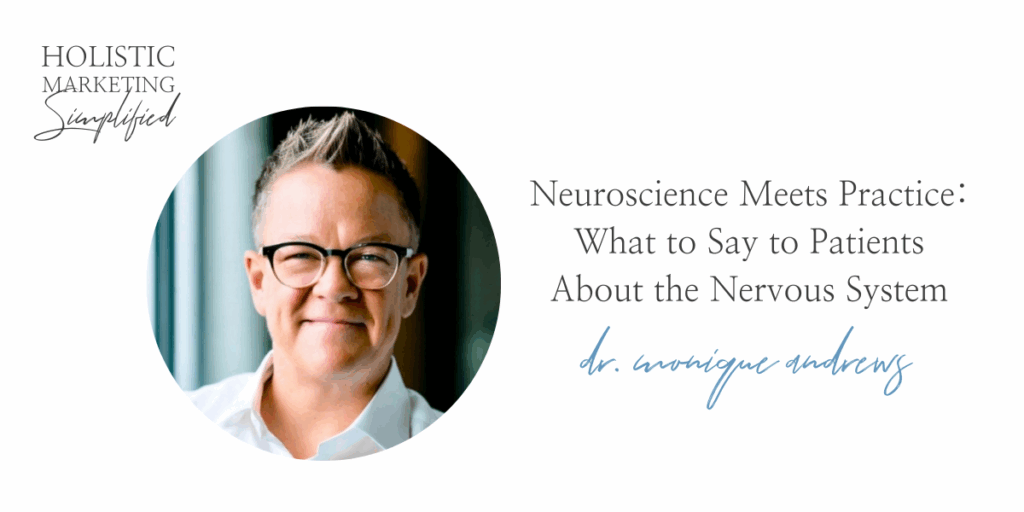
Neuroscience Meets Practice: What to Say to Patients About the Nervous System in 2025 with Dr. Monique Andrews [Episode 133]
Subscribe on Your Favorite Podcast Player
Apple Podcast App | Spotify | Stitcher
How do you explain something as complex as the nervous system in a way patients actually get?
That’s exactly what we’re unpacking in this episode with Dr. Monique “Dr. Mo” Andrews — chiropractor, neuroscientist, and educator who’s dedicated her career to making neuroscience accessible.
Whether you’re a chiropractor, acupuncturist, or wellness provider, you’ll leave with practical tools to talk about the brain-body connection in ways that build trust, increase retention, and empower patients.
Why Patients Crave Simplicity in Science
As Dr. Mo explains, your patients don’t want a lecture — they want clarity. In a world where AI-generated content and “health hacks” are everywhere, the ability to explain the nervous system in plain language is what sets you apart.
Instead of overwhelming people with technical terms, try:
- Analogies that relate to daily life (like comparing the nervous system to Wi-Fi or an electrical grid)
- Visuals or metaphors that show how stress interferes with regulation
- Short, repeatable phrases that your patients can remember and even repeat to others
The Neuroscience Behind Retention
Here’s the kicker: when patients understand what you’re doing, they’re more likely to stick with care.
Dr. Mo highlights that neuroscience isn’t just academic — it’s practical. It helps you:
- Show the “why” behind your recommendations
- Reinforce that you’re not just treating symptoms, but supporting the body’s ability to self-regulate
- Foster a sense of collaboration, rather than authority-driven compliance
How to Train Your Brain (and Your Team)
The good news? You don’t need a neuroscience degree to use these strategies.
Dr. Mo has created resources designed for busy practitioners who want science-backed messaging at their fingertips:
- Dr Mo Knows Neuroscience Training Program
– Save $200 on the annual subscription with code DMKNEURO - Dr Mo Knows Chiropractic Research Review
– Save $100 on the annual subscription with code SPECIALCODE
These tools give you ready-to-use scripts, metaphors, and evidence-based explanations so you can feel confident every time you talk about the nervous system.
Wrapping It Up
Your patients don’t need a textbook — they need a guide. By using simple, neuroscience-informed language, you can build trust, increase retention, and ultimately help more people experience the power of holistic care.
👉 Ready to blend marketing with science-backed storytelling? Join me inside the Holistic Marketing Hub. Use code PODCAST to save $100.
Connect with Dr. Mo
Dr. Monique Andrews — known as Dr. Mo — is a chiropractor, neuroscientist, and educator who has dedicated her career to teaching the science of chiropractic in a way that is simple, powerful, and deeply human. With over 20 years of clinical and teaching experience, she helps chiropractors bridge the gap between neuroscience and communication so they can elevate patient retention, build trust, and step into potential-based care.
Connect with Molly
Instagram | Facebook | Youtube
The Holistic Marketing Simplified Podcast is brought to you by Holistic Marketing Hub, our hybrid program that supports you with personalized coaching, caption templates, and virtual classrooms. In this program, we teach health and wellness professionals how to fish, but also bait their hook!
Make sure you’ve hit that follow or subscribe button on on your favorite podcast player to get notified each week as we air new episodes!
Episode Transcript
Molly: Oh, hi my friends. Welcome back. I am so excited for this is the second time I have had Dr. Monique Andrews on the podcast. A lot of you already know her, and she's more known as Dr. Mo, and she's just one of those people who, whenever I get on a call with her, I just feel. At ease. Does that make sense? You know those people, you're around, you're just like, Ugh, my nervous system likes you.
So I think you're really gonna love this conversation today. And one of the reasons I wanted to have her on again, is because her membership, Dr. Mon knows, is. Really based in like a lot of the newest research that's coming out, it's chiropractic specific, but I think that even if you aren't a chiropractor and you still do a lot of nervous system based stuff, that this is just so invaluable for you.
Because I was just starting to like wonder like, okay, what are we getting wrong when we talk about the nervous system? Like how are we educating about this incorrectly and. I think it's gonna be kind of like a little bit of a, ah, crap, I've been saying this, you know, and now we know like more recent, more recent data tells us this or says this.
So, like I said, it's, it's, you know, nothing to panic about or anything like that. Like, oh, I'm gonna have to scrap all of my marketing messaging. That's not what I mean. But I just think she does such a really beautiful job of taking the more dry like data and research and distilling it down into sound bites and things that you can not only use in your marketing, but also when you are talking with patients in your office.
So, like I said, um, for those of you who don't know, Dr. Mo is als, she's not only a chiropractor, but she's also a neuroscientist and she's an educator who's de dedicated her career to teaching the science of chiropractic in a way that is simple. Powerful and deeply human, and I love the deeply human part is like, yeah, that's just like her to a T.
She's got over 20 years of clinical and teaching experience and like I said, she really like her superpower is bridging that gap between neuroscience and then communicating that to really elevate that patient retention, build trust. I really, really think you're going to love this conversation, so here we go.
Hey, welcome to Holistic Marketing Simplified. This podcast boils down to the fact that we wholeheartedly believe that more humans need to know about holistic health solutions, and you didn't go to school to learn how to be a full-time content creator and show up on Instagram and do all of this marketing stuff all day, every day.
So let's come hanging out while we chat. All things ease in your marketing and my goal is that you shift your mindset around your marketing from a quote, should to a I get to more dream patients and clients. Yes, please. Hey, I am Dr. Abby chiropractor in Apple Valley, California, and I listen to the Holistic marketing simplified podcast.
Trust me, you'll love it too. Dr. Mo, I am so pumped to
Dr. Monique Andrews: have you back on the show. Thanks, Molly. I'm, I love our chat, so I'm looking forward to see what distills out today.
Molly: Me too. I was doing a little happy dance when I saw her face Come on. You and Tamara both are just like some of my favorite humans that just kind of like, you know, you have those certain people that when you're even in their energy via Zoom, you're like, oh, you're one of those people for me.
So thank you for that. Thanks
Dr. Monique Andrews: Molly.
Molly: Um, so I wanted to have you on today. Well, first of all, I'm gonna have you introduce yourself for the people who don't know who you are. But I wanted to have you on today because I think there's a lot of things that we're talking about that aren't quite correct in 2025 and beyond about the nervous system.
And just beyond our, like my chiropractor, chiropractic listeners, I have a lot of, you know, acupuncturists and all types of holistic healers who talk about the nervous system all the time. So I was hoping we can kind of go over some of that and some of the latest research and how we can kind of weave that into our marketing to fill some gaps.
Like what's, you know, keeping people from booking. Go ahead and tell everybody about yourself.
Dr. Monique Andrews: Yeah, so I am a chiropractor. I'm a neuroscientist and educator, and basically I've spent, you know, the most of my career teaching the science of chiropractic in a way that's really simple, powerful, and. I guess deeply human, you know?
Uh, so 20 years spent in the clinical and teaching realm, and essentially what I do is I help chiropractors, b, bridge the gap between neuroscience and what's happening in research today and how to effectively communicate it because I think. I've been in chiropractic for like 20 years, and the biggest gap is not in the doctor's adjusting skills.
It's in their ability to communicate what they're doing.
Molly: Yeah. And
Dr. Monique Andrews: so I've dedicated my life to teaching chiropractors how to communicate it in a way that doesn't just elevate patient outcomes, but also deepens their, their purpose and what they do.
Molly: I absolutely love that and. You're just so, um, I mean, I always love reading your content and I'm a lay person, right?
And like, if I can get it, I'm like, okay.
Dr. Monique Andrews: Yeah, that's the key. And I think, I think, I'm glad you brought that up because I think what happens is. You want to be able to explain what you're doing in a way that a five-year-old can understand. Yes. But also a PhD is gonna nod their head like, you're not losing either one of them.
Because the more your patients understand, the more they refer, the more they stay, the more they transform. Transform. And that's the goal, I think, for every chiropractor.
Molly: So how did the doctor Mo knows come to be?
Dr. Monique Andrews: That's a really good question. You know, when I was, I, I taught at a chiropractic college for a number of years.
And, uh, everybody called me Dr. Mo. No, Dr. Mo there. And when we left there, we created the Prana Foundation, which is largely focused on teaching holistic health professionals, various realms of, you know, the science, philosophy and art of chiropractic. And so, Dr. Mooz was born. When I wanted a platform to translate neuroscience into chiropractic for practitioners.
Molly: You have, you've had, you've had one, you've had several posts go viral. But the one that always comes to mind for me that everybody likes to reshare is what you think chiropractic does versus what it real or what is it? Isn't that the one Oh, yeah,
Dr. Monique Andrews: yeah. What you think chiropractic is versus what it actually does.
Molly: Yeah. And then you kind of list out all of the different things. So yeah, you have a
Dr. Monique Andrews: pie chart. It's a big, it's a big one.
Molly: Yeah. Yeah. I'll have to, I'll, um. Grab it from you and link it in the show notes so everybody can see it. Okay, so let's dive straight in 'cause I think a lot of people will already know who you are.
So that's brief intro is great. So let's dive straight into how, I don't wanna say what are we getting wrong, but you know, typically when we talk about the nervous system, it's like you're in fight or flight, you're in rest and digest. But that's not actually quite, I don't wanna say accurate. You, I'll let you take it away.
Dr. Monique Andrews: Yeah, it's. So much more robust than that. And I think a lot of people grab onto the jargon and, oh, it's fight or flight, or it's rest and digest. And that's a real, that's actually so outdated at this point. I think, you know, chiropractic in general is moving really way out of this pain model and into deeply understanding nervous system, right?
And how it functions and how it impacts our subjective lived experience. So a lot of the focus, the way that I talk about it now is in terms of different nervous system states, right? You know, polyvagal theory is something that I love to use, and so that's one way that we can borrow the language from a brilliant theory and start to apply it in chiropractic.
And so. It's always evolving, right? The science, the research is always evolving and we wanna find a way to be able to take that, distill it down. I like, I call it like translation fuel. It's not about weaponizing the science because you hear some people talk about science. It's like, study says this and boom, like a hammer, right?
Yes. And I think. We don't want to use it to weaponize it. We use it as fuel to inspire our patients to be able to distill that complexity of it into simple bite-sized sticky points that are meaningful to them.
Molly: Oh, I love that. What are some of the I'm like, yes, simple bite-sized, sticky points. I'm like, Ooh, I need to, I need to use.
Okay, so can you think of any of those off the top of your head, like when it comes to like the different various like nervous system states?
Dr. Monique Andrews: Yeah, I think like you have to start really simple. Number one, the nervous system controls everything. Every patient needs to know these three things. The nervous system controls everything.
The state of your nervous system determines your object, your subjective lived experience. And number three, when there's dysfunction within that nervous system, there's dysfunction throughout everything. Mental, emotional, physical, spiritual, you name it. So number one, uh, help them understand the basics, right?
We are no longer in a model of pain. We're in a model that's focused on nervous system. And so if you're not having that conversation. You're just like any other pain based chiropractor out there who's only focusing on symptoms, which, if that's what you wanna do, that's fine, but that's not my model.
That's not where I think we're gonna elevate chiropractic in the future.
Molly: Okay. So if we're just going a little bit beyond the, like you said, this is kind of outdated at this point. Normally I feel like a podcast host would say, I don't wanna get too far into the weeds, but I kind of do. I kind of, I, 'cause last night I was reading, um, Maton, KIPP's Reclaim Your Nervous System or You Fan or No, I haven't read it.
Oh, okay. Okay. I was about to say, tell me if it's like not good. Another chiropractor actually recommended to me, he talks a lot about polyvagal theory. I have to be honest, it's just, it's tough for me to read 'cause I'm like, just the way it's written is a little snoozy for me, but, well,
Dr. Monique Andrews: poor Porges book on Paul, his, the OG is very hard to read, so I'd be, I'd be, I'd love to have that reference to check it out.
Molly: Yeah, he, he references him all the time, you know, he's like, okay. So, um, basically he was talking about how there's this huge gap in like his, is coming at it more from a psychology standpoint about like, here's where there's a big gap when it comes to. Like how we're training mental health disorders and I was introduced to it just 'cause I had such, I had a huge, God, we haven't even caught up, but I had a huge mental health crash back in September of last year.
It was almost like I was manic for like an entire month. Like I couldn't sleep, I couldn't eat, like, it was just wild. And anyway, long story short, I'm fine now. It took a while, but I'm here. I'm back. But I was, I got introduced to that book because I was just like really interested on like all of the different, the actual different states of the nervous system.
So in his book, he breaks it down into like a stoplight where it's, instead of just like red and green, he's got like. Red, yellow, green. Yeah. So how are you, because you do have, it's mostly practitioners listening to this podcast, so you don't have to talk to the people like me. If you were giving like a quick five minute crash course in what we actually know now about the nervous system states, what would you say?
Dr. Monique Andrews: Yeah, and in fact, I would even go beyond red, yellow, green because we know that there are three primary states, which is that sort of the social nervous system we, where we are engaged, connected. It's, it's where most healing happens, right? Then we have that sympathetic fight or flight, that's the red. And then we have what is called the rest and digest or dorsal vagal.
And that's the most, the three states that most people know, but they're also are hybrid states. Like what is it when we are like really revved up, but also feeling connected where both the sympathetic and that ventral state are activated at the same time or what, how is it that allows us to be completely immobilized?
And still really connected to another human that happens during sex cuddling, you name it, right? These are now hybrid states. So as we learn more and more about the nervous system, we've even gone beyond the two basic, the three basic, and now we're saying there's actually six potential states. And I think it's like any application of a theory, it's going to expand.
You know, someone else will come along and say, no, there's actually eight. But I'm just really happy that we, now, we know that there's more than two. And so I think that just allows, again, it brings it back to how does that translate in practice? Because that's the most important thing. Like we can all play that game where, you know, we're feeding our own mind, our own brain, but what, how does it make a difference for our patients?
Yeah. And I think that's what really matters.
Molly: Yeah. So say more about that. How, like if you were still in clinic now and you were educating your patients who are like. Oh, well, how many times should I come? Like my, I came because my back hurts, but now it feels better. Yeah. You know, because, because at the marketer in me is still like there is sometimes you have to meet people where they are, and if that's what gets them in the door and introduces them to chiropractic care because they're in pain, I say, great.
Yep. Now you get to use what you've learned from Dr. Mo. Go ahead.
Dr. Monique Andrews: 90% of people come into a chiropractic office for pain. So let's not ignore that. And I think the worst thing a chiropractor can do, and we kind of moved away from this, but there used to be this real push to say, well, we don't focus on pain here.
And I'm like, well, that's like going to a dentist, you know, with a cavity and your tooth hanging out and being like, and they're like, oh, we don't focus on pain. I'll be like, I'm, I'm gonna go see another dentist. Like, you can't ignore. Why somebody comes to see you. But what you can do is a thorough evaluation and explain to them that pain is a sign of a deeper problem.
It's not the problem, as annoying as it is, and that actually in this practice, we don't just focus on your physical symptoms. We are focused on unlocking human potential for neuroplasticity. And uh, I think that's where chiropractic is headed. That's where the research is. The direction the research is going and the place, the gap is that practitioners don't really have a framework for the languaging and how to explain that in a way that either sounds too woo woo, right?
They don't wanna lose credibility. And so that's what I do. I train people how to take the science and use it as a fuel for translation, for transformation and not a weapon, and also in a way that. Again, it has to be distilled down so that it sticks, right? That it makes meaning. That's the gift, right?
That's the gift of the science.
Molly: I love what you said about unlock human potential through neuroplasticity. So say more. 'cause I've seen you post about neuroplasticity before. Say more about that and what the research is showing us now.
Dr. Monique Andrews: Yeah, so here's a big problem that a lot of chiropractors have and, and probably holistic health practitioners, but chiropractors in particular, they have management plans.
They might say, I need to see you twice a week, three times a week, what have you? Here's the dirty little secret, and that is there's not a lot of data out there that actually outlines where that management plan comes from, and no chiropractor's gonna tell you otherwise. Some techniques will very specifically say this is, but it's not really based on, or it hasn't been based on.
A really scientific approach until we start to look at neuroplasticity. Now, if you're gonna have a practice that focuses on unlocking human potential through your impact on neuroplastic change in the brain, then you need to know and explain to your patients that neuroplastic change requires three things.
Everybody loves the numbers, right? Yeah. So number one is intention, right? Intention or attention. Those are kind of interlocked, but like we want to focus on, we want to create this change. It requires, so attention, action, you actually have to do the thing, you gotta get them adjusted. And then number three, and this is where management comes in.
Repetition.
Molly: Yes.
Dr. Monique Andrews: We know that it, to change the brain, it requires frequent and repeated exposures. And that's why. Your patients need to see you frequently, especially in the beginning because you're retraining
Molly: the brain. I always, you know, in exercise I would do a lot When I was having my, when I was in my state, I, I, I never know what to call it.
I was calling it, uh, Molly's great Depression, but it wasn't that. So I keep trying to figure out a name for what whatever was happening to me. But in hindsight, it ended up being a good thing, which I never, at the time thought that I would say, but I kept trying to envision. So tell me if this is kind of like a good analogy of what you're talking about.
You know, the elephant tracks analogy where it's like, you know, if the elephants forged the same path over and over and over, over and over, and then they're trying to, for, you know, forge a new path through the woods where they've never been through before. It's like the first time the twigs might get a little bit bent, but they're not actually going to have a path.
And so I would always imagine these elephants in my brain. I'd be like, no, go the other way. Go the other way.
Dr. Monique Andrews: Go the
Molly: other
Dr. Monique Andrews: way. I
Molly: swear
Dr. Monique Andrews: it like eventually worked. Yeah. And I think I'd probably even choose another animal and, and because intention is powerful, right? Your, your actually, your brain doesn't know the difference between what's real and what you tell it.
Number one, most important thing we can learn. So intention is powerful, but when you tie that to action. It radically accelerates your success. Intention tied to action, tied to repetition, repetition.
Molly: Say a little more about the intention tied to action.
Dr. Monique Andrews: Yeah, so if all you do is like, I don't know, I just read a great book by, uh, James Doty, the How to Manifest Through Neuroscience or something like that.
It's called. And essentially, if all you do is have an intention without action, it's kind of like you're having a salad without the dressing. Like you need to have the full experience in order to accelerate it. If all you have is intention, that's just a dream. Mm-hmm. But when you add action to your dream, when you take action towards your intention, then you're actually creating more substantial change in the brain.
You take it from like. A 10% chance to a 40% chance. And then if you start to add repetition onto that intention action, it goes even greater. And all this is laid out in the different, uh, networks within the brain. How it actually works. It's not enough to think about it. You gotta do something.
Molly: Okay. So when you're talking about the action in this specific instance, we're talking about the actual adjustment, just making sure I'm making I'm
Dr. Monique Andrews: Well, if that's your application Yes.
In the chiropractic office, like one of the biggest barriers. Is, why do I have to come so often, doc, besides, you know, you're paying your mortgage, uh, and it's like, well, actually this is how the brain, because I guarantee you most chiropractors won't have an answer to that. That's actually based in an evidence-based reality.
And so here's the, this is the, if you, if you hear nothing else, and this. However long we're on this call. The most important thing to know is that if you're gonna have a nervous system focused practice, and your focus is on unlocking human potential through neuroplasticity, which we know when you adjust the spine, you change the brain, then it requires three things, right?
Intention, action, repetition. The intention is you're here because you wanna get well. I'm here to adjust your spine because I know it impacts your brain. The action is, I'm gonna be adjusting it in the repetition pieces. You're gonna keep coming back at a, in a management plan way that is gonna be most lucrative for your neuroplastic success now, and not just to focus on that piece, right?
Because really, neuroplasticity is the tool for unlocking human potential. Okay. 'cause if you want change, you gotta change. The brain runs the show. You can think about it all day long. Molly, if you're not doing something about it, it doesn't matter. It's, it's, it's rare that you'll create
Molly: change. Oh my gosh.
This is so, I'm like making notes. 'cause I'm like, okay, this is the part I wanna make sure we're highlighting, uh, for my, your, your soundbite for Instagram. If you hear nothing else, I'm like, go back to that. If you hear nothing else go. So going back to, like I said, from a more, um, if we're still talking about how we are talking to.
Patients about this, the ones who still just cannot wrap their head around. They're like, wait a minute, I don't get it. Like you're my bone's outta place and you're putting it back and that's why I'm in pain. Like that's how most people think. Right. And so you're talking about their neuroplasticity piece.
Explain how like you would talk to a patient about how does a chiropractic adjustment. Create change in the brain? How does it facilitate this neuroplasticity?
Dr. Monique Andrews: Yeah, so what we know from current science, and you can even say what current research has told us, is that when you adjust the spine, it actually creates change in the brain, both structural and functional change in the brain.
And research is also now starting to highlight how when we create those changes in the brain that we're actually creating change. That's neuroplastic change, and that's the only way that we can evolve and unlock higher states is if we're actually creating change in the brain. So you came here because you have low back pain.
I want to help you change that. And I know the fastest and most direct way to do it is through the spine because we're impacting the brain. It's so simple. It's simple. You can understand that, right? Mm-hmm. A 5-year-old, maybe not a 5-year-old, but I bet a 12-year-old could understand it. Mm-hmm. And the PhD would be like, Hmm, yeah, that makes sense.
And that's what I want for practitioners to be able to explain it in a way that, uh, nobody gets left out. You're not oversimplifying it, you're not overcomplicating it. What does it, Einstein said, if you can't explain it simply, you don't understand it.
Molly: So let's use that same example, but without back pain.
And let's go to something more like that's even more obtuse for most people, let's say like, um, infant reflux or constipation.
Dr. Monique Andrews: Yeah. And again, before we dive into how I might go about the patient education around that, it's really important that you evaluate and do an exam to figure out, hey, is this actually, is this related to an allergy?
Or ileocecal valve, you know, lapse. Or is it actually a chiropractic problem? Because not every single thing that comes into your office is gonna be, oh, I have the solution, right? Oh yeah. So just step back and say that like a thorough evaluation and exam to determine, Hey, what's going on here is really important.
You don't have to diagnose it, but you have to know, is this something I can help with, or does this patient need to be referred out? Number one, please. All practitioners. Don't assume every single patient is for you, but for the ones that are kid comes in with reflux, Hey, here's what we know. After doing an evaluation, we can see that that part of your nervous system that's actually relating to this part of your child, there's some, uh, dysfunction there.
And what I want to do is correct that and see if we can create some change. It's just simple. Simple.
Molly: Yeah. And I think too, when you people even see just like a very basic. Image or chart of like what the spine looks like with all of the nerves. You know what I mean? Like I, I know that it's not proper to say like, it's obviously not like a pinched nerve, like that's not what it is.
But I think even just seeing that they're like, oh, okay, I can see like this, this makes sense to me.
Dr. Monique Andrews: Yeah, the old Merrick charts, which I think can be a great tool, but I've moved away from relying on it because people will be like, they used to be, it used to be like this, and it's not even. I think many chiropractors probably still do it.
It's not horrible, but it's not quite correct because when you say, oh, look right here at T six, this goes to your heart. This may be why you're having cardiac problems, because that then means that if you adjust T six, they're not gonna have any problems. And that's a real, what we call like a local segmental approach to chiropractic.
And I believe that what's happening is happening more centrally in the brain than it is just in the spine. The spine's a conduit, right? But the brain is where the real change is being affected. That's, we could probably spend an hour talking about how to move away from just using it's great visual for patients.
Yes, but don't, I would say to start to move away from the idea of pointing at a nerve and going to the organ. It's better than, it's better than foot on a hose, but not, not far from it.
Molly: Yeah. I mean, I don't know if some of these questions I'm asking might sound obtuse, but it's hard because me being a lay person and being the marketer who's, who's doing a lot of this content, and obviously all of our clients review it and Okay.
It's not like I'm just creating this and putting it out in the world to somebody without a degree. All right. In that. But it, I still find it hard to kind of, you know, how are we making this leap and making, so like, you know, if you're putting your hands on my back down here, how is this affecting my brain?
Like, I still feel like that's something that's like a hard. Jump to make, especially when you're in your marketing language, but maybe I'm thinking about it, maybe I'm trying to make it more complicated. Well, and again,
Dr. Monique Andrews: that's where the education comes in and that's why it's important to actually train to understand it at a deep level so that you can provide that fuel for translation and transformation.
Like of course, it's like, how do I make that leap? Well, you need to actually put some time and energy into deepening your understanding so that you can make that leap and help others have that leap as well. One way I like to explain it is that, you know, sensation is the language of the nervous system and literally your spine is a conduit for talking to the brain, and that gets manifested like any.
Anything that you wanna say to the brain? One of the easiest ways to do it, I mean, every sensory experience we have gets filtered through the brain, right? Right. And your brain has one job, which is literally to respond to its environment. Any input comes in, the brain has to integrate it and create an output.
What we know because the spine is so intimately attached to the nervous system, right? Only system in the whole body encased in bone, which is the nervous system that when we stimulate the spine we are, it's a faster route to creating change in the brain because we're so, we're actually. Because of the, the anatomy of the spine itself and how through the dentate ligaments and the dura chiropractors will know what I'm talking about.
When you adjust the spine, you're actually creating shifts and changes in the neuro tension and you're, you, you really are creating central nervous system change. And we've come so far from even 20 years ago, we used to think that nerves didn't regenerate. Now we know that they do. And so this our ability to vary specifically and purposefully put inputs into the spine that we know are impacting the brain.
Do we have all the details yet about specific genetic changes? No, but we do know that we are creating genetic changes in the brain through something called immediate early genes. Now we're getting jargony. I don't care though. I
Molly: think it's so cool. I'm fascinated. I'm sitting here with my jaw. I'm like, this is so cool.
Actually, I'm getting adjusted today at five 15, so I'm like, Hmm, yeah, I'm gonna know what I'm, uh, my brain, my brain's gonna be popping. So, well actually, ba based on your. Have I told you this, you like saved me. I, it was having that itchy, like neck pain thing and you're like, I think you need an upper cervical doc.
And that really helped me a ton. I'm still going, I'm still going to it. Oh good. Yeah. Yeah. I, it actually had held forever and I really didn't have any issues for a long, long time, but just recently, the last three weeks, it keeps, I don't know, I'm probably doing something I shouldn't be, but, and I wanna go back to two things and just put my own.
Input in as a patient, as someone who, you know, you know, we were a military family. I've, we've moved a lot, I've been adjusted by a lot of different chiropractors and this doesn't just pertain to chiros. This is like anybody in practice. Yeah. Um, I've done a full episode on things kind of like this before, but I just would be remiss if I didn't talk about it.
Now talk, going back to what you were talking about confidently giving your professional recommendation for frequency. I cannot tell you how many times I've been. I'm like, okay, well when should I come back? It's like, oh, let's just see how you feel. And I'm like, no. Like you're, that would be like, Hey Molly, can you do my Instagram?
And I'd be like, yeah, uh, how often do you want me to post for you? And you're like, yeah, well that's what I'm counting on you for. Don't you know how
Dr. Monique Andrews: often you're supposed to post? Like, it's, it's one of the biggest failings in chiropractic I know. Is not being able to lay down. This is how often you need to see me.
It's not how often I need to see you. It's how often you need to see me. Mm. And the reason why is because they don't even, they don't know how to explain why because they're not taught in chiropractic schools. And until recently, evidence doesn't. Tell them why. Mm-hmm. If they're not, if they don't belong to some practice management company or some particular technique that says, see them this often, they kind of follow the old pattern of three times a week for six weeks, then twice a week and dah, dah, dah, dah da.
Based on old quest practice management, the key when if you are trying to create neuroplastic change in the brain, the key is patterning. The brain works through patterning. Repetition is key, right? What do I say the three things were, intention, action, repetition, and just, I would just keep hammering that home.
You can't keep saying the same thing over and over again because what happens is it becomes stale in the patient. You won't have, you won't have retention, but you have the same core message in a variety of different ways, and then retention will happen. Na, naturally, right? Because you're giving the same message, but you want to use metaphors, ask reflective questions, have different diagrams.
That's the key to what I teach is like, how can you say this? Same thing, the same core message, 50 different ways so that it never gets stale for your patients, and then there'll never be, there'll never be a problem with retention pe you know, you want high PVA.
Molly: The follow up piece to that is not only have I, I mean multiple, multiple, multiple, multiple times been like, well, let's see how you feel.
I'm like, well, then you're putting all the decisions on me. And I, I, it makes me feel like, am I coming too much? Am I not coming enough? Like, I don't know. You know what I mean?
Dr. Monique Andrews: It's not even putting just the decision on you, it's also putting the focus squarely on symptoms only. Yes. And that is not where we want to be.
Molly: Well, and then on top of that, I would say then when you don't get better, you just think chiropractor doesn't work. That's because you never were giving like, Hey, you know, the, this is the oldest sales trick in the book. It's like, because you told me that you're having migraines five days, you know, a month I'm recommending that we, you know, do this, you know, three times a week until blah, blah, blah.
Like, you're like, oh, okay, you hear me? Like this is your professional recommendation. But what I was gonna say is the follow up piece was. I also then feel like you get a lot of attention as a new patient, and then it's like by visit four it's like, oh, hey, here, all right out the door. And I'm like, wait, did you ask me how I was doing today?
Like, did you ask me
Dr. Monique Andrews: like this old model of approach, it's an old like practice management and chiropractic's been around for several decades now it goes back to the eighties, right? It's a very old model approach, and our patient base today is much more educated. Exposure to technology has changed people's ability to go and find, you know, ai.
It's like, tell me everything I need to know, and all of a sudden it becomes scary for the uninformed practitioner to start answering questions from the AI informed patient. I never want that to happen. I want, I always wants to know beyond what the general Yeah. Person knows you want to be able to trust is not established on authority.
It's established on cues of safety in your communication, in your effort, effortlessness. And I think what you, when you are just being the human giving this gift in a way that's very informed and very confident. That's what builds the trust.
Molly: Man, that's so true because let me just tell you, MJ just started third grade and I walked into her, meets the teacher, and her teacher was shoulders back, laid back, confident, sitting on the desk, talking to the kids.
Now, her teacher in a previous year, very uptight, looked very uncomfortable and, and had been a teacher for longer too, and that I ended up being not a great year either. And you could just tell she was uncomfortable in the classroom. Whereas, like I said, this year, she's like, eh,
Dr. Monique Andrews: I got this. You know? And guess what?
Her, the, the uncomfortable one. Which nervous system state was she in? Right? It was probably was Red Fight or Flight State. And before you had the conscious awareness of she looked high uptight, before any of those words came, your body already responded to it.
Molly: Oh yeah. And the kids do too.
Dr. Monique Andrews: MJ hated hated school last year.
You can't, your nervous system. You're not gonna trick somebody because there's this language that's happen happening below the surface, right? And it's why we need to communicate in a way that embodies safety, because the nervous system is constantly surveilling its environment for cues of safety and before a patient processes.
Any word you're saying, their brain is going, am I safe? Do I feel safe? Is it safe to be here? And a lot of that comes from posture tone, eye contact. I read somewhere once that when you give a presentation, people only remember something like 7% of what you say. What they remember is how they felt. Your tone, your posture, did you make eye contact.
And so much of that is happening. Below the level of conscious awareness. And that's just how the nervous system works. It's beautiful, right? Love it. And so let's start to get strategic about how we're using it.
Molly: I just started seeing this new acupuncturist for some upper GI issues and actually she's helped tremendously.
And it was so funny 'cause I was like, all right, so based on everything, you know, how often you think I should come back? And she just was kind of leaned back against the cabinet and she goes, will we get you better if you faster if you come every week? I don't think so. I think every other week. And like the way I was like, okay, like she, like you could tell she was actually thinking through, like you could see like the wheels turning, like thinking through my case and like thinking through.
And I've kept up with every other week and I have felt better incrementally every time. Yeah. And I just feel so safe in her hands.
Dr. Monique Andrews: Safety is our highest human need. And if you can find a way. Through your confidence. Confidence only comes with deep understanding. If you can find a way to enhance how safe people feel, you're never gonna have a problem with acquisition, retention, conversion.
Molly: I wanna talk about two more things. Obviously I wanna end on how people can work with you and learn from you, but like, just one more. We talked a lot about what the research is telling us about n neuroplasticity and the different states of the nervous system that we know now, but you also have had some other things.
You said you got a lot of, uh, people talking back to you about a study on, was it Gabapentin?
Dr. Monique Andrews: Oh, yeah. Because, you know, gabapentin is madly successful in helping people deal with neurological pain, like. Chiropractic initially became very successful because it actually got people out of pain, neurological pain.
Right. So no drug can actually touch neurological pain. That's why chiropractors make a living. Mm-hmm. A large part. Now, gabapentin is actually, what it does is it is it activates one of the, well, the primary inhibitory neurotransmitter in the brain, gaba. When it does that, it turns everything down. Not just the pain, but all kinds of things, including cognition.
And that's what this most recent study came out with.
Molly: Wow. So like saying like, yeah, it's helping your pain, but you're also,
Dr. Monique Andrews: and, and no doctor ever tells you that, Hey, look, um, I'm gonna give you, this is gonna help your pain, but it's also gonna really. Mess around with everything else in your body, right?
Everything is there in a balance, right? We're supposed to have a balance of our chemistry. Yeah. And when you start to mess with biology, well there's gonna be, you know, desired consequences and undesired consequences.
Molly: Yeah. Well, okay. So this is a perfect segue into how people can work with you and continue to learn this.
Dr. Monique Andrews: Yeah, thanks, Molly. You know, I, if chiropractors are ready to elevate their communication game and they really wanna feel confident in explaining the nervous system, then I have different programs that help you do that, that sharpen that skillset. So, Dr. Mooz is my chiropractic neuroscience training program.
We have live classes. We have a live class every month, and on demand, we now, I've added case calls to that. So every month you can bring difficult cases and we work through them together and that's an incredible community.
Molly: I love that.
Dr. Monique Andrews: Yeah. That's cool. I've been doing that for about five years. That's my Dr.
Mona's program. Then I've recently this year just added a chiropractic research review subscription. So once a month you get a research article that's broken down into key talking key points. But then also I include patient scripts, so talking scripts just like we're going through today. As well as how to clinically apply the data.
So you're, again, it's like you're not just trying to hammer people with the science, it's translation fuel, right? To elevate your communication skills and actually improve retention rates.
Molly: And are you still offering continuing education sometimes too?
Dr. Monique Andrews: Yeah. Dr. Monaus, 18 CEUs per year, if you do the annual, uh, plan.
And I, I gotta tell you, when people join Dr. Oz, they don't leave. They stay like, I've had people in the program since its inception. So if there's doctors that wanna shift, you know, from being the last stop for pain to the first choice for unlocking human potential, this is exactly, you know what my mission is?
I would love to help any doc who wants to translate into a nervous system focused practice. How you teach, how you communicate, leading with the science in a way that's accessible and engenders that feeling of safety. This doc really knows what they're doing and I feel safe. I'm in the right place. I absolutely
Molly: love that.
Yeah. Uh, well I told you, this is so funny 'cause I did not know we were gonna talk about this, but remember what I said when we first got on the. I was like, you're just somebody who, I just feel calm around. Like, that's so funny. I did not even like
Dr. Monique Andrews: play that well. And actually I, I do a lot of embodied work to also make sure that I'm in that elevated ideal state.
I mean, you know, it's not without intention, action, or repetition. I didn't even try that.
Molly: And then how can people find, obviously we'll link all of this in the show notes, but if you're like me and you're like driving, I do better with like, oh, this is her website. I'm gonna go look at it later. You're active on Instagram?
Dr. Monique Andrews: Yeah, on Instagram. Uh, at Dr. Monique Krus. Dr monique kres.com is my website. From there, you'll get links to dr mons.com and chiropractic neuroscience.com. Yeah. That's amazing. Yeah. Thank you so
Molly: much for your time and. Everything you've done for the profession and yeah, I'm just so honored to call you my friend.
Thanks, Molly. I love, I love our chats. We could talk for hours. Thank you for listening to Holistic Marketing Simplified, and hey, you know how every podcaster at the very end of their episode asks you to rate and review their podcast? Well, that's because it's super important. These podcasts take a lot of time and heart, and.
Effort to produce to bring you free information. So in order for me to be able to continue doing that, we need more people to find out about the show. So if you could please just take like two minutes out of your very busy day to leave me a rating and share this on your Instagram stories and tag at Molly a Cahill That's.
C-A-H-I-L-L-I would greatly, greatly appreciate your support. I know your time is valuable and I can't wait to see you in the next episode.

![Beyond Brick & Mortar: How to Monetize Your Personal Brand with Dr. Lauryn Brunclik – PART 2 [Episode 114]](https://mollycahill.com/wp-content/uploads/2025/04/How-to-Monetize-Your-Personal-Brand-with-Dr-Lauryn-Brunclik-Ep-113.png)

![Small Tweaks, More Clients for Practitioners with MFR Business Coach Heather Hammell [Episode 143]](https://mollycahill.com/wp-content/uploads/2025/11/Small-Tweaks-More-Clients-for-Practitioners-with-MFR-Business-Coach-Heather-Hammell-Ep-143.png)