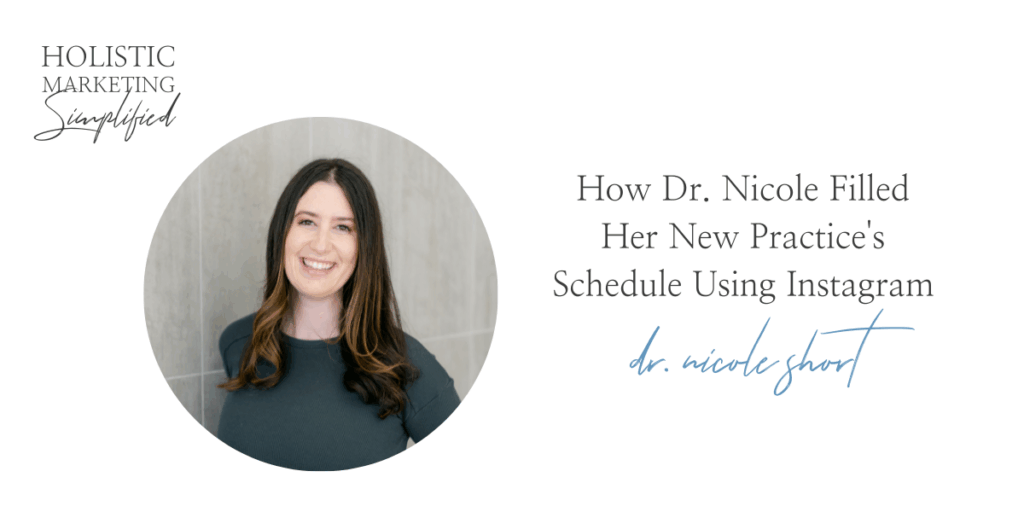
How Dr. Nicole Filled Her New Practice’s Schedule Using Instagram [Episode 138]
Subscribe on Your Favorite Podcast Player
Apple Podcast App | Spotify | Stitcher
Starting a new practice from scratch can feel overwhelming—especially when you’re juggling patient care, operations, and trying to get the word out online.
But Dr. Nicole Short did it. She opened her chiropractic clinic in a brand-new area, built a following on Instagram, and filled her schedule—all without paid ads or complicated marketing funnels.
In this episode of Holistic Marketing Simplified, Dr. Nicole shares exactly how she used Instagram to attract patients who already trusted her before they even walked in the door.
Building a Practice from the Ground Up
Dr. Nicole didn’t have a massive following, a marketing team, or endless hours to post online. What she did have was consistency and intention.
She started showing up regularly on Instagram—posting educational, personable content that reflected who she is as a chiropractor and as a person. She focused less on perfect graphics and more on connection, storytelling, and showing her face.
Her audience started to grow organically, and soon, local followers began converting into loyal patients.
Consistency Over Perfection
Like many practitioners, Dr. Nicole once struggled with overthinking her content. But what changed everything was realizing that Instagram isn’t about impressing—it’s about connecting.
By consistently showing up—even when things weren’t perfect—she built familiarity and trust. People began seeing her as the chiropractor to know in her area.
As Molly points out in the episode, this is what holistic marketing is all about: showing up as your real self, consistently, so the right people find and resonate with you.
Lessons for Every Health Pro
Whether you’re a chiropractor, acupuncturist, or wellness practitioner, Dr. Nicole’s story is a reminder that you don’t need to go viral to see real results.
- You need clarity about who you’re speaking to
- Consistency in showing up regularly
- And connection—sharing who you are and what you value
When those three pieces align, the results come naturally.
Wrapping It Up
If you’ve ever felt stuck wondering how to grow your patient list without burning out on social media, Dr. Nicole’s story is proof that it’s possible.
Start simple, stay consistent, and remember: people don’t book with businesses—they book with people.
🎧 Tune into this episode to learn how Dr. Nicole turned a brand-new Instagram account into a thriving chiropractic practice—and how you can, too.
Connect with Dr. Nicole
Connect with Molly
Instagram | Facebook | Youtube
The Holistic Marketing Simplified Podcast is brought to you by Holistic Marketing Hub, our hybrid program that supports you with personalized coaching, caption templates, and virtual classrooms. In this program, we teach health and wellness professionals how to fish, but also bait their hook!
Make sure you’ve hit that follow or subscribe button on on your favorite podcast player to get notified each week as we air new episodes!
Episode Transcript
Molly Cahill: Hello everybody and welcome back, and I just wanted to take a minute to thank everyone because if anybody's been falling around along on my Instagram stories, you know that I've had family emergency with my sweet 80-year-old stepdad with dementia. It's just been a whirlwind of a crazy week. In fact, I'm recording this from not even my real podcast, microphone through my headphones at a hotel in Kentucky.
Long, very long story short, we were flying from San Antonio back to Cincinnati where we live. We were in San Antonio for the women Chiropractors convention a couple weeks ago, or at the time, you're listening this. My family came with me, which was amazing. If you have not ever checked out the women chiropractors organization and you are a women, a woman chiropractor, I highly recommend it.
But anyway, we landed in Atlanta for our layover, and I had a text from my mom saying that my stepdad was, no, he'd been in the hospital, and that he really wasn't doing well, and that I should probably just not fly home to Cincinnati and I should rent a car. Since Birmingham and Atlanta are pretty, you know, only about two and a half hours away.
So I did, I rented a car in Atlanta. My husband and my kiddo took our connection and flew on back to Cincinnati and I rented a car and drove to Birmingham. I had zero stuff 'cause I had checked my bag. I literally, I didn't even have a phone charger 'cause I was traveling with my husband and he had one and I didn't even think to like, so yeah, I had, I, I did have my laptop, luckily drove to Birmingham, was able to be there for my mom and stay with my stepdad.
The time I'm recording this, he's still kicking. He's tough. And you know, for anybody who's ever lost a loved one, you know that um, the end stages are tough. 'cause you never know if you have days or weeks and yeah, it's just, it's just really hard. So I made the decision to go ahead and drive back home to Cincinnati yesterday to be with my family since my brother and my stepbrother are there for my mom and just play it by year.
So. Traffic was terrible driving up through Nashville yesterday. So I ended up spending the night in a hotel last night with my, I call it my hobo target, uh, bag of luggage. Literally just like a plastic target bag is my luggage. I'm telling you all of this because I'm like trying to start this revolution of there just being more realness in the world of like, this is real life, right?
Like I think, you know, all we see from other people, I think I just have this theory that. If everyone talked about what was really going on, more like everybody's mental health would be a little better because it could be so isolating when you think like, oh, everyone else is just like living this charm life and nothing's going on.
It's like, oh, now like the amount of support that I've gotten just from my stories and everything just like blew me away. People I don't even know. So I say all this to say. I just appreciate this community so much. I feel like a lot of the problems that a lot are not that I'm like a huge creator or anything, although I did finally go viral for the first time.
I hear lots of complaints from people about just like getting nasty comments and all of that. And I just wanna say like, I don't experience that. And I think it's because all of you are just such incredible human beings. And I just wanna thank you for being here and thank you for listening. And like I said, if I sound like I'm okay, I actually am because for any of you who please reach out to me via dm.
I know so many of you have gone through this. If you've gone through a loved one having dementia. You know that you lost them a long time ago, and while it still will be a whole new wave of sadness when he does pass on, it's also a little bit of that, like you knew that person wouldn't want, have wanted to live that way.
And yeah, sometimes it can be like, nobody wants to admit it out loud, but it can be a little bit of a, a relief. And I don't feel guilty in saying that because again, I know he would not have wanted to live this way. So. Anyway, I just, again, say all this to say thank you for being such an amazing community, and thank you to my podcast editor for being so patient with me and getting this, this intro in so late.
But I do think you're going to love this episode. I recorded it not too long ago with one of my og like original holistic marketing hub students. I think we were trying to figure out when she joined. I think it was like 2021. And she is just such a poster child and so, I mean, don't worry. This whole episode is not like a giant pitch for the hub.
It's literally she's sharing like some of the main parts she took away. What she implemented when she first started the hub, she was an associate at someone else's clinic. And then it was just so cool to see her grow and then go out on her own and start her own clinic. And her first week in her brand new clinic, she was 50% full just from.
People finding her on Instagram. So I promise you that everything I teach really does work if you actually implement it and stick with it consistently. And she's just this beautiful example of that. And I think, I mean, I learned a couple things from her. I actually messaged her afterwards and was like, Hey, can you share with me a little more about what you're talking about?
So I hope you love this episode with Dr. Nicole Short. She is just lovely and I think you will learn a lot. Again, thanks for being here.
Hey, welcome to Holistic Marketing Simplified. This podcast boils down to the fact that we wholeheartedly believe that more humans need to know about holistic health solutions, and you didn't go to school to learn how to be a full-time content creator and show up on Instagram and do all of this marketing stuff all day, every day.
So let's come hanging out while we chat. All things ease in your marketing and my goal is that you shift your mindset around your marketing from a quote, should to a I get to more dream patients and clients. Yes, please.
Dr. Tara: Hi, I am Dr. Tara Carlson, and I'm from Wiseta, Minnesota, and I listen to the Holistic Marketing Simplified podcast.
Molly Cahill: All right, Nicole, welcome to the show. We've been trying to do this for a really long time, so I'm glad you've just been a little busy. Just a little bit going on.
Dr. Nicole: Yes. But thank you for having me. I'm so, so happy to be here.
Molly Cahill: So, um, Nicole was one of my like OG holistic marketing hub students. Was it called Master Graham then when you joined?
Do you remember? Yes, it was, I think I was in
Dr. Nicole: your first, maybe your second, like, iteration of the launch. We were in the Google Drive, like we, yeah, this whole fancy portal you have, it's a whole new thing.
Molly Cahill: Yeah. Oh, that's right. Oh my gosh, yes. It was just like Google Drive recordings, which I always try to tell people.
I'm like, listen, it doesn't have to be that fancy. Like the information's still the same no matter what. So totally forgot about that. Yeah, so this was back, and I was looking back to try to find like a screenshot of when you first joined and it was like, yeah, I, I found it and like how many followers you had and all that kinda stuff.
So I am so excited 'cause you're like my poster child that I always refer to. See everyone. See Nicole like, but are you, would you say you're like a pretty type A person or do you think you like I would say
Dr. Nicole: generally B plus I'm, I would say B plus. I mean some areas that I'm definitely type A, but I feel like motherhood has brought a lot more of this like B plus energy to my life and I'm just learning to like go of things and it's been actually probably really healthy for me.
Molly Cahill: Well, I'm so proud of you. That's amazing. That's how I'll never forget when my daughter was a baby. I remember having like pee on me and like not changing my clothes and my mom was like, wow, who are you and what have you done with my daughter? I'm like, you know what, just me only do so much laundry in a today.
It's just me. So tell us a little bit about like what you're doing now and then kind of give us like the rewind of your situation when you joined Holistic Marketing Hub in 2021. God, that was like over almost five years ago, which is crazy.
Dr. Nicole: Um, yeah, so currently I own a practice with my husband. It's called Rise Chiropractic and Nutrition, and we're located in Dublin, Ohio, which is a suburb of Columbus.
Our practice is really kind of built on how we would want to be treated if we were the patient. And so we have built a really collaborative health experience in our office, primarily focused on wellness. We do things chiropractic, nervous system, base movement, rehab, energy, like fascia release sort of stuff.
And then we all kind of combine that together with like lifestyle nutrition coaching. 'cause Jay's a dietician. And so with that, we have, what I would say is like a tiny but mighty team. We have another chiropractor that works underneath us and we have an amazing rockstar office assistant that kind of keeps us all in check and keeps the office rolling and grooving and all that kinda stuff.
But if I take you back five years ago, um, when I first found Molly, I was an associate at a different practice in Columbus, and the practice model is very, very different from what I'm currently doing. I would say it was a little bit more of your traditional chiropractic office visits were, you know, five minutes with the doctor.
And we still did a lot of the things that we do. Like there was a rehab component, there was nutrition component, but it was all very segmented. And the doctor, that wasn't necessarily one like coordinating all of that. It was also an insurance based practice, very pain focused, not a ton of wellness. And at the time when I was in that practice, one of my roles was to like build my own patient base to help grow the clinic.
That was like part of what I did. And so I'm like a younger millennial I guess I would say. And so I was in a practice where people who are older than me and using more traditional marketing styles, like going to be an eye groups or. Things like that. And that was really hard for me because I was young.
I, I was married at the time I had met Molly, but like, I didn't have a house. I didn't, I didn't have plumbers to refer to people. Like I just, the way B and i groups like work was not functional for me. And I was kind of, I like social media. I was good at it and I was like, there's gotta be potential in terms of like how to reach people who are my ideal client.
That's kinda what I found. Molly and Molly really helped me navigate who, what I was passionate about in chiropractic, communicate that and. Kind of long story short, that kind of allowed me to build my own brand within this practice. And I eventually had stepped away as an associate and I used the platform that I created, which I never intended to like leave that other office and build this other brand to start my own practice.
But it kind of just worked out that people who love, loved what I was saying, continue to follow me and found me. And Instagram has been a huge platform as how we get our message out and have built our practice to this day.
Molly Cahill: So I still have a screenshot from you that I still use in my testimonials where you're like, first week in the new practice, easily 50% full just from Instagram.
Dr. Nicole: Yeah. I mean, I started my practice like I remember, I mean I do, I, once I decided I was opening my own business, I kind of, I worked my regular hours and then from, I don't know, seven to midnight every night, I like built my new business in the background for probably like. Nine to 12 months. It did it for a long time until I was like, okay, yeah.
Like this is what we're doing. Um, but from when I like gave notice at my practice to when we opened doors at the new office, it was less than a month's time. And my first two weeks of patients were completely full with new patients. All of that came from, I mean, really Instagram and then people who had followed me from the other practice who had been wanting to work with me, but really they like knew about me from Instagram 'cause I never announced at the old practice.
Hey, I'm leaving. I wasn't allowed to. It was just like one day I, poofed didn't show up anymore and yet people found me. So was it Google? Maybe. But like I built my website and I can't say I'm graded SEO, so I'm gonna attribute a lot of it to just my consistent presence on Instagram.
Molly Cahill: Yeah, that's absolutely incredible.
And one thing that you. Like I said, I always use you as like the prodigal student because, and, and I get it. 'cause I have courses that I've bought that have sat there and I'm like, uh, but you truly took every single part of it and implemented it. And that's where the magic happens. And that's what I tell people.
I'm like, A lot of people join. For those of you who don't know what Holistic Marketing Hub is, it's like my membership that, I'm calling it a membership now 'cause I'm like, I have to update this thing so frequently because it's like, oh, now there's another new feature and here's another new, you know. You can't have a course on Instagram.
It just like doesn't. Work 'cause it's out of date within, you know, months. Um, so I, yeah, at the time this is airing, I'm getting ready to launch brand new curriculum, brand new, uh, platform. And what's funny is I'm going back to almost like the roots of how simple it was when you started, because I think we tend to want to over teach a lot.
Like I'm sure as even a baby chiropractor, you were like that, you're like, oh, let me give you. 25 exercises to do at home and here's all these new tricks. 'cause you're like, I just wanna show people how much I know. Mm-hmm. And then it kind of turns into like this behemoth of a program and you're like, okay, not that this isn't good information, but it's just a lot for people.
So I deleted the other day, like 18 training. I was like, let's just get
Dr. Nicole: it down to the bare bones, you know? Well, and sometimes I think too, like even as much as Instagram has changed. So I'm not even looking for it. But there's so many like clickbait things, like, here's the hook, you need to get a thousand new followers, here's this.
And it's like Instagram makes you think that you need all of these different things. But like something I learned from you way back in the day, it was like, it really is just about actually building relationships on Instagram. Mm-hmm. And I feel like you actually, once you made like a. Reference. So like no one is like looking for new tires for their car, but like if they see the advertisement for it and they pop up over and over again, one day they're going to need new tires and they're gonna be like, wow, I remember that one.
Yes. And like that's kind of how I approach like the chiropractic stuff. Like I'm not looking at my feed being like, oh my gosh, this person definitely needs to come in and see me. And this person definitely needs to come in and see me. I truly just like want to build relationships with people in my community.
And have them think highly of me. And if they need a chiropractor, great. They pick me or their neighbor needs a chiropractor. They say, oh, actually I know this one. She shares great information. You should check her out even if they've never seen me. And having that mindset has really allowed Instagram to work well for my business.
Not being like, okay, how can I get 2000 more followers today? Mm-hmm. And dancing around doing something crazy, which there's a time and place for that. And getting engagement is great, but. Doing it with the right intention and not letting Instagram like control. Yeah. Like make me feel like I have these other intentions I'm trying to get out of it, if that makes sense.
Molly Cahill: Oh, it makes perfect sense. That makes me so happy that you remember that analogy. I should bring that back. It's been a while since I've used that. Yeah. I think about it a lot. Yeah. Oh, that's, see, thank you for sharing that with me. I'm have to bring that back. It's like, yeah, and, and I know a lot of, especially of the more like nervous system based chiropractors and, you know, I work with, you know, acupuncturists as well and Functionalizing.
Yeah. It's like, yeah, I, I get that Your end goal would, tpic would be like, it would be lovely to just have people who are already doing well and like want to just come in for wellness care, but like, that's just not the reality of where, and, and maybe it is for some people. I, I don't know what your experience is.
Like a lot of people, you just have to meet them where they are, even if, if it takes like their back hurting or a fall, like I dunno if you saw, I posted with me falling on the hoverboard. That was actually an older video, but I was like, oh my God, I need to resurrect this. Like you said, and have that top of the mind awareness of like, oh, well now I need this thing.
It's like, yeah, ideally we could catch them before they, you know, are in pain, right? But sometimes it's just not the reality.
Dr. Nicole: Yeah, and I think when I started care, I started a lot more by targeting people who were well, and it was like really, I would say in a sense, like easy to do because no one was doing it like this was five, six years ago.
Saying that you are a nervous system based chiro on Instagram was not a thing. Like nobody, that was not a buzzword. Now I scroll through Instagram and maybe it's the algorithm, but like every third post is like down regulate your vagus nerve and like come do this. And I'm like pe, like I don't want to read this as a provider.
And I feel like we just get lost in this. And so something I've done is like our practice has evolved is like really go back to our patient journey and like there's a whole portion of our patient journey that starts where. People are actually in pain. Mm-hmm. And if we're doing our job well then we are educating them and teaching them about why they need this more like restorative or wellness based care as time goes on.
But also being open to the fact like when a new patient comes in, it's not cookie cutter. It's not like, well, you have to be in pain and then you're gonna go through steps A through Z. Like you might just start at Step U, I don't know. Or step L, like your goals are so different. And I think that sometimes where providers get themselves.
Stuck is that they're like, well, this is what happens when you come in, so we need to do X care plan and we need to do this, and you want your marketing to kind of match that versus like casting a wider net and just like educating because you want to and providing value, but then also actually speaking to your ideal client's pain points.
It can bring them in at any point of that journey. And then it's the provider to like actually listen and discern and figure out where they're at and then build that plan. Your marketing message was conveying that you were going to do,
Molly Cahill: yeah, I love that. I have some older episodes too where I kind of talk about the difference in like cold, warm, and hot leads and like, you know, where you can potentially like reach people on the spectrum of everything and like sometimes.
You know, you might be, sometimes we might position a hook where it doesn't say anything about chiropractic. It just says like natural solution. Just for people who don't know, chiropractic is a solution, but they're looking for this quote natural solution. Or like maybe you reach people where they know they want chiropractic, but they don't know which one, and then you know, that's gonna be a little slightly different.
So I love that you pointed that out there. So one thing I wanna go back to is you talked about building relationships on Instagram, and I would say that's probably the biggest. Anytime I have like a student, it's like, oh, I'm just not getting results or whatever, and I go back, I'm like, you have not watched the most important training in this whole thing.
I was like, go watch this. Implement this and come back to me and it is on that community building and engagement part. So I don't know if you wanna talk about that.
Dr. Nicole: Yeah, so I would say when I first started, we had our, our ideal client has like evolved over time. So Jay didn't, Jay used to do some nutrition stuff, but it used to be very separate and segmented from like the chiropractic piece.
So we were very like mom and baby heavy office, which is great and we love that. But as we've evolved, we've transitioned a little bit more into people who are active, who might work out, who have more like injuries, but they wanna work on their posture and their wellness. And so you could still be a mom or baby in that category, but it's a little bit more refined into who it is.
And so when we started, when I started my practice, one of the biggest things I did is I would reach out to three to five people a day who were a provider or a local business in my community. And so a lot of pelvic floor PTs, doulas, yoga studios, massage therapists, and sometimes it was just like a, Hey, love this content you're posting.
Can you tell me a little bit more about like why you do dry needling, um, and how often you do it or other, and like just asking an act actual, genuine question like I truly wanted to know for my own interest. Other times it would be like, Hey, I really love the stuff that you're posting. Your office is a mile from mine.
I would love to be able to connect and refer, like, connect with you, learn more about who you are. Would you like to hop on like, like a 15 minute zoom call? Tell me about yourself and how I can support your business. But when I reach out to businesses, I always do it from a place of like true, genuine curiosity about who they are and what they're doing.
I'm thinking about it like, how can they better help serve my patients? Because at the end of the day, I want the people in my clinic to have the best results possible. And sometimes that means they need a pelvic floor PT or an acupuncturist. Mm-hmm. And things that, even like a PT where I have my master's in rehab, there's a lot of rehab stuff technically that I can do.
But I'll be honest, I don't wanna rehab a shoulder or knee. Yeah. That's not something that sounds fun to me. Even though I have a knowledge base to do it, so let me go find PTs that my patients might actually enjoy seeing and then figure out how we can work together. So I do it with providers a lot, but I also do it with businesses because I'll be like, oh, your yoga studio's down the street.
Tell me about like this deep stretch class you have. Is it heated, is it not? Um, do you only offer it on Fridays? Like I truly. Want to know. Um, and I've learned the more questions that you ask them when you're coming from a place of genuine curiosity, it really starts a good conversation. And I don't know, some of them you're gonna be like, this was a dead end.
We don't, we don't vibe, we don't have the same energy. And that's okay. 'cause there's another chiropractor down the street that probably will vibe with them better and they can have a good relationship. And you don't have to like force yourself to be somebody or not to like fit yourself to connect with a different provider.
Molly Cahill: Yeah. I just wanna point out two things. One that. I think when people think they're gonna be learning Instagram, for me, they think it's only gonna be content because you have this, the content library when you first started probably was like very tiny. Now it's like 700. Oh yeah.
Dr. Nicole: Now I go look at it. It's like you've gone through 2% of the content library.
Yeah, because I don't use it like I used to and I'm like, what? There's so much stuff in here.
Molly Cahill: Oh, there are post galore. But like I'm really, honestly, and especially in the age of ai, I'm kind of trying to take the emphasis off of it. Like, Hey, like. Now in the new curriculum, I teach you how to set up your own project in either Claude or chat GBT.
You can use my cap, my captions as like the skeleton. If you're like, Ugh, I just have no creativity today, you know? But then you know you can run it through your own project to make it. More of your own and stuff like that because, um, like I said, the content alone, yes, like good content is obviously important, but there's so much behind the scenes stuff that I do teach step by step in the program that people just like don't even realize is happening.
I'm like, it's like real life networking, but you're just on Instagram doing it.
Dr. Nicole: Yeah. Like it's really, truly, rather than sending an email, I'm like going to somebody's website and being like, Hey, I wanna have coffee with you. It is just doing it through a DM and Instagram. And it's so much more casual. And oftentimes, like now that I'm a lot busier, some people will do this to me.
They'll reach out to me and they'll say something similar, which I love and appreciate, but I often will like, this is great. We'd love to meet with you. Here's my email. Please email me because this will get lost in my dms. But it's. A great way for me to start a conversation and then I can transition it over to email as where it's like more, okay, let's put a date on the calendar.
Because yeah, it's hard to keep up with, you know, the messages sometimes, but it's also really easy to reply to somebody's story and be like, wait, that made me laugh. And like, because it actually made you laugh. Yes. Um, not some forced.
Molly Cahill: I mean, that's what I even teach. Like I have three girls who just do engagement for our clients on our top tier package and the, I'm like, listen, if it's taking you more than, and this is what I teach inside the program.
Like if it's taking you more than five seconds to think of something to say like, move on. That means it's like gonna be forced. You know what I mean? It's not, you're not actually resonating with it. But the other thing I wanted to point out, other than, like I said, content alone is not the only piece of the puzzle.
And that's why I love like teaching the behind the scenes strategy. Is what you said about every day and the consistency, because it always, and look like we're all, we're all human, right? We all love instant gratification. But I've had people, like, you know, I have those email scripts that you can email your patient database, be like, are you following me?
They're like, I sent it one time. And I'm like, you did one time. That's cute. You like, you know, or like, I sent like two messages and they didn't reply. I am like, oh, okay. You know what I mean? But it's. Just like you would tell your patients, right. Who don't expect to get, it's like, oh yes, miracles after one or two visits.
It's like, no, you have to like stick with this.
Dr. Nicole: Right. And also like right, you don't wanna be spammy if you reach out to somebody. Maybe a, they just suck at Instagram and they're not checking their dms. 'cause guilty. I go through phases and I don't do that either. But like, you know, don't reach out to them three days in a row and be like, Hey, did you see my last message?
Do you wanna get coffee? Yeah. Okay. I guess you're ignoring me. But like, call them. Um, if they have a good story, react to it. Like you can engage with them in other ways. It's still going to link you to their dms, and at the end of the day, if they don't respond, like maybe it just wasn't meant to be.
Molly Cahill: That's my favorite, is responding to stories.
And if they don't have an active story yet, sometimes we'll go to like their story highlights and like, yes. And that kind of shows like, oh, she's really checking me out. Or like, I'll comment on a really old post of theirs or something just to show like, Hey, I'm paying attention. So what else would you say like was kind of when you got in the program, other than, like I said, the behind the scenes networking, was there anything else that kind of stood out as like something you wouldn't have thought to do?
Dr. Nicole: I mean, it's so hard 'cause like when I first joined the program, like reels were like, reels didn't exist.
Dr. Tara: Oh yeah.
Dr. Nicole: Yeah. I remember like making my first reel in my kitchen like months after this like had come up. So like, I think just Instagram honestly has evolved so much. Gosh. But I would say it's true, the consistency.
And I feel like even I have, I feel like decent comparison to this. 'cause when I started my practice, I, my Instagram for the office was attached to my own personal Instagram. Mm-hmm. So I have like a Dr. Nicole Short Instagram. And as we've grown patients, were starting to get confused. We had different providers.
They were like, wait, I thought I was coming to see you, but I'm seeing Dr. Courtney. So we built Rise Its Own Instagram, and I think I built it like maybe a year and a half ago, and I've grown it from like zero to nearly a thousand followers. But what I would say is I'm not as consistent on the Rise account as I am on my personal account.
I still build all of the relationships from my personal account. Mm-hmm. Because like I am the person reaching out and it doesn't make sense or feel congruent for me to like be the same person reaching out from the business account 'cause it's still just me. And so having that separation has been really helpful and like that's something I would say.
I get people who, you know, even people who work with you or have questions about working with you, they'll DM me and be like, what do you think about this? And like, that's something that I really like adding that separation, but having my own. Personal lens and almost like personal brand that compliments the business has been a huge piece of, I don't know if that's something specifically you taught me, but I've taken all of your tools and principles to kind of bring both to like marry and compliment each other.
Molly Cahill: Well, I remember, didn't you, when you first joined, you just had your Dr. Nicole Short, it wasn't even like a business page, it was just almost like a personal No, it was a personal page. Yeah. Yeah. Like it
Dr. Nicole: literally was
Molly Cahill: a
Dr. Nicole: personal page with people that followed me from high school. Yeah. I think I had like 12 posts.
Molly Cahill: 'cause that's what I typically teach people is only because I'm like, listen, if you're trying to start, like, it's just so much easier to get momentum usually to start, take something you already have.
Dr. Nicole: And I would totally start, I would not change what I did. Like I think starting from who I was was great because people needed to get to know me.
I, I guess, you know, another thing people wanna know, like they want to know the doctor behind. Who's delivering their care. Like you have to show your face. You have to not be afraid. I don't have to like speak boldly and like, say controversial things, but like, you need to actually speak what you believe and like, not dance around things.
Like if you are somebody who thinks that like your care plans are three times a week for four weeks, and like, great, oh, not share that because the right patient is gonna find you. If you are a PA or somebody who thinks something different, then you should share that too. But it needs to like come with your voice, your face, your inside of your office.
Like people need to see what's actually happening and not be this elusive. Like I'm just using stock photos like recently. I don't know if it's like a new trend or if I've just decided it is a trend, but taking pictures like from your camera roll. Yes. And like typing on it like it's a story, but like posting it to your grit.
One, it's 10,000 times easier than having to think about like, oh, what Canva thing do I wanna use? And ah-huh. Like, it's so much less time. It feels so much more authentic. And so even if you're afraid to show you don't wanna speak on the camera, that is still better than nothing. Like we, it's the templated things that I think get so cookie cutter.
And so that's where having the two accounts as we've grown has allowed me to kind of be like, this is more like the office voice and then this is my own personal voice, but they all kind of. Complement each other.
Molly Cahill: Yeah, and that's exactly what I mean. I posted, I just posted something yesterday about that, about exactly what you just said.
Um, I also posted something probably about a month ago now, about the rise. Well, I did a podcast episode on it, A couple. If you go back, you can, uh, or we can link it in the show notes about that exact thing. How, you know, when you first started with me. And we still have some content in the content library that is probably like, you know, three tips for better sleep or something like that, that just doesn't work anymore.
And so now it's like, it's not like you can't use that as your base, right? But it has to be education through the lens of Nicole's lived experience as a provider and as a human. It's like, yes, even if someone went to this has identical credentials to you, they're gonna have a slightly different lived experience.
So that's the type of thing. I had someone message me, um, just last week, a new follower, and she was like, I'm just in this part. I'm like, paralyzed. 'cause I'm like, why do I add to the noise? There's already a million. She was an acupuncturist. There's already a million other acupuncturists. Mm-hmm. On here.
Why? Should I, I'm like, because only you have your own unique lived experience, your lens, your patients, that you've seen stories from them, like that is unique and that is the stuff that is cutting through the noise. Like people, it's kind of going back old school too to like, you know, camera, photo dumps.
Like Facebook when we were. In In high school? Yeah. Well, you're younger than me. We didn't have it in high school. Came out my freshman year of college. And you couldn't even upload photos for a while. It was just like your status and stuff. Status, yes. And poking people. Yeah. Yeah. Oh, po Oh my God. I forgot about that.
Or checking in. Remember you like, yeah. Checked in at. Um, and I did just wanna go to, I'm gonna talk about two more things and then we can kind of wrap up. But I did get someone recently who reached out to me via email, and he was in a very similar situation to where you were when you came to me. So I came, told him about you.
But he was very, very in the weeds and overthinking. He was like, but like I know I don't wanna be an associate forever. So like, do I go ahead and start a personal brand page or do I start, I'm like, dude, you're way overthinking this. You just start doing it and then like figure out the rest later. Because what we try to teach and it's.
It is harder when you have a bigger clinic, you know, with multiple, multiple providers. But like you're still personifying that clinic page. Like you, your clinic page cannot just be, like you said, stock images can graphics and like this generic, here is my professional clinic page. Like it still needs to be personified.
It still needs to have. That human, like personal photos, like you and Jay go into a Ohio State game, like whatever, like that all still belongs on a clinic page. So I don't want people to hear you talking about like personal brand and be like, oh, like no, no. Like, because then what you can do is like if you have yours, Courtney has hers and Jay has his, you could just add the rise page is collaborator.
Yeah.
Dr. Nicole: So
Molly Cahill: we CoLab,
Dr. Nicole: I would say that 90% of the time that's what we do and it kind of allows us like, so me as a mom, like I have different lived experience. Courtney is not married. She is a huge animal lover. She is really like passionate about like sports and like rehab, chiropractic care, and so it allows us to blend our care super great in the office.
In terms of like the office page, I'm not on there saying like, as a mom, here are the three things I do to prevent ear infections. Like I tend to put that more on my personal page and the office page is more about like why you're missing, like why chiropractic and diet is missing from your kids' lifestyle.
Like it's more. Encompassing of the whole office experience and not just like my personal mom story or like my birth story or things that I know people care, my patients care about, and it still speaks to my ideal client, but maybe not all of them.
Molly Cahill: Does that make sense? Do they make appointments in your practice with.
You or with Courtney or is it uh, just whoever. Okay.
Dr. Nicole: We see both and like, we like that because even though like I, you know, I have gone through childbirth like Courtney Stills, the training and Webster and all of the things, and we tend, we do a really good job of like taking CEEs and then teaching each other what we're learning and kind of amazing bringing the whole picture together because at the end of the day, like.
We're all working on the same thing. Even if it's different goals and different people, like the root of what, how chiropractic works, it is foundationally the same and we kind of need that knowledge base and the expertise and the experience from different lenses and different angles to really get better.
And like I, I mean, I think that's why in our approach, like people, like when I tell you they're better in eight to 12 visits, they're better. Don't have any complaints. And so that doesn't happen in a lot of other offices. And I think it just has to do with the how we approach chiropractic care. And that's a whole other conversation.
But it does, having the different Instagram pages has allowed us each to have, I think, our own voice, but then blending it together as one
Molly Cahill: joint unified voice for our community. So you're a unicorn because I almost always recommend that people outsource and get help, but you said it from the beginning, it is something you enjoy.
So could you kind of speak to like, if someone hated it, you know, versus like, you know, like if you hated it, I'm sure you would be the first to be like, okay. Like, well,
Dr. Nicole: yeah. Okay. So, but I did outsource to you. Yeah. And to other people. Um, so I don't know. I, I think part of it was like I got busy. With patient care, which is great.
And I think it was probably around the time that I was onboarding Dr. Courtney and I was like, great, I have another doctor to train. I have systems to update. Like Instagram is something that I could easily offboard to somebody else. And so I actually started working more on a one-to-one basis with Molly's team and they were doing our content for us and they did an amazing job.
And then I was like, okay, I have more bandwidth and I kind of miss it, so I wanna take it back on. And then I went on maternity leave and I had a local company kinda helping me do the same thing. Also did a great job. But I feel like what I've noticed, and I think this is probably my own issue if you do want to outsource it to someone, is that I didn't do a clear enough job like communicating like what was happening day to day behind the scenes in our office.
Like if we were having a team meeting, we're like, okay, we are going to be prepping for a Halloween event coming up. What does that mean? How do we wanna integrate that into our marketing? And we had this whole energy and vision about it that we had a 32nd conversation about it in the office that wasn't being translated to the people that we're doing the marketing for it.
And so I just say, oh, we're having this event, and they put something together and I'd be like, oh yeah, okay, that looks great. But it wasn't converting in the same way or the same voice that I would have wanted it to come across, or I would've written it. Now since we started this like, or since I referred out to you and the other people, AI has become a significantly bigger portion of how, how content can be created.
So you can do a lot to create your brand voice to better define your ideal client so that even if you are outsourcing, it is still sounding like it is. From you. Not to say that the content was generic, but it like literally can sound like it was written exactly like you if you train your tools Yeah.
Molly Cahill: Correctly. Yeah. We, we do things differently now too. Like our totally onboarding form has, like, we have our new clients upload examples of their writing and video. You know what I mean? Like we have a whole like, like you said, like we, because, and it's hard, right? Because we have some clients who are hands off, right?
And they're like, they, they just know that they're in coast mode. Their schedules are busy. We're doing the best we can to pretend to be them and get the content out that we can, you know? Yeah. But then we have other clients who, we emailed them, I guess it was about six weeks ago, about like, Hey, I hate to call this a trend, but like we, we want more of your voice.
Like we want more of your like, just thoughts. And um, we had one lovely client who like was on a plane and was just talking to Chatt PT about all the stuff. And then she just like sent us that file and it's beautiful. 'cause it's like, okay, now we can actually, like, this is you. I do my own chiropractors here too, which is nice.
'cause like I can remember things she said like, oh well you know Kristen, it was funny. She was, um, yeah. I remember her telling me about diaphragmatic breathing. She's like, all right, I can breathe out your butt. And I could write like, breathe out your butt. 'cause I know that's what Kristen said,
Dr. Nicole: she would say.
I was say, I like back to what you said about like what do you do if you don't actually like it? Like, okay, if you wanna outsource, right? It's like kind of what you're saying, like be give the people who you're outsourcing to better information so that it actually sounds like you, because that is truly where I will take ownership of where I could have done better.
But more importantly than that, if you're like, okay, I don't have the funds, or I don't want to outsource and I still want to do it, but I hate doing it. I think you just have to really approach it as like a glorified business card. Like you are literally just out there like being yourself and you don't have to like.
I don't know, like if you're eating ice cream at 10 o'clock at night and watching tv, then like share that your client probably is too. Um, you don't have to like make it this very professional. Perfect. Like, I don't know, especially now that I'm a baby in my house, is a literal disaster all the time. Like I was trying to take a picture.
I bought cinnamon rolls from a patient and I wanted to like give a shout out to say like, thank you so much for making them. They're great. And I literally could not find a space in my house that like didn't have like bottles or pots and pans on the counter. I was like, this is the most anesthetic picture in the entire world.
But you know what? It doesn't matter. I posted it. Got great engagement. She super appreciated it. Like you just have to post like the real authentic moments of your life. And put your voice, your brand, your thoughts, like what you believe about what you're practicing and presenting all day to your patients, and that's what will convert.
Oh, people
Molly Cahill: are over. This is why I love it. People are over the perfectly curated like every, which is just so exciting to me because I never fit into that mold anyway, so I'm like, oh, never. Oh, yay. Now what I'm doing is actually a trend. I don't know. Like, okay, this is what I've been doing all along, but like.
I love that. And then like I said, one other thing I wanted to touch on is you talked about how your ideal patient has changed and stuff. 'cause that's another place that I get people who get stuck. Like I said, one they overthink about, well I'm here but I might, I might change offices. And so I might wait.
I'm like, no, don't wait. Like you can always like build up your personal brand now. Build up the consistency now. Right. But then the other thing I have a lot of people get stuck and get in their own way is over their damn niche. I'm like, guys, like it's not. It's going to change anyway. Like, it's very likely like just start where you are.
And I, I actually built that again into the brand new, I can't wait for you to go through the new curriculum. I'll have to make sure you got here. Yes, I'm excited. Yeah. Yeah. Um, I built that into an AI prompt, into the curriculum of like, this is gonna tell you, like, all you have to do is mine your own patient data, like you have, you have it.
Mm-hmm. And your EHR will tell you who your ideal patient is and what your niche is. You don't have to come up with it. Your Google reviews will tell you. Totally. Exactly. And so, like I said, I've built in that as an exercise to mine that data, call it and be like, okay, now who's, you know, and then it's
Dr. Nicole: gonna change, right?
Like I update my bio all the time. Right. Well, and I think that's like one of the other things, like when I first started, like again, having the one page that turned into, like I updated my Instagram name and my bio a million times. Yeah, like I don't even think about, I mean, I know Instagram gives you a limit.
You can only update your name like twice in a week, whatever. Yeah. But like over the course of the last five years, as my business has changed, as my practice has changed, as I was an associate to a clinic owner. It has changed drastically and that's okay and everything. I think everything I've posted, I still firmly believe, like if I posted something about pediatric development four years ago, I still think that's true.
And if not, I can go in and delete it. Because I learned better research. I learned something else. And actually I, there's a post that I made, I don't know a long time ago about seasonal allergies and how to do like sinus drainage. And it's a video of me doing it before reels, like it's really that long ago, but I've never remade it and I still go back and reshare that post from like 2020 to this day.
It because I love it. It still applies even though it is so old. And so just rep, like just having the ability to like repurpose your content, it still applies even if you're talking to different people five years from now, even if you're in a different location, change your address. It really just doesn't matter.
You just need to get your voice out there. And it could be your individual voice, your clinic voice, just you. You just need to be present and show up in your community. Yeah.
Molly Cahill: And that's how people will find
Dr. Nicole: you.
Molly Cahill: I'm so glad you said that. 'cause I know it sounds like one more thing, but really this is important.
This is what, I also have a new group coaching offer, and so it's basically like, it's very similar to the Hub except for it's just a small group and I'm walking people through almost like when you first started, like I'm walking people through it. Yeah. Um, they've got homework assignments that I'm checking and it's, so it's literally the hub just with like extra support.
Right. And I told them, I was like, guys, what the cool thing about this is once you get momentum, it gets easier. And I said exactly what you said. I was like, you don't have to keep filming videos all the time. You don't have to keep writing new content all the time. Like last week I shared. Two reposts and they did great.
Again, I have a carousel, I've reposted the same one three times and all I did was change the cover image and one of 'em is going viral and it's the same post, same caption. So yeah, that's the beauty of this is it's not like you're gonna be in this like never ending wheel of of content. That's like, yeah.
And I think we can get so wrapped up in the analytics of it
Dr. Nicole: all, like, you know, oh, this post made people unfollow me, or this post got, you know, seven likes, but this one got a hundred likes. It changes all the time. And so I was talking to a patient about this yesterday who does like influencer marketing for like a corporate job sheet.
That's like her job. And it's like I could do a like reel that has nothing to do with my business and it could go viral because I'm wearing a blue shirt and I could post a post on the exact same content and it could get one like, and it has the same caption and the same information, and it's just, there's so much of the algorithm that's beyond your control.
It's just not worth stressing about. And if you can just, if one person sees it, that means you got your message across to somebody. And if somebody unfollows you, that means they weren't gonna buy from you anyways. And you want more of your actual audience to see your content anyways. So I think like just not getting in the weeds of it and you can use your analytics to say like, oh, okay, like actually people are really interested in X format or X this.
Great. It can help you make your next month's content, but you don't have to live and die by it.
Molly Cahill: Well, no, we had a client tell me if this has happened to you. We had a client who she was like, Hey, that tour to call us Carousel, actually had two different people pick up the phone and call and make an appointment.
And I went and looked back at the post and it got seven likes and zero comments, but it's like it got someone to pick up the phone,
Dr. Nicole: which honestly matters 1000 times more. Yeah. Like I would rather my post get zero engagement, but the phone rang off the hook. And I, I've also found to like the more like complete our marketing is like the more we are doing our email newsletters, the more that we are.
Consistent with posting on Instagram, the more that we're doing our Google ads, like the more that we're doing all of the things, the more it's all complimenting and working together. Because when people find you on Google, they're gonna go, oh, you have a social media? Lemme go check it out. Oh, you, you know, I'm gonna get on your email list.
Oh, I'm gonna get this freebie like. These people who are just finding you on the internet who aren't sure that they're ready to buy, having all of your systems set up helps them actually engage from all angles. And then they're like, oh, I'm obsessed with you. And there's, I don't wanna say they're an easier sell 'cause it's not selling them, but they have decided before they walk in that door that like they're ready to commit to working with you.
Versus like someone who's super apprehensive, like a cold lead walking in and you're like, this is just gonna be like an uphill battle. 'cause it doesn't matter what I explain to them. They're like not really interested in hearing it.
Molly Cahill: Yeah, they don't really trust you yet, or really? Oh my God, I'm so glad you said that.
'cause yeah, you're right. And I, I also get really annoyed when people don't have an Instagram. Oh, my mother-in-law was thinking about getting microblading and my girl isn't here in Cincinnati, and so I was like looking up Instagram accounts and I'm like, or I was Googling first and I was like, I'm like, man, if you don't have an Instagram, like that's dumb.
It just annoys me. I'm like, that's how I feel like I can get to know you. Oh, I can see myself there. Like I love my therapist, but I see her virtually 'cause she's not here. And I would love to find a therapist in person. Not, not because I don't, like I said, love my other one, but just because I work from home and I need to get outta the house.
It'd be so cool if I could find someone who had a cool Instagram and then I would like be bought in before I even make my first appointment. Yeah. I feel like I do that all
Dr. Nicole: the time. And I think that you need to just think about, you know, if you listening to this, like how that your ideal client is interacting with you.
Like if I go look looking for a dentist or something like that. Mm-hmm. And I am like, okay, this one looks pretty good. They have a decent website. I go to their Instagram and it's all stock image, Canva, et cetera. I'm like. Ah, like, I don't know, like I wasn't excited about going to the dentist in the first place, but like now I'm really excited.
I really do think it, it, it's all about how you want your brand to come across to others. And Instagram is really just a very, very, very visual business card that allows people to get to know you before they walk in the door. I think that, yeah, you can hate being on the app, but you can also like value what it can provide for you.
And I think it's kind of a mindset, mindset shift that you kind of have to make as a business owner. It's not so much about heating me on the app, it's like just learning how to leverage it for what you're looking to do, which is make connections and help people understand who you are.
Molly Cahill: Yep. I absolutely love that.
And you know, going back to the whole outsourcing conversation, a majority of the people who've been joining recently. I wouldn't say major. I'd say it's maybe 50 50. I get a lot of like solo practitioners. Mm-hmm. And then I also get a lot of like front desk cas a patient that's training to learn to go. I have this one lady, it's her, her, um, 19-year-old son.
This was so funny. She said, yeah, I was walking by his, my son's room the other day and I heard your voice coming out of his room. She was watching one of your training videos. Yeah, that made me laugh so hard. She said, yeah. She was like, so what do you think about the training? And he goes, I think it's good for the intended audience.
Meaning not a 19-year-old, like 19-year-old was way more about social media than like, you know. Totally. They grew up with, it was like their, you know, um, anyway, I just, that thought that was really funny. But, and, and too, like the cost of the hub is, it's just so ridiculously like, I'm like, you could get.
One patient and you've more than made up for.
Dr. Nicole: And I think that like if I think back to like my original investment, like on obviously like it has changed significantly since you Yeah, because I was on Google Drive version, but like Yes.
Molly Cahill: Yeah. You were my
Dr. Nicole: You were an
Molly Cahill: OG Beta. Beta,
Dr. Nicole: OG beta. Yeah. But like. It was so worth it.
Like I learned so much about the app and even just like from a mindset perspective, which like I love working with various different coaches and like different aspects of my business. 'cause I just think it's really important to learn from people who are, who have done it and you can kind of learn from their mistakes.
But just the letting go of like the going viral, really trying to figure out how you can actually use Instagram to benefit you and your business and the tools to actually help you do that. And letting go of light count, letting go of some of these other things like. Is it nice to have a bajillion followers?
Sure. But like you don't have to, like I have 2000 followers or something like that and like I have a really successful clinic and it's not like I'm over here with like 15,000, 20,000 followers and that's okay. Like that's not why my Instagram exists. I'm speaking to my people. And the hub really helped teach me how to do that.
And I'm excited to go through the new version with like just the new AI updates and like the simplicity of it. 'cause I think the more complex you make it, the harder it is for you and as busy practitioners, whether you're show or you have team, or it's as a front desk person, have time to worry about some of that.
It's just like make the content and post it. And I'm excited to see how this new version helps us do that.
Molly Cahill: Yeah. Well I'm excited for you go through it too. Okay. Nicole, how can everybody find you and all that jazz? Yeah. Um,
Dr. Nicole: on Instagram, my handle is Dr. Nicole Short. Feel free to reach out if you have questions.
If you're growing a business, I started as a solopreneur and now I'm at a place where I manage team and see patients myself. So if you're anywhere in that journey and you have questions about how to use Instagram or just wanna see what I'm up to on the app, feel free
Molly Cahill: to follow along in one day. It's what?
Only like a two hour drive to see you. One day. I am gonna come up there and see you, Dave. Every time like something has come up, either I've had to cancel. You've had to cancel? Yes. Maybe like something has always come up, so I'm like, I am going to go meet and hug Nicole one day soon. Yes. I, and I have a couple clients in like the Columbus area, so if you're listening to this, lemme know.
We'll make a day out of it. Yes. And then I don't know Ohio geography that well because I'm newer here. How far are you from like, Cleveland is still a good like. Cleveland's like two hours. Two hours. So like
Dr. Nicole: Columbus is about two hours between Cincinnati and Cleveland. Okay. It's like the exact halfway point.
Cleveland's four hours from ci.
Molly Cahill: Okay. Well, I've got another really good client in Cleveland and I'm like, okay, maybe one day I'll just stop along, see Nicole, then keep on trucking. Yeah, absolutely. All right. Thank you so much. Thank you for listening to Holistic Marketing Simplified, and hey, you know how every podcaster at the very end of their episode asks you to rate and review their podcast.
Well that's because it's super important. These podcasts take a lot of time and heart and effort to produce, to bring you free information. So in order for me to be able to continue doing that, we need more people to find out about the show. So if you could please just take like two minutes out of your very busy day to leave me a rating and share this on your Instagram stories and tag at.
Molly a Cahill, that's C-A-H-I-L-L. I would greatly, greatly appreciate your support. I know your time is valuable and I can't wait to see you in the next episode.
![Social Media Mindset: Transform Your Toxic Relationship With Instagram Marketing [Episode 3]](https://mollycahill.com/wp-content/uploads/2023/07/Molly-Brandin-Session-Retouched-157-1-768x768.jpg)
![Social Media Strategy for Offices with Multiple Providers [Episode 106]](https://mollycahill.com/wp-content/uploads/2025/02/Social-Media-Strategy-for-Offices-with-Multiple-Providers.png)
![How to Run a Promotion on Instagram, Inspired by Buc-ee’s Marketing [Episode 129]](https://mollycahill.com/wp-content/uploads/2025/08/How-To-Run-a-Promotion-on-Instagram-Inspired-by-Bucees-Marketing.png)
![How to Use Instagram Hashtags and Keyword Update for Local Business [Episode 153]](https://mollycahill.com/wp-content/uploads/2026/01/How-to-Use-Instagram-Hashtags-and-Keyword-Update-for-Local-Business-Ep-153.png)