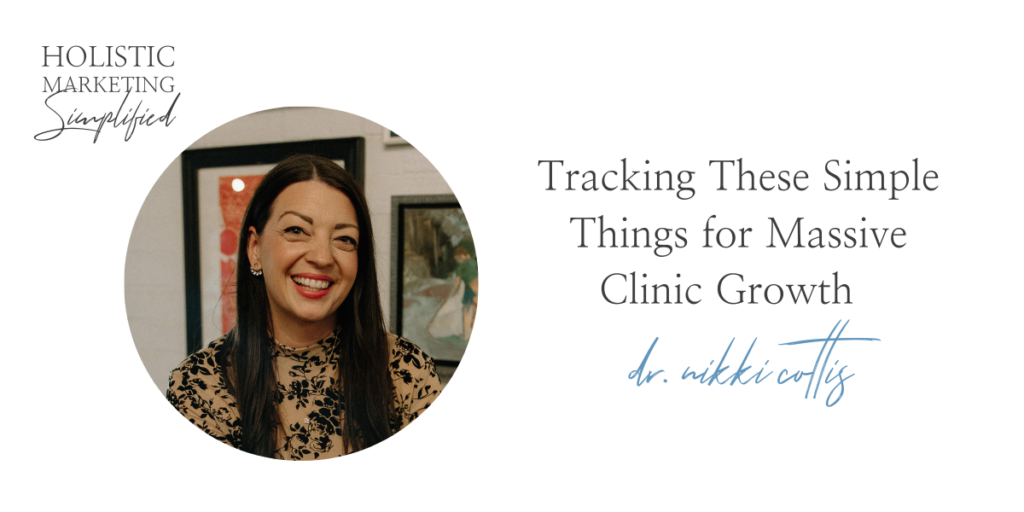
Tracking These Simple Things for Massive Clinic Growth with Dr. Nikki Cottis [Episode 151]
Subscribe on Your Favorite Podcast Player
Apple Podcast App | Spotify | Stitcher
Some podcast episodes are helpful. Others completely change how you look at your business.
This conversation with Dr. Nikki Cottis did the latter.
In this episode, I’m joined by Dr. Nikki Cottis, chiropractor, clinic owner in Gulf Shores, Alabama, and coach inside The Wealthy Practitioner organization. What makes this conversation especially powerful is how practical it is. We’re not talking about complicated dashboards, fancy software, or abstract strategy.
We’re talking about simple things clinics can track that quietly make (or cost) them a lot of money.
The Reality of Running a Busy Clinic
Dr. Nikki owns a multi-doctor practice in a tourist-heavy area and sees firsthand how easy it is for clinics to leak revenue without realizing it.
One of the biggest themes that came up early in the conversation was this: you can’t improve what you’re not tracking.
Before Dr. Nikki started tracking leads, her team didn’t realize how many potential patients were calling the office and being turned away — especially seasonal visitors and snowbirds. Once they saw the numbers, it completely changed how they structured their systems and care processes.
Tracking Leads Is Not Optional
A lead, as Dr. Nikki defines it in the episode, is anyone who calls your office or reaches out asking about your services.
If you’re not tracking:
- how many leads are coming in,
- how many book appointments,
- and how many actually show up,
you’re guessing — not managing.
In the episode, Dr. Nikki explains how her clinic uses a simple spreadsheet to track leads, objections, who answered the phone, and conversion rates. Nothing fancy. Just clear visibility into what’s happening.
That visibility is what allows clinics to adjust scripts, train team members more effectively, and understand what’s actually working.
Understanding Attrition and Where Patients Drop Off
Another major focus of this episode is attrition — where patients tend to stop care.
Instead of looking only at averages, Dr. Nikki breaks down why it’s more useful to know where patients most commonly drop off and what can be done earlier in the journey to support retention.
If patients consistently leave around the same visit number, that’s not random. It’s a signal. And you can only respond to that signal if you’re tracking it.
Why Systems Have to Stay Flexible
One thing I loved about this conversation is how honest Dr. Nikki is about changing systems over time.
Some of the systems she used early on in her practice no longer made sense as the clinic grew, added doctors, and served a more diverse patient base. COVID was a turning point that forced her to rethink long-term commitments, care plans, and how to meet patients where they are — without abandoning core values.
Systems aren’t meant to be permanent. They’re meant to evolve with your practice.
Team Meetings That Actually Move the Needle
Dr. Nikki also walks through how her clinic structures team meetings, rotating between systems, marketing and events, finances, and education.
One standout takeaway is how education meetings help front desk staff confidently communicate what the doctors do — so when patients call with specific concerns, the team isn’t guessing.
That internal clarity shows up directly in patient experience.
Selling Less by Tracking More
Throughout the episode, one message comes up again and again: tracking gives you freedom.
When you know your numbers, you don’t have to rely on pressure, fear-based selling, or guesswork. You can make changes intentionally, test new systems, and know whether something is actually helping your clinic grow.
Wrapping It Up
This episode is a reminder that growth doesn’t always come from doing more.
Sometimes it comes from finally paying attention to what’s already happening inside your clinic — and making small, informed adjustments based on real data.
If you’ve ever felt overwhelmed by the idea of “tracking everything,” this conversation will help you see what actually matters and where to start.
Connect with Dr. Nikki Cottis
- The Wealthy Practitioner Podcast
- The Wealthy Practitioner Podcast
- The Wealthy Practitioner Instagram
- Dr. Nikki on Instagram
Connect with Molly
Instagram | Facebook | Youtube | Holistic Marketing Hub
The Holistic Marketing Simplified Podcast is brought to you by Holistic Marketing Hub, our hybrid program that supports you with personalized coaching, caption templates, and virtual classrooms. In this program, we teach health and wellness professionals how to fish, but also bait their hook!
Make sure you’ve hit that follow or subscribe button on your favorite podcast player to get notified each week as we air new episodes!
Episode Transcript
Molly: Gosh guys, I just recorded a whole intro and realized I hadn't actually hit the record button, so this is Life of a Podcaster. Um, hi, welcome back. Uh, what did, now I'm gonna be like, did I say that already? But lemme, lemme try again with this intro. Um, what I was saying was that you didn't know is that I absolutely loved this episode and I feel like I say that all the time, but let me just be like, this sounds bad to say, but for most of you who've been listening for a while or have been in my community for a while, you know that I have a DHD and that, I'm not gonna lie, I have a hard time focusing sometimes on longer conversations.
And this conversation with my friend Dr. Nikki codis actually. Kept and held my attention the entire time. I felt like I was like wrapped, like I was like, my jaw was, I was like, wait, say that again. Every single tidbit that she had to share, I found so fascinating because as you know, what's different about me as a marketer is I don't have any clinic experience, right?
Like I'm not a practitioner who has worked in a clinic and then is in like, here's what worked for our clinic. I think I bring a fresh perspective because I am your ideal patient, right? So like I have experience going to multiple. Acupuncturists, chiropractors, massage therapists, therapists. I've been to physical therapy like you name it, I've done it.
And so that's where, and you know, my background's in marketing, so it was just so fascinating to see, um, Dr. Nikki talk about the systems that she runs within her fairly large clinic in Gulf Shores, Alabama, which is fun. Fact, I'm from Birmingham, Alabama and grew up going to Gulf Shores every single year.
It's like super nostalgic for me. So I, I wanna go visit her. Um, so speaking of visitors, if you are somebody who does have a clinic that's in more of a, like a destination like vacation destination, she talks about that some, like how they handle, you know, vacationer patients, which I thought was really interesting.
She also talks about, um, the different meetings that her clinic has every, like her team meetings that they have within their clinic and the different topics that they cover. And then she also just talks about like. Small needle movers that make a really big impact in your revenue. So for those of you who don't know, Dr.
Nikki codis, she is a coach within the Wealthy Practitioner Organization, Dr. Steph Wegner, a lot of you know, and she's just so, so brilliant, and I think you are going to absolutely love this episode.
Dr. Nikki Cottis: Hey, welcome to Holistic Marketing Simplified. This podcast boils
Molly: down to the fact that we wholeheartedly believe that more humans need to know about holistic health solutions, and you didn't go to school to learn how to be a full-time content creator and show up on Instagram and do all of this marketing stuff all day, every day.
So let's come hanging out while we chat. All things ease in your marketing and my goal is that you shift your mindset around your marketing from a quote, should to a I get to more dream patients and clients. Yes, please.
Dr. Nicole Omoro: Hi, I'm Dr. Nicole Omoro and I'm a holistic marketing hub student and chiropractor in Gilbert, Arizona.
I listen to the Holistic Marketing Simplified podcast.
Molly: Um, Nikki, my fellow Alabama girl, I'm so happy to have you on the show. I'm so happy to be here. Thanks
Dr. Nikki Cottis: for having me.
Molly: Tell us a little bit about you, who you're, I said my fellow Alabama girl. I know you're practice owner in Gulf Shores. Tell us about your practice and tell us about your.
Second full-time job. And then your third full-time job is a mom.
Dr. Nikki Cottis: Okay. Yes. I do live in Alabama, and you probably can't tell because I think I have a full-on Southern accent, but I did grow up in the Northeast, so I grew up in Pennsylvania, but I've been living in Alabama for 13 years and I've had my own practice here for 10.
We just celebrated our 10 year anniversary in September of 2025. And my other job is I am one of the coaches inside of the Wealthy Practitioner with Stephanie Wegner. I also do a lot with client success, so making sure that people are happy, making sure people have all of their needs met, doing that. And yes, I have a seven.
She's almost seven and like 17 days she'll be 7, 6, 7. That's what she keeps saying to me. I'm six today. Like the only people who understand that is if they have kids. Yeah. At an an awkward age. But yeah. Anyway, so she will be seven in December and yeah, that is my life in a nutshell, wife, mom, business owner and business coach.
Molly: So tell us a little, you have a big clinic. Tell us a little more about your clinic and I would say in a historic. Okay. To be fair, I have not lived in Alabama in 20, no, it hasn't been 20 years, 15 years, and I'm from a different part. I'm from Birmingham and Nikki's in Gulf Shores, which is where I'd go vacation every year, and I, it was just like my happy place.
Like, yeah. Tell me about being a chiropractor in Alabama of all places. Maybe I just have an outdated notion of what it,
Dr. Nikki Cottis: that's like a lot of people too, even when they're like looking for coaching advice, like, well, I'm in a small community, or I'm here and people don't value their health. I'm like, I live in Alabama, like the second unhealthiest state in America, and we're also.
A really heavy tourist area, but we've built a huge practice. Um, I have myself, I have two other doctors as well, and we're really busy, so we stay really busy. We stay really full and it's like. People do live here full time. I think people don't really realize that. And we're also just really pulling from other areas around us, so like smaller towns, a little bit northeast and west of us, nothing south of us, but we're pulling from other areas too, where there's like a huge local following as well.
People who live there. Population.
Molly: Do you get
Dr. Nikki Cottis: any like snowbirds? Do you get seasonal patients too? We do. And so funny, like I used to be like, we don't see vacationers, like that's not our practice model. We don't see snowbirds. Um, and then once I started tracking off my metrics for my business and like tracking leads, who's actually calling your office?
One month I was like, I'm sorry, did you say that 60 snowbirds called us over the last two months and we just sent them up the street. And she was like, yeah. I was like, that's not a thing anymore. That's actually not how we're running this practice anymore. So especially like when you have the capacity with extra doctors, we have totally changed, like how we're able to take care of transient people, still having them go through a process, but having like specific processes for them.
Having specific processes also for vacationers, so. Just figuring out A, we had to know how much money we were leaving on the table and sending to our quote unquote competitors and just making sure that if one system works for someone who lives here locally, that we didn't have to follow the exact same model for every different type of patient that we could see.
Molly: Okay. So I wasn't planning on going here 'cause this didn't even dawn on me, but I would like to expand on this if that's okay with you. Yeah, of course. There's gotta be so many. This isn't unique. Like there's gonna be so many other people who live in like, or their practice isn't like a, a destination
Dr. Nikki Cottis: Yeah.
Molly: Town. I mean, so, yeah. So talk to me. I mean, even like, this isn't my niche at all. You know how you get a lot of like destination chiropractors who are like the crack pop.
Dr. Nikki Cottis: Yeah.
Molly: Like, that's not my, I mean, look like if that's how you wanna do it, go for it. By all means. Yeah. But I, like I said, this is not like a unique, and I'm not saying that's why you're a destination because of that, but talk to me about how that, like how different, that looks like you said, I mean, and how you keep your I I guess cost isn't the right.
I've never owned a practice anyway. You know what question I'm trying to ask? Yeah. Talk to me about the difference there.
Dr. Nikki Cottis: When we would have vacationers call 'em first when we wouldn't see them, we would just be like, Hey, so and so the street sees vacationers, here's their phone number. Then that was also when I was like, okay, we're also losing a ton of money doing that.
We were just being like, okay, here's our protocol. If you live out of town, out of state, you need to be under regular chiropractic care. We need to talk to your chiropractor at home. Then we need them to send us your last two patient visit notes so that we can see exactly how they adjust you and blah, blah, blah.
Well, that was like a disaster for many reasons. Number one, it's like 10 barriers to entry to even coming into the office. Mm-hmm. Number two, if you've ever seen chiropractor's notes, most of them are non-existent or just like they circle a few things and you're supposed to figure out what that means.
And then you're like putting this trust in that, did they do an exam? Did they actually do anything for you? So my team actually came up with the idea. They were like, Hey, this is an inconvenience for us. We have extra paperwork to do. We have this, we have that. So I think we eliminate all of the middlemen.
We let them come in within, like we try to get them in within two hours and they have to go through our process and we charge extra money for that. So it's like, yeah, we can see you. This is what it costs. This is what we'll do, and you'll get an adjustment that day as well. So the first month that my team, my, I literally give 100% of the credit to my team.
They're like, this is so much extra work and we're not making money. The first month that we implemented that, it brought it in extra $10,000.
Molly: Holy crap.
Dr. Nikki Cottis: Yeah, and it was like, for stuff we were already doing, we just weren't doing it right, if you will. Or you
Molly: had to turn on like a little faucet, you're like, oh, here we go.
Yep.
Dr. Nikki Cottis: Exactly. And so that's where it's like. Just getting super creative, but also you have to understand what your market is, but also. Like what you're losing. If I was never tracking leads, I would've never known that I was losing that much money. If my team wasn't like, Hey, this is a bottleneck, trying to get in touch with these chiropractors, waiting for a fax, this note is totally worthless, then we would've never changed our systems.
And so that also brings me to another point is like your systems and your processes, they have to be fluid. Like what's happening right now? What are you optimizing for right now? Like if I was a solo doctor by myself, I couldn't do that. But we have three doctors, so it's like we have the extra hands, we have the extra bodies, we have the extra brains, so why not utilize that?
Molly: I would've never, you know me like I get adjusted once a week. I still don't think if I was on vacation I would ever think to call a
Dr. Nikki Cottis: chiropractor same. And
Molly: that's no, because I would be like, oh, this is gonna be so much work. Like does this office do x-rays or are they gonna make me do that? Like I've already done it, like, you know what I mean?
So do you do x-rays typically in your office?
Dr. Nikki Cottis: We do. And then on vacation? Or is it just depends. So if they come in with like red flags, yeah, we're gonna x-ray you. But if not, we'll do a history. We'll do an exam, we'll go through that and maybe we can forego that. And that's all like laid out to them in the process.
That's also what we realized on Molly. Like people are not calling a chiropractor on vacation unless they're desperate. So they're like, percent, I actually don't care what it costs and I don't care that like. If I have to go through something, most people that are calling are like, I am in dire need. And that's another thing too, like, we wanna help these people.
It sucks to be at the chiropractor when you're on vacation, right? It's like, this is exactly what you Yeah. Like,
Molly: or
Dr. Nikki Cottis: not
Molly: one be like, oh, like I would, I was thinking, I was thinking that. Exactly Nikki, like. I'd have to be in some serious pain.
Dr. Nikki Cottis: That's exactly what it is. Yep. You'd have to be like, I don't care what it costs or, you know what I need to do.
I'm willing to do that because it's ruining my vacation. And think about too, a lot of times people will be like, I drove 12 hours sleeping on these crappy beds. So it happens so much more than someone would think.
Molly: Wow, that's so fascinating. So do you always do, if it's a new patient, who's gonna be long-term, do you always do x-rays or do you do them?
We do. Okay. I'm just curious, like I said, 'cause I know there's so many different models like Yeah. I've never gone to, nor would I appreciate the ones who don't adjust on the first day. I know that's, I think that's maybe kind of becoming a little outdated. Have you seen
Dr. Nikki Cottis: that? I think it's too, I was, I was just thinking, I think it's like something that started in the eighties that they're like, you have to build the value.
I haven't done a two day new patient process in probably five years, and I literally would never do it again. Yeah.
Molly: I mean, as a patient I'm like pissed off. I'm like, no, I'm here.
Dr. Nikki Cottis: Same.
Molly: I rearranged my schedule. I drove
Dr. Nikki Cottis: here. I've already been here for an hour. Yes.
Molly: Yeah. Like now I have to go home and come back tomorrow like, no.
Dr. Nikki Cottis: So you can tell me what is wrong with me? Nothing. Okay. So I can just be worried about it for 48 hours.
Molly: Yeah. No. Well, and especially me, I go to a upper cervical doc, so I drive. I mean, I pass like probably 20 chiropractors.
Dr. Nikki Cottis: Yeah.
Molly: Like I drive in no traffic, it's like 25 minutes, but when there's traffic it can take me 45.
So I'm like, I'm not driving. Especially if it's like for kids or whatever. I'm like, mm. Yep. Nobody wants to go back a second day. I might ruffle some feathers with that one, but you know, like I said, and Okay. So I also wanna just point out something that I think is a powerful lesson that I'd love to hear you talk about that I'm sure is something you coach on.
You said two things that stood out to me. One, you said, my team came up with this idea and we ran with it. And then two, just the fact that you're like, well, this is how we've always done it, so this is how, you know what I mean? You, you were able to be like, huh. So talk to me about both of those things.
Dr. Nikki Cottis: Okay. We were in a team meeting and I was like, Hey, what are some, it was a systems meeting. We have like four different topics once a week, so four different meetings a week, and they all have, sorry, four different meetings a month. And each week we have a different topic. So this was during our systems meeting and it was like.
What is the biggest bottleneck that you see in your position? And everyone went around and three out of five people on the team had the same bottleneck, and it was seeing these vacationers or seeing these snowbirds. So they went through and then I was like, okay. Do any of you guys have an idea of a solution of how to fix it?
And my office manager, Michelle did, she was like, we go above and beyond for them. Like we do this, we do that. Like we make sure that they're taken care of. We need to be paid for it. I was like, heck yeah. Michelle Like, what do you have in mind? And so then when she came up with that, I was like, I love it.
And the thing too is. We could always try it. And that's what I said. Let's try it on the next 10 people and if it doesn't work, we'll go back to our old system. But guess what? Nobody said no. So we were like, cool, look how this works long-term. And then as far as like just doing things because you've always done it.
That was my biggest lesson during COVID. So I used to have like year long care plans and that's when I was also like, I don't see vacationers doesn't fit into my model. I'm not like a bandaid, I'm not a fix it. I'm like wellness and I care about your nervous system. And then during COVID, these year long care plans, people would look at me and they'll be like, I don't even know if I'm gonna have a job tomorrow.
And I'm like, Ooh, that hits deep. And so you're like, okay, so how can we still. Stick to our values, stick to the practice model that we want, but also kind of meet people where they are. So like getting a shorter commitment. So like now we do three month care plans, and then from a three month care plan, they go on to like a monthly wellness where it's month to month, you can cancel any time.
So, and guess what? People stay with me for a whole lot longer than a year. And so just getting like a shorter commitment on the front end. For me it was COVID, it was learning that like. You can't be so set in your ways that, because it literally was like, do it or die. Like if you don't do this, your business could close.
If you don't adapt and pivot, you may not have a business in six months. So figuring out like, okay, what do we need to do to make this still work so that we could get through this pandemic? And then just learning even over those last almost six years now. Like everything's always changing. Nothing is staying the same, and it shouldn't be staying the same.
Like us as people, us as doctors, us as clinicians. Everything should be fluid. Everything should be adapting and changing. And we're always telling our patients like, you need to be adaptable and chiropractic helps you be adaptable. So like as the owner or as the doctor, you also need to be willing to be adaptable too.
Molly: Do you see me like I'm rarely this, I shouldn't say this 'cause this is gonna sound bad, but like I'm rarely, I'm a DH adhd, so I'm like rarely able to just like lock in and focus and like everything you're saying, I'm like, oh my God, this is so good. Like now I see why Steph like snatched you up as a coach.
Because I'm like, we've never really had these conversations on the podcast before, so this is like fantastic to me. Okay. A couple things you said, one, you said, we'll try it on the next 10 people. I'm like, no, she didn't say We tried it once and it didn't work once.
Dr. Nikki Cottis: Yeah. You can't try anything once, right?
Because that could just be some fluke thing where someone says, no, I like to give things at least 10 tries. Let's present this new care plan to 10 people. How many yeses do we get? How many nos did we get? Is it better than when we presented our old one? So again, like knowing all of your metrics, that's where it's so important.
Like if you don't even know what your conversion to a care plan is, how are you gonna track if it's getting better? If you don't know how many leads are calling your office and becoming new patients, how are you gonna know if, if you raised your price, if that's actually an improvement or if that's a barrier to entry.
So first, like understanding what your tracking and why it actually matters, and then making like strategic decisions off of that. So like knowing all of your metrics, knowing all your stats so that it's like, okay. We got 10 rows in a No, this ain't the way. Yeah. But if it's like, we got 10 yeses, this is obviously the next path that we need to go down.
Molly: So I would also think that this helps with decision fatigue too, because. I could see value in being like, this is my model, this is how I do things. 'cause it eliminates so many decisions and you being the bottleneck as the CEO, because you're like, this is just how we do it. And also when your team and your data is telling you.
Okay, but this isn't working anymore. I love that you're like, this is our benchmark. We're gonna try it on 10, because it's like, okay, I've made that decision and I'm not going to waffle or continue to remake the decision until we've done it 10 times.
Dr. Nikki Cottis: Yeah, totally. And it's also like we're not changing things a ton.
Like it's truly during our touch points, during our meetings. What's coming up for you guys repetitively? Where are you guys seeing the same issues? Because. Ultimately, anytime you make a system, a system is created out of a need. And so you have to kind of mess it up first to figure out, oh, we need a system around this.
And then it's like, okay, now the system that we had isn't evolving the same way that our practice is evolving or that our patient base is evolving. So that's where you would need to look at. Okay. We're not changing things all the time, but we're making sure that we have a pulse on everything that's happening, and we're not also just like this is a problem.
We're like, okay, there's a problem, and I've already thought of a solution.
Molly: Okay. So you said, I have two different things I wanna ask you. You said that you do, uh, weekly meetings and each week is a different topic. So one of them is systems. What are the other three?
Dr. Nikki Cottis: So we have systems and then we also have like finances and goal setting.
We have, um, marketing and events. And then the last one is education. So what the education piece one is, is that the doctors, they will do like a presentation for everyone else on the team and once a month. So like I'll go once a month and then my associate will go the next month. But we're teaching on a topic that helps our team to understand chiropractic better.
So like one month we did it on Websters, one month, Dr. Sarah Catherine did it on headaches. Then we did it on immune function. So that's also how we're taking like what we know in our brain and what we're trying to teach our patients, and also helping our team to understand if someone calls and says, I have headaches.
Is this something your doctors can help me with? And they're like a hundred percent. Like I sat through a whole presentation on it. Or I'm like, I'm sick. This teaches them too, to be like, an adjustment can help boost your immune system. So just coaching them too to understand what we're doing, what we're telling our patients, so that they can relay that information super confidently on the phone.
Molly: I love that because I, I'm just thinking back to when I first started seeing my upper cervical doc, the whole reason, you know, Monique Andrews. Yeah. Dr. Mo.
Dr. Nikki Cottis: Yeah,
Molly: you should actually, that would be a great education. You should totally be in her. Dr. Mo knows membership. Have you seen
Dr. Nikki Cottis: this? Yes. No, I haven't.
I'll check it out.
Molly: Yes, you totally should. Not affiliate should be. No, I'm just kidding. She's, but no, that's her whole thing is she breaks down like the most recent research into like, I don't wanna say sound bites, but you know what I mean. She's like, here's what the most recent chiropractic research is saying.
We're not talking about the nervous system properly. Like here's how it actually work. You know, it's very, very cool. She just did this whole thing on like gabapentin and anyway, she was the one who, I was at a conference with her and I was telling her what was going on and I was like, yeah, like the manual adjustments, like I just keep not getting better.
And she was like, I think you need upper cervical care. And so when I called, I was like, Hey, I have pots. Do you know if that's something And she, she was so nice. She's like, I'm not sure.
Dr. Nicole: Yeah.
Molly: But like, you know, I know we've seen stuff like X, Y, Z, like she knew like adjacent stuff that was similar and it was still helpful enough.
Like obviously I booked the appointment. I've been there a year and a half. It's helped me tremendously. But I never thought about that, about that cross training that the people who answer the phone need when patients are asking those questions. So that's brilliant.
Dr. Nikki Cottis: That's also, I cannot take credit for that.
I learned that from my friend Bailey, who she came into the wealthy practitioner and she did team trainings for us, and it was so good, but I was like, wow, this eliminates. What are we gonna talk about at our meeting today? Because that's like half of the problem with like staying consistent with meetings is I don't know what to talk about today.
So now it's like I know that on the first Monday we talk systems on the second when we talk marketing and events. So then you can like be prepared and so can everyone else, like if they know there's an event coming up, they know what needs to be prepared for this specific day. So honestly like implementing that has been so helpful.
Not just for my team, but also for me, like staying consistent and also not having to think about what is this meeting gonna be about? What are the things that I need to cover?
Molly: So before we hit record, I was like. Tell me about your coaching, like your role in coaching with the wealthy practitioner and with Steph.
Um, so you wanna talk a little bit about how that came to be with your systems and stuff? Like you were one-on-one coaching with her? Yeah.
Dr. Nikki Cottis: Yeah. So I went to one coach with Steph years ago. She actually invited me to a Taylor Welch conference. He's like a business consultant too. Yeah. And so I, I
Molly: was at a scale up.
You adjusted
Dr. Nikki Cottis: this. Oh yes, yes. It's alright. Yes. And Taylor was there and he's freaking awesome. So Steph invited me to this event, and it was in Colorado and it was because I was like, thi just like every chiropractor, they're like, oh, I have a good practice. Let me just be a coach. Right? And so I was thinking about doing it and so she invited me to this conference and they had us sex exercise.
And they wanted us to write down everything we love to do in our business and everything that we hated to do. And I was sitting next to Steph and I literally like made my list and I'm peeking over at her list. I was like, our lists are completely opposite. She doesn't like anything having to do with checklists or like nothing was the same.
And so I didn't say anything about it then. But later that evening, after I had two vodka drinks, I. I was like, I saw your list and. Uh, I don't know if you saw my list, but I can help you with all this stuff that you hate because it's actually all this stuff that I love. And she was like, yeah, dude, like your systems are freaking on lock.
Like, she's like, everything that you could bring to TWP is different than what Steph brings or different than what Gabrielle brings. See other coach. So it's like we all have specific things that we're like really good at and that we're also good at helping other people understand, breaking it down super easily.
But really that's how I got the job was honestly, it's the biggest ask I've ever had in my whole life. Just vodka helped for sure. But just being like, I could help you do these. And her recognizing in me that I would bring value to her company.
Molly: That's, yeah, absolutely incredible. So funny, if Steph's listening, it's sidebar.
I messaged her one day and I was like. So I'm just gonna be awkward and tell you that I'm so intimidated by you. She's like, oh, it's just my face.
Dr. Nikki Cottis: It's her face is, I know. My associates said that too. She was like, Steph scares the crap outta me. I'm like, it's just her face. She's actually very nice.
Molly: No, she's very nice.
It was just so funny. And if you know me, like I feel like you know me pretty well, like I'm not a shy. I have no problem being like, Hey, you know,
Dr. Nikki Cottis: yes.
Molly: I'm just like, what? It's about you, but you intimidate me. And she's like, oh, it's just my face. I'm like, Ooh, get that. Um, it's funny, I have a, my acupuncturist, she's a cosmetic acupuncturist and she's from Belarus and she's like 10 years older than me, and she has zero wrinkles.
And yes, she does her own treatments on herself, but I was like. Vanessa, how do you like you have no wrinkle. She goes, I trained my face.
Dr. Nikki Cottis: You're like, I believe it's
Molly: so funny. I'm like, I'm way too expressive and animated to like not have wrinkle. You know what I mean?
Dr. Nikki Cottis: Yeah, same.
Molly: I trained my face and crack me up.
Okay, so let's go. Well, let's wrap this up just by kind of talking about some of your systems when you are coaching. What would you say if you had to pick, like maybe I'm putting you on the spot, like three things that people aren't tracking and don't have in place. What would they be and like what's a like quick way to get people started with that?
Dr. Nikki Cottis: People are not tracking leads, so,
Molly: okay.
Dr. Nikki Cottis: A lead is anyone who calls your office or sends you a message on Instagram inquiring about your services. So if people are calling your office and you're not tracking how many of them are calling and how many of them are actually showing up to be a new patient in your office, that is one of the biggest and most important metrics that you can start to track.
Another big one is your conversion to wellness. And then the third one would be your attrition number. So attrition would be like the most common drop off point. So we talk a lot about OVAP, V-A-C-V-A and like patient visit average PVA really takes like a global view of your wellness patients and your acute patients, whereas attrition shows you where your holes are in your patient journey.
So if people are most commonly dropping off at visit 12, what can we do at visit nine? To make them stay three to six visits longer, and the only way to fix that is if you know what the numbers are. So we really dive deep into the patient journey. So what does it look like when someone calls your office?
What is step A through Z? What happens when they show up? Is everyone giving the same tour, the same experience? Is everything happening the same? That's also how you scale your practice, right? Like if. I didn't teach my associate, this is the patient journey, then their experience would be different and our numbers would struggle.
But having everything just dialed in, like, Hey, on visit 12, we send a handwritten card with some really quirky stickers on visit 26. We send this on visit 44, they send this. And what we figured out in our practice was that if we could get someone to visit 89, they would stay forever. So it is like, what do you need to do and how much money are you willing to put into this person to get them to 89?
Because what's the lifetime value of a patient? So if you're not tracking attrition, that is one that you should definitely start to look at your patient's,
Molly: what, seven times cheaper to keep that new person, even if you're putting in that extra. I mean, why would you not? I mean, I could, we could spend a whole podcast just as me as a patient, and I've been to so many different chiropractic clinics since we were military.
Yeah. I actually did a whole episode. I'm like, here are the things I'm too nice to say in the office that have made me leave offices. You know what I mean? Yes. Like I'm like, and I know I'm not, listen, I recognize that I'm not being helpful to the provider by not just telling them. But it's, you know, maybe it's the southern girl in me.
Dr. Nikki Cottis: You're helping the, the chiropractic though, as a whole by Yeah, it's so true. Like from a patient perspective, like these are the things that would make me leave your office.
Molly: Yeah, I did. Yeah, I did like a whole episode because it, I feel like you get so much attention in the beginning and then Yes, it just drops off.
And I feel like there have been times where I'm like having an issue that's coming. It's week after week after week. And it's like you should, I don't know how your scheduling works, but you should have been like, oh, this is the third week. She's come in with this. Let's schedule five extra minutes. Like
Dr. Nikki Cottis: absolutely.
Molly: Sit down like, okay, all right. Maybe let's try, you know what I mean? Like why I don't wanna be in charge. Like, yes, I'm in charge of my care, but I mean like you as the, I'm looking to you to lead, like, Hey, why is this continuing to come up? You know?
Dr. Nikki Cottis: Yes.
Molly: Um, and I think when you're high volume, you can lose sight of how much that extra few minutes can really,
Dr. Nikki Cottis: can go for sure.
And you bring up a point too, that is like if people, providers are not reviewing their schedule with their team beforehand, that's also a way to catch those red flags. So it's like, Hey, Molly's coming. The last two times she was here, she said she had X, Y, and z. So today, let's try this. Let's talk to her about this, and then if that doesn't make a difference, we need to also talk to Molly about, Hey, maybe we need to do something different.
But just having those touch points with your team too, so everyone knows like, Hey guys, Molly is at risk right now. Molly has come in the last three times and she's not doing well. What are we doing to overcome that before she quits? What are we doing before? She's like, I made an appointment with my ortho.
Having that conversation with your team too, like, Hey, or we'll do it. If someone's missed several appointments, Hey, she's missed two appointments in a row. Call her, make sure everything's okay. Like if you're not reviewing that with your team, they don't know and they're just like, oh, she's just not here again, but.
And it comes from that like genuine place too. Like call her and make sure she's okay. And then if she's like, well yeah, the last few times I was in there, I told you guys that I had this problem and nobody did anything different. You're like, I'll be sure to let the doctor know. And then the, you know, and then the doctor can call and take care of that and rectify the situation.
But I think that also comes down to communication. Tons of people that, um, are in our coaching program, they don't even have team meetings at all. So it's like if you're not meeting with your providers, if you're not meeting with your team, if you're not having a 10 minute. The huddle before you open, you're just losing opportunity to keep and retain your patients.
Molly: Actually, that's a great question. So when you say review the schedule, how does that happen for you? Is it in that huddle before the day or when does
Dr. Nikki Cottis: that happen? Happen? Yeah, so before each shift we do that, and so we have two people that are in charge of it, and we have Sarah Catherine, who's my lead associate, and then Michelle, who's my office manager.
So Sarah Catherine looks at. Patient appointments. Make sure that if someone's coming up on a progress exam, PE next we have someone else who's making sure all appointments are marked, that we make sure that all of the progress exam paperwork is done in advance. Michelle's saying if they're on a care plan, if they're paying per visit, whatever that looks like.
And so as a team, we all have a role. My role is just kind of like overarching, and then I'm out of the office a good bit. So they need to be able to do that without me too. So we all have a role and we all have a responsibility of knowing who does what and what patients are at risk, who's coming up on something, and who do we need to do something special for.
Molly: Yeah, I love that. Anything that we didn't, I wanna talk to you about your marketing last, but anything I didn't touch on with the systems or. Like when you say track your leads mm-hmm. If someone's calling, do they just have like a spreadsheet or like how do you, is it fancy or are you just like, Hey,
Dr. Nikki Cottis: we have a spreadsheet, and so in the spreadsheet it's like, name, date, called birthday.
Also, birthday's important. If you don't see Medicare patients, like you wanna be able to eliminate them immediately. Oh, you're 40. Born in 1945. Like we don't see Medicare. Getting the, uh, metrics who referred them and then scheduled appointment, yes or no. And then if no, what was the objection and who took the phone call.
So that also matters because let's say that someone on your team has gotten eight nos out of 10. You need to figure out what are they saying differently than someone who's getting nine out of 10 to schedule. So that also tracking who's taking the phone calls and who has the best, like lead to new patient conversion.
Then it's like, Hey Michelle, you're doing a rockstar job. Can you train, uh, with tests and help her get her conversion numbers higher? Or if they're like, oh, we don't take their insurance, it's like, okay guys, now we need to work on how do we value stack on the phone call so that they don't even care if we take their insurance.
So looking at the objections, so it's not fancy, but it has like the key metrics of. Things that you would be able to improve just by looking at the lead tracker.
Molly: I'm all about not fancy. Do you know what I teach? Well, your associate is about to take my group coaching program, which is so exciting. Yes. And do you know how I teach to batch?
Create two weeks worth of content? A freaking Google doc.
Dr. Nikki Cottis: Yeah. We use Google. Google Docs are life for us, like Google Docs and click up. And so if,
Molly: yeah,
Dr. Nikki Cottis: don't all click up. That's something else too.
Molly: We're on Asana, but just 'cause we, you know, it's one of those things. Yes. We've been in it for years and we're not gonna change like we, you know what I mean?
It works. Like in our agency, we've used plan only later Plan, like now there's like probably some new ones. I was just actually Danielle Roach, you know her. She's just so, she and I like clicked immediately and I was like, oh, I need you in my life. She was talking to me about a new. Way of like scheduling social content.
I'm like, I'm sure it's fancier than what we do, but like at the end of the day we've tried. We've just like, you know what? Freaking Google Doc
Dr. Nikki Cottis: has been
Molly: easy for us because then our client can make change it. You know what I mean? It's,
Dr. Nikki Cottis: yeah. Make a copy. Yes.
Molly: So simple. It doesn't have to be fancy. So I'm glad you said that.
Yeah. I guess the last thing I would say with a team your size, like, talk to me about the marketing. Is it like a shared endeavor like. If you're doing videos for Instagram or if you're whatever, like is everybody kind of like required? Is it part of their job description? Like how do you fit in?
Dr. Nikki Cottis: It's something that fell on me for a really long time until probably a couple months ago.
I was like, I can't do this by myself. Like I, I was like, our Instagram is basically an active, and I have like a young, cute, fun doctor who she wants to do stuff on video, so, great. Let's have you help and create content. Make sure you're getting pictures, getting videos, doing this. So I did it by myself for a long time.
And then as far as just the rest of our marketing goes, we really focus on like what kind of internal referrals are we getting? Do we have a specific referral system in place? What kind of outbound marketing are we doing? We have a lot with email marketing events, strategic partners, referral partners. Uh, we have something inside the wealthy practitioner.
It's called the Codex. And the codex is basically you fill in all of the buckets and you look for gaps. So where could I add lines to this to make this marketing codex a strong ecosystem? So if I, like, there was a point where I had never done paid ads and I was like, I've done everything else. Why don't I just throw 500 bucks behind Google and see what happens?
And then I also know is this working because I track my leads. So if I wasn't tracking leads, I'd be like, this isn't working. But if you see that two times the amount of people called and that's the only thing you changed, then you know what's working and what's not. So again, all coming back to like tracking things, but I use that codex to see what are we missing, what can we make stronger?
And who on the team can take responsibility for X, Y, and Z to make this a strong ecosystem?
Molly: That's so cool, and I don't even know
Dr. Nikki Cottis: what that means. I'm like, what does that mean? What's a codex? I know it's, it's cool. It's just you go through and you just fill in the different topics. So it was like, oh, and that was for me, I didn't have anything paid, so I was like, do I need paid?
Yeah. It's my only open. I see what you're
Molly: saying.
Dr. Nikki Cottis: Yeah.
Molly: Yeah. You're like, okay. Yeah. It's like what? I'm doing an audit of a client's account and I'm like, okay, you don't have any engaging posts. Yes. You don't have any personal posts. You only have educational, like
Dr. Nikki Cottis: Exactly. That's what it is. Yeah. It's like a.
Like a whole system where you can be like, I'm super strong in internal referrals. I have providers who are referring to me. I have events once a month, but I don't have anything that sends out automatically emails. I don't have anything on my social media. So that's where you just figure out like, okay, these are my gaps and these are how I can fill them in.
Molly: Which associate is taking that program? Is it Sarah Catherine?
Dr. Nikki Cottis: Yeah. Sarah Catherine.
Molly: Okay. So funny. For those non southern girls. Uh, double names are like all the things. So my name's Molly Catherine. I don't, I dropped Catherine when I got married and used my maiden name, which also is a Southern thing.
Dr. Nikki Cottis: Yep.
Molly: Now, Molly Alexander Cahill. I always joked when I, 'cause I went to Alabama that. I loved my sorority. Don't get me wrong, it was for the very normal gals just like me, but I was like, oh, I got dropped from all the rich girl sororities the first day. 'cause I should have gone by. Molly, Catherine. Molly,
Dr. Nikki Cottis: Catherine.
It's true. I know when she started and I was like, I called a company to get her name on the door, and they're like, Hey. Sarah Catherine Snell. Girl, that's too long. We need to drop her middle name. I'm like, unfortunately that's not her middle name. That's her name. Yeah. And they're like, oh, okay. I'm almost like, and I'm like, Sarah Catherine, your name is so long.
So I just call her SC all the time. But yes, that is such a southern thing. I also drop my maiden name too.
Molly: Well, I did it to my daughter. My daughter's March
Dr. Nikki Cottis: middle.
Molly: Yeah, my daughter's Martha Jane, and everybody's my friend who has a double name. She's like, don't do that to your kid. I'm like, I can't help it.
I did it.
Dr. Nikki Cottis: I have Hazel's, middle name is Jane also. She's Hazel. Jane, yes.
Jane.
Molly: Yeah. Oh, I didn't even ask. Okay, so sorry if you have time. I do have one more question.
Dr. Nikki Cottis: Yeah.
Molly: Like what kind of support and help do you have? Or do you feel like you need more? Because you definitely have a lot on your plate, like the full-time, are you seeing patients?
Dr. Nikki Cottis: I do see patients two and a half days a week. Okay, so in the office, two and a half days a week? Yes. I have great sport at home. My husband, he is a, a terrific dad. We've also had like kind of a year of change where he took a new job and he left a lot of like, quote, freedom and flexibility to be dads. So that has been tough.
Like I've had to be mom more this year than I ever had. I hate to even say that. Um, like with pickups and things like that, whereas Jonathan always just had it covered. If there was a half day, if it was out of, he always had it. But I'm in a season now where I can do that, where I do have the appropriate team that it's like, okay, Nikki is not here five days a week.
Nikki does need to do these things and be a mom. But my husband is amazing. He cooks dinner every day. He goes grocery shopping. I don't have to cook at all. So it's wonderful. And I also have like a house manager, which Oh
Dr. Nicole: yeah.
Dr. Nikki Cottis: And my time bougie as hell. But I have someone who comes in, she does our laundry twice a week.
She does. She organizes my kids' room. If you have kids, you know, that's like a freaking job in itself. And she was on vacation two weeks ago and I was like, Rebecca's my most valuable employee. Like I was like having to do laundry. She's terrible. So that really helps just free up time and learning like, okay, what can I pay someone else to do so that I can actually like do work and work on the business?
And of course my team at the office. Have a super solid team right now. I really feel very strongly about that and I wouldn't be able to not be in the office without them. They're learning how to figure stuff out. They're also coming up with solutions, which is one of the, the best and most important things.
And they're all just really committed to the office and the office growth to, so I'm totally invaluable.
Molly: Yeah. I have a house manager too, and because today's a snow day, she's like, I can still come. I was like, Amy. You've got four young kids, like have a snow day with your kids. Like, I can, yes, I can do my laundry this week.
You know what I mean? But like
Dr. Nikki Cottis: I, yeah, yeah.
Molly: Like you said, it's. Once you have it. Oh my, it took a little convincing to my husband, and now he's like, she's the woman I never knew I needed in my life.
Dr. Nikki Cottis: It's, it's so true. And there are so many people who need that, especially like they have kids and they're like, oh, I just can't afford it.
But once you do that, you'll understand how much of your time it frees up and it's, it's like, oh my gosh, it's one of the best things you can do.
Molly: Well, I now I look at it as like, I can't not, I can't not afford it because like, same, we host Christmas, so like I already have her schedule. She comes December 23rd, like, you know what I mean?
The house will
Dr. Nikki Cottis: be ready.
Molly: Stress you out so bad. I drive an 11-year-old, no 12-year-old Ford Edge that's been paid for because I'm like. Yeah, I'd much rather, and I don't know if this is allowed, like I'm not an accountant, I'm not giving tax advice, but I pay, she's like my assistant. I call her my assistant to the CEO EO for my business.
Yeah. I pay her through the business. Like, you know, she, she's selling stuff on Facebook Marketplace for me right now. I'm like, you gonna have 50%? 'cause I don't wanna sell it. It's, I'm just gonna donate it. You know what I mean? Like, but it's like good
Dr. Nikki Cottis: stuff. That's I do too. I'm like, if you sell this, I'm like, if you sell this, like, I don't care 'cause I'm just gonna throw it out.
So
Molly: I'm like, I don't wanna message anybody. I don't wanna meet them like. So, and what was so funny, it was two weeks ago, she sold our dining table. 'cause we got, um, I got like a antique from my mom. I was in the office and I like was working, but I could hear her and like the lady was here to get it and she was like, hard balling her with the money.
And I like got up and walked in there and she looked at me and she was like. She was like, Molly, I thought you were about to like, come in, we're
Dr. Nikki Cottis: win this deal. Yeah.
Molly: Under undercut the sale. But I was just like, Amy, a bird in the hand, a bird in the hand. She's here. You know what I mean?
Dr. Nikki Cottis: Yeah. That is so funny.
Molly: But I was like, I should have just trusted you. You got it. And then she, yeah, she sold it and like helped the lady load her truck, and I'm like, I would've never. I just would've, anyway, so yeah, house manager hit up. Me and Nicki, we'll help you.
Dr. Nikki Cottis: Yes.
Molly: Where did you
Dr. Nikki Cottis: find yours? Where to find them? Mine was actually, she was a full-time employee and she was an excellent ca.
And then she had a baby and she wanted to be part-time, so we transitioned her from the office to this role and it's been awesome for both of us. So it's like she can, she brings her kid with her and she still does like some random stuff for us at the office, but I found her through. So as someone I already like trusted Totally, which was great, but a lot of people have good luck finding them on like Facebook, mom, mom groups.
Molly: That's how I found mine. I actually searched laundry. And that's how I found her. And she's been like an absolute godsend. And now her business has gotten so big. I've almost had to like, what? Let's see, two, two and a half times pay what? I started paying her two years ago. Yeah. I'm like, girl, like that's fine.
Like,
Dr. Nikki Cottis: yeah, you like, don't forget. Don't forget who you started with.
Molly: I'm like, well, but I mean, I'll gladly pay her. You know what I mean?
Dr. Nikki Cottis: I know. Yes.
Molly: Every cent. Where do you find most of your good people? For the office?
Dr. Nikki Cottis: We've. Poached a few people. I hate to even say that. Like Rebecca, that girl I had poached her from a vet's office.
She was a patient and she was a fabulous patient. And I was like, Hey, you wouldn't have to work weekends here. And she was like, sold.
Molly: Okay, bye.
Dr. Nikki Cottis: Yep. See you later. Vet. And her. And then all the other ones have really come from Indeed. And then all of my doctors, this is crazy. All of the doctors I have. I've always found when I wasn't hiring, they've always reached out to me.
So even like Sarah Catherine, I wasn't hiring and I decided just to hire her anyway, best decision of my life and then. My other doctor, he's part-time, but he's 74 years old, so he's semi-retired, and oh, he's the man and his name is Dr. Dan. And he's just like, he's the man. Everyone loves him. And he had practice in Tennessee and he was moving to Alabama and he cold emailed me and said, Hey, I'm moving to your area, would love to work part-time.
And I was like. Okay, so beautiful. The doctors I've found and they went, I was looking for doctors, have a super hard time finding 'em, which is just the universe, you know, Uhhuh. So yeah, a lot of my doctors always that
Molly: way.
Dr. Nikki Cottis: I know they've pretty much on me, but Indeed has been good for us. Referrals and asking people like, do you know anyone who needs a job?
Molly: Well, hopefully I can come see you and hug you this spring.
Dr. Nikki Cottis: Yes.
Molly: I told you we're coming down. You know, Gulf Shores, orange Beach. It's where my mom and stepdad always vacationed. It's where I grew up vacationing. So my mom wants to sprinkle some of my stepdad's ashes, which is against the law, so don't tell anyone.
I'm kidding.
Dr. Nikki Cottis: I didn't know that it was, but I would never tell anyone.
Molly: Um, but yeah, I'll definitely have to come.
Dr. Nikki Cottis: Yes,
Molly: there's an airport there, which is like.
Dr. Nikki Cottis: Life's changing. I know,
Molly: I know. I have a direct flight from Cincinnati. There's
Dr. Nikki Cottis: not, that's, I know. That's insane. That's so awesome.
Molly: I know. I just can't even believe it.
So, yeah. So hopefully I get to hug you and see you this spring. If I don't see you at an event. I don't have any events planned. Have y'all got any
Dr. Nikki Cottis: coming up? We've got lots of events. Yeah. We have a popup at the end of January that's in Tampa at the, which looks like a really nice hotel. But yeah, if you guys are not in TWP and you wanna check out an event, that's a great way.
To see the community also just kind of get a vibe for our coaching style. So I mentioned like, there's me, Gabrielle, and Steph, we're all very, very different. Steph is very like mindset heavy, very like she's a, a pusher is the best word I have for it. Like she holds you to a high standard. And then Gabrielle, she's really good at marketing and like building community.
And then me, I'm your system's girly. So lots of different things, topics that we'll cover, but our in-person events are always really awesome. So if anyone's interested in that, they can send me a message on Instagram and I'll be happy to get you all the info for it.
Molly: Yeah. So tell me a little bit more. Are y'all still, it's not just chiropractors, right?
It's
Dr. Nikki Cottis: Yes. We have a lot of. Different providers now is still practitioners mostly.
Molly: Mm-hmm.
Dr. Nikki Cottis: Um, Steph did just also launch a new program for, for coaches, so any online business. Uh, we have a florist in there. We have a catering company, so she's helping people create their online offers. Um, how she scaled from brick and mortar to online, how she's been so successful.
So that's a new one. And then inside of the seven Figure Experience, which is like our flagship program, it's all different kinds of providers. So it's chiro heavy, of course, but we have nurse practitioners in there. We have physical therapists, so different providers. Any kind of health and wellness type of person can be in the wealthy practitioner.
Molly: I mean, it's probably very similar to my audience, right? Like I really totally care too. Any brick and mortar, like if you are a health practitioner that draws a local audience. Like I have a, yes, I'm still chiro heavy, but I have a lot of acupuncturists now. Yep. I'm starting to get into the MFR community, which is fun.
But yeah, I did step away from teaching online business 'cause I just didn't enjoy it and I'm like, there's lots of people doing it well, and to me it's a very different skill set than local marketing. And so I'm just like, you know what? I don't feel like I can continue to teach local marketing well.
While like people are asking about their funnels and stuff, I'm like, eh, you know, so yes. Um, yeah. So definitely. So is it the Wealthy practitioner? Instagram is the best place.
Dr. Nikki Cottis: Yeah, you can message Wealthy Practitioner Instagram. You can message my personal one, which is just my name and with Dr. In front.
Dr. Nikki codis.
Molly: Okay, awesome. Thank you so much for your time, Nikki.
Dr. Nikki Cottis: Thank you.
Molly: I kept saying last thing. I said that like five times. Alright, thanks Nikki. Thank you for listening to Holistic Marketing Simplified, and hey, you know how every podcaster at the very end of their episode asks you to rate and review their podcast.
Well that's because it's super important. These podcasts take a lot of time and heart and effort to produce, to bring you free information. So in order for me to be able to continue doing that, we need more people to find out about the show. So if you could please just take like two minutes out of your very busy day.
To leave me a rating and share this on your Instagram stories and tag at Molly a Cahill, that's C-A-H-I-L-L. I would greatly, greatly appreciate your support. I know your time is valuable and I can't wait to see you in the next episode.
![Hiring a Virtual Assistant is THE Missing Piece for Business Growth [Episode 92]](https://mollycahill.com/wp-content/uploads/2024/11/Hiring-a-Virtual-Assistant-is-THE-Missing-Piece-for-Business-Growth-with-Keali-Scheider.png)
![Case Studies: How to Turn Silent Lurkers into Paying Patients [Episode 136]](https://mollycahill.com/wp-content/uploads/2025/09/Case-Studies-How-to-Turn-Silent-Lurkers-into-Paying-Patients-Ep-136.png)
![Two Super Simple Marketing Strategies You Can Implement Right Away (Zero Planning Involved!) [Episode 101]](https://mollycahill.com/wp-content/uploads/2025/01/Two-Simple-Marketing-Strategies-to-Attract-New-Clients-Ep-101.png)