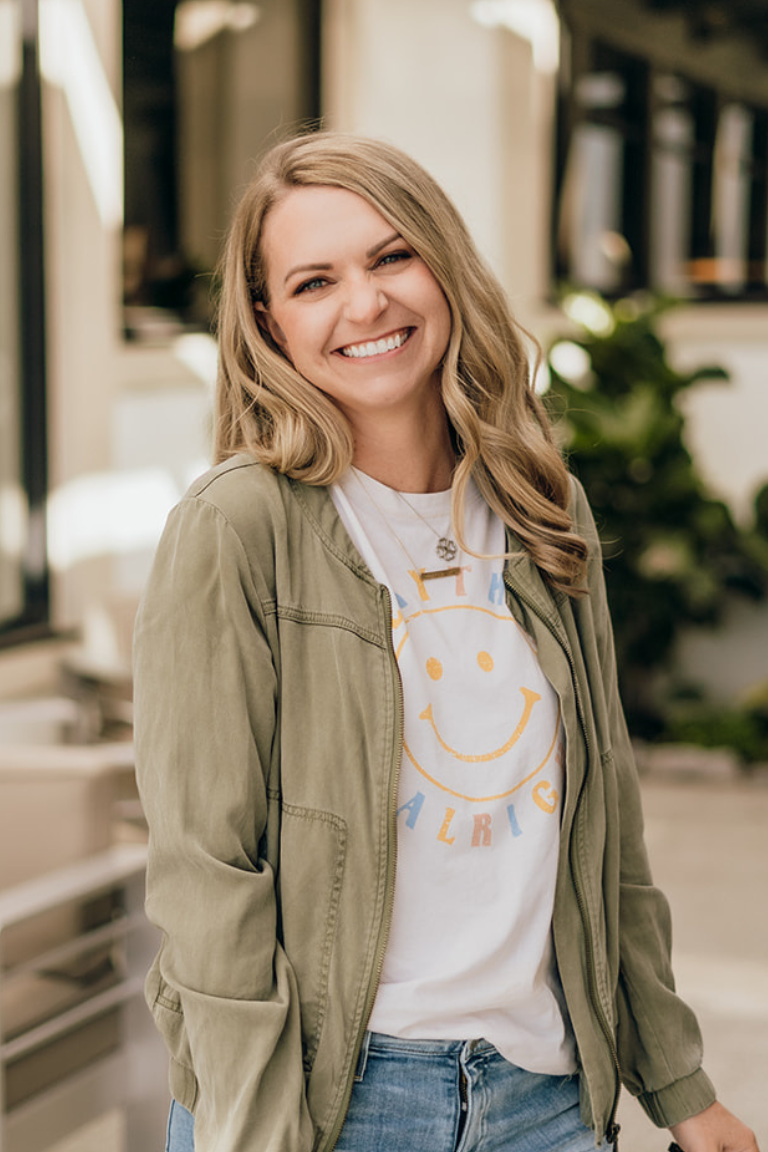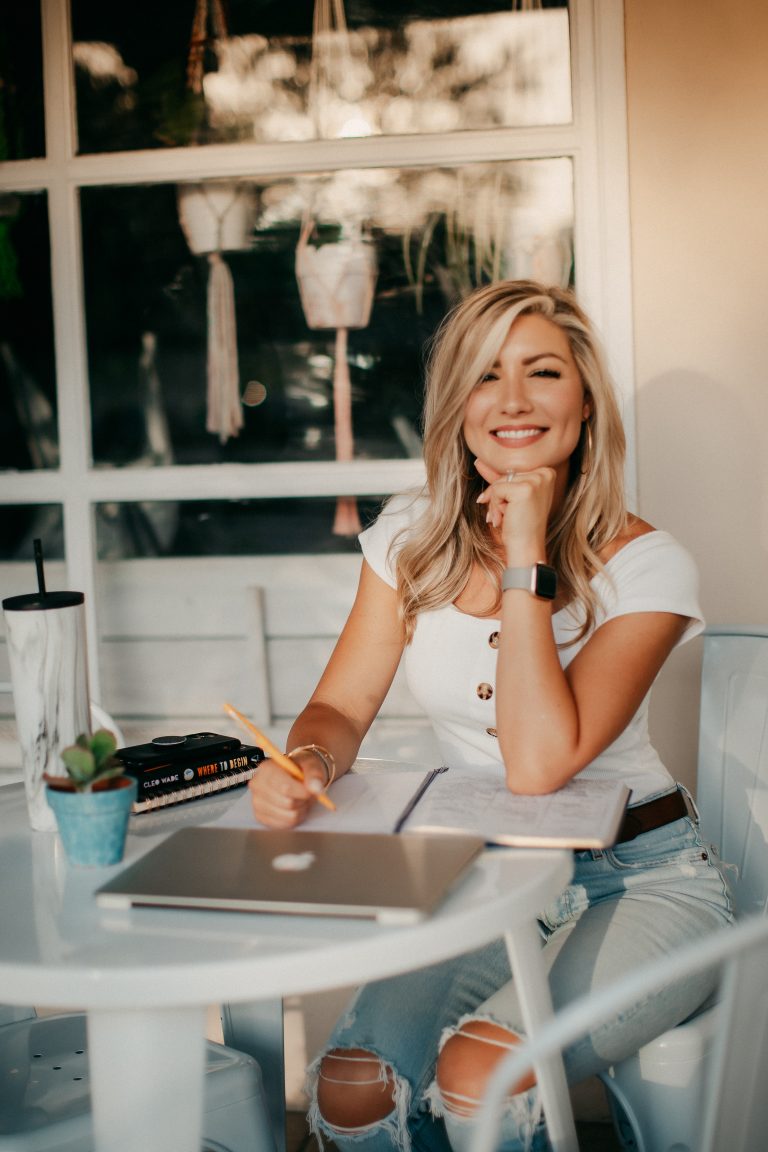
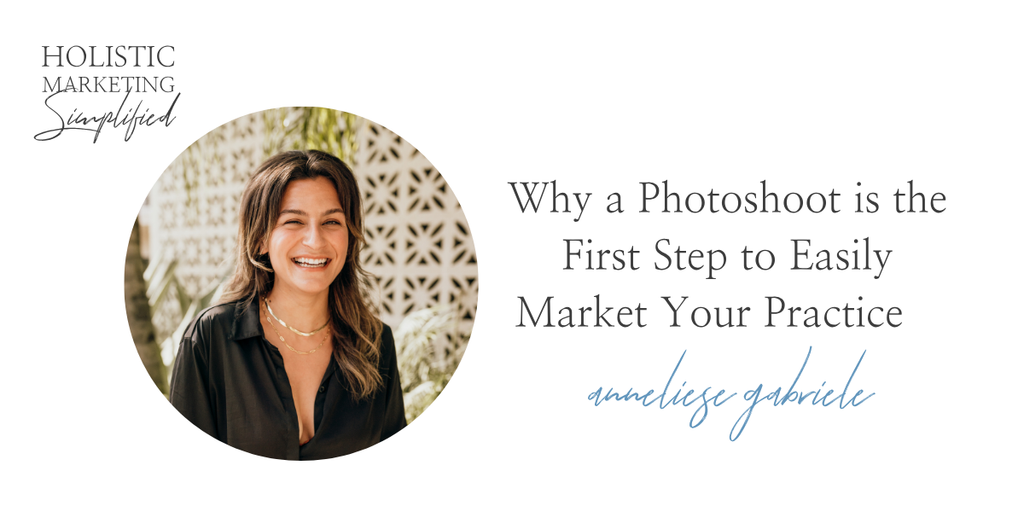
Why a Photoshoot is the First Step to Easily Market Your Practice with Anneliese Gabriele [Episode 181]
Subscribe on Your Favorite Podcast Player
Apple Podcast App | Spotify | Stitcher
If I had to tell you the actual ground zero, step ONE for making your practice’s social media easier and more consistent, it would be this: hire a professional photographer.
I know that might not be what you expected me to say. But after years of running social media accounts for healthcare practices, I know how much harder it is to consistently create content when you don’t have good photos and videos to work with.
I’ve seen this come up over and over again recently with our agency clients and Holistic Marketing Hub students, which is why I’m bringing back an oldie but a goodie for this episode. This conversation originally aired all the way back in Episode 18 with my former photographer, Anneliese Gabriele. And even though it’s an older episode, so much of the advice still applies.
In fact, I’m STILL using photos from the brand shoot Anneliese did for me years ago.
So if you’ve been struggling to consistently market your practice, let’s go back to ground zero.
Why Professional Photos Make Marketing So Much Easier
A brand photoshoot isn’t just about getting a nice new headshot for your About page. You’re creating a library of images that shows what you actually do.
If you work with pregnant women, get photos of you working with pregnant women. If you see babies, toddlers, or kids, capture that too. If you work with athletes, offer cupping or decompression, or you’re an acupuncturist, make sure your photographer captures you actually providing those services.
You also want some headshots and lifestyle photos of you at your computer or around the office, but the biggest thing I want you to capture is you doing the things you actually do. That’s what makes these photos useful for your marketing.
You can pull from them again and again when you’re creating social posts, Reels, emails, blogs, website updates, and other marketing materials. Instead of stopping in the middle of a busy clinic day and thinking, “Oh crap, I need to take a picture for Instagram,” you’ve already done the work.
Don’t Wait for Professional Photos to Start Marketing
I do want to make one thing very clear: do NOT turn this into procrastabranding.
You don’t need professional photos before you’re allowed to start posting. Take the car selfie. Use the iPhone photo. Start with what you have. Your Instagram doesn’t need a perfectly coordinated, pretty grid.
But when you’re ready to invest in professional photography, it can give you a much stronger library of content to work with and make consistently showing up SO much easier. It can also give people a better feel for your practice, your personality, your office, and your approach than a generic stock image ever could.
And in 2026, we’re basically not using stock photography at all for our agency clients. I’d rather see the actual practitioner, actual office, and actual experience than another random stock photo that could belong to any practice anywhere.
How to Find the Right Photographer for Your Practice
One of the easiest places to start looking for a photographer is Instagram. Search for photographers in your city and look through their work. You can also look at other local professionals whose photography you like and see who they’re using.
And don’t assume someone has to specifically advertise themselves as a “brand photographer” to be a good fit. If you’re in a smaller town, you might find mostly wedding or family photographers, so look through their portfolios and ask questions.
For example, if most of their work is outdoors in natural light but your clinic has fluorescent lights and very few windows, ask whether they’re comfortable photographing indoors and request examples of that work. Anneliese even suggested looking at real estate photographers if you need someone who’s particularly skilled with tricky indoor lighting.
You also don’t necessarily have to shoot inside your office. You can use a studio, coffee shop, fitness studio, outdoor location, or another space that fits your brand. But for practices, I LOVE having at least some images inside the actual clinic because they give potential patients a peek at what working with you looks like.
Think Beyond Headshots
This is one of the biggest mistakes I see practices make. They tell me they’re getting professional photos done, and I get SO excited. Then I get the gallery and it’s basically 75 headshots. 😂
A few headshots are great, but if you want these photos to make your marketing easier, you need variety. Think of your photoshoot almost like you’re recreating a normal day in your practice. What would someone see you doing?
If you see patients virtually, photograph yourself on a video call. If you’re in a brick-and-mortar practice, capture different treatments, interactions, rooms, equipment, and types of patients you commonly work with.
And if you’re using real patients or clients in your photos, make sure you have the appropriate releases in place. Anneliese and I are not lawyers, so you’ll want to make sure you’re using whatever releases are appropriate for your specific practice.
I also recommend getting some photos where the patient’s face isn’t visible. For example, if you work with kids, you might photograph them from behind or frame the photo so their face isn’t shown. That gives you more flexibility later when you’re using those images to talk about different topics.
Please Get Video While You’re There
This is the biggest thing I’d add to the original conversation now that Reels and short-form video are such a big part of social media: while you have everyone there for the photoshoot, GET VIDEO.
Even if your photographer doesn’t offer video, set up your phone on a tripod and let it record. Better yet, have another person with a second phone grab little clips throughout the shoot.
Capture yourself adjusting a patient, walking through the office, typing on your computer, talking with someone, setting up a treatment room, or working with a patient. These don’t need to be complicated. You’re simply building a bank of B-roll you can use as background footage for Reels.
And just like your photos, you can reuse those clips again and again. If you’ve already scheduled the photographer, the models are there, the office looks good, and everyone is camera-ready, take advantage of it.
Do not sleep on getting the video while you’re there!
How Much Should You Expect to Spend?
Pricing is obviously going to vary based on where you live, the photographer’s experience, how long you’re shooting, how many people are involved, and how you’re planning to use the images.
Anneliese shared that for a smaller two-hour branding session where the photos are primarily being used for your social media, newsletter, and website, you might expect something around $500 to $1,000. But she has seen photography range from $200 to $20,000 depending on the scope.
If you’re brand new and genuinely don’t have the budget, you could also consider a barter arrangement. That’s actually how I got my start doing social media!
But if you barter, BE SPECIFIC. Put in writing exactly what each person is receiving. For example, maybe you’re exchanging four adjustments for two hours of photography and a specific number of images.
The clearer you are about the exchange, the less likely someone is to walk away feeling like they gave more than they received.
Prepare for Your Photoshoot Without Overthinking It
You do not need 75 elaborate poses planned before your shoot. Remember what I said earlier: pretend it’s a normal day at your practice.
A good photographer should also be able to guide you through posing and help you feel more comfortable in front of the camera. If you’re unsure, look through their portfolio for examples of individuals they’ve photographed so you can get a feel for how well they direct and pose people.
For outfits, start with something you feel confident and comfortable wearing. If your clinic has scrubs or another uniform, include them, but you don’t necessarily need every photo to be in your work uniform.
And outfit changes don’t have to be complicated. Keep the same pants on and switch your shirt, or throw on a sweater or jacket. Small changes can give you more variety without turning the day into a full wardrobe production.
If doing your own hair and makeup is going to add another layer of stress, Anneliese also recommends hiring a hair and makeup artist if it’s within your budget. The goal is to remove some of those little things that might make you feel self-conscious once you’re in front of the camera.
It’s also worth talking to your photographer ahead of time about editing style. For branding photography, clean images tend to give you more flexibility than something very trendy, heavily filtered, dark, or moody.
You’re investing in photos you ideally want to use for YEARS, so ask yourself whether you’ll still want to use that editing style a few years from now.
Use Your Photos Over and Over Again
Once you get your gallery back, PLEASE don’t use each photo once and decide you’re done with it.
Reuse those images across your social media, website, emails, newsletters, and blog posts. You can add different text overlays, use them in carousels, turn a group of photos into a Reel, or pair the same photo with an entirely different caption a few months later.
You invested in these images so that you could keep using them.
For Instagram specifically, I also love adding a simple text overlay to photos when it makes sense. It helps someone looking through your profile immediately understand what a post is about and makes your feed easier to navigate and binge.
Stick with your brand fonts and keep it simple. And if you need help figuring out your visual direction first, I have a free blog post on creating a Canva mood board from scratch that you can find in the blog section of my website.
Your Photoshoot Is a Content-Batching Day
This is ultimately why I think a professional photoshoot is one of the best first steps you can take when you’re struggling with marketing consistency. You’re essentially batching a huge library of visual content in one day.
I’m still using photos from my own shoot with Anneliese years later. And if you add video into the mix, you can walk away with a bank of B-roll you can continue using for your Reels too.
That means you’re not constantly stopping what you’re doing to remember to document your day, relying on generic stock photography, or reinventing the visual side of your content every single week.
So if your practice’s social media has been feeling harder than it needs to be, this might be your ground zero. Find a photographer who fits your practice, get photos of yourself actually doing what you do, set up the tripod while you’re there, and give yourself a library of content you can keep coming back to.
Connect with Anneliese
Connect with Molly
Instagram | Facebook | Youtube | Holistic Marketing Hub
The Holistic Marketing Simplified Podcast is brought to you by Holistic Marketing Hub, our hybrid program that supports you with personalized coaching, caption templates, and virtual classrooms. In this program, we teach health and wellness professionals how to fish, but also bait their hook!
Make sure you’ve hit that follow or subscribe button on your favorite podcast player to get notified each week as we air new episodes!
Episode Transcript
Molly: Hello, friends. So this intro I'm recording right now is new, but the episode today is actually a replay all the way back from episode 18. So, like, this is a very old episode. And we're what? Episode 181 now, I think. But the reason I'm replaying this is intentional. I have-- Well, first of all, we've kind of onboarded a few new clients recently in the agency, and then also this has come up just, like, so many times in the last month with Holistic Marketing Hub students that I was like, "Okay, it's time to either record a new episode or I'll just replay this episode I have about photography."
So if I were to truly, truly, like, okay, you know, if I were to actually tell you this is actual ground zero, actual step one of making your practice's social media better and more consistent, it would be to hire a professional photographer. Because I know for a fact, not just I think, that what makes posting consistently feel hard is when you don't feel like you've got good, just, like, base content to use.
So at the time I'm recording this in 2026, like, even back when I recorded this episode with Annaliese, she was actually my photographer when we lived in Pensacola. She did my, like, brand shoot from a few years ago. And fun fact, I mean, I think that brand shoot was back in 2025 Through, no, 2022 actually. Um, I'm still using those pictures today still.
Anyway, I know that when you have really good images to use and really good video to use, it's going to make posting consistently feel one million times easier. And even back when I recorded this episode originally, we were already seeing stock imagery, like, not perform well. And now we don't use stock imagery in our agency, like, basically at all.
It's very, very, very rare. And if you are-- I mean, I don't ever like to, like, bash competitors or anything like that, but if you're subscribed to, like, a syndicated social media content service that literally just, like, all this random stock, randomly branded images go out on your behalf. I've heard people say, "Well, it's better than nothing, right?"
And I would actually argue it's not. It's just a waste of money. Um, you probably notice that you get, like, two likes, one's from your personal account, and one's from, like, your CA. Um, it's just not worth it. So if I were to truly tell you go back to ground zero of what to do, I would hire a professional photographer.
You will use these images for years and years to come. But a question that I always get is, like, "Well, how do I find someone and, you know, how much is it gonna be, and how do I know, like, what pictures to get?" All of that. So all of that is answered in this episode here. Um, one thing that I don't say in the episode because r- God, this is-- this episode is so old that, like, reels weren't even as popular as they are now.
We do talk about video a little. We talk about the actual photographer capturing the video. But what I would do, this is what a lot of our clients do, is I would have, while you've got models there, um, to do, like, doing your photos, I would set up a phone, like a tripod in the corner, and just let it keep rolling video, and then I would have a person with a second phone recording, like, other just, like, little video B-roll clips while the photographer is there.
And then you have built this, like, massive video B-roll bank that you can use for reels for, like, literally we have, uh, like years to come Okay. I think, like I said, everything... I, I will listen back to this episode. I think everything else is covered in this episode, but I did just wanna, like, say the bit about the video.
Do not sleep on this, like, getting the, getting the video while the photographer's there. Because like I said, this is like true ground zero if you're feeling stuck. And I do think we, uh, we talk about this in the episode, but now I'm just gonna say it 'cause I'm gonna worry that we don't. Um, a lot of people are like, "Well, what poses?"
Like, "Send me the poses." I'm like, "No," like, you're overthinking this. Literally, you just need pictures of you working. If you see pregnant women and babies and toddlers and kids, like, that's the pictures you need. And if people don't wanna show their kids' faces, you can get the kids from, like, the back of their head, or you can get, like, waist down or whatever.
You obviously do want some head shots, and you kinda want you at your computer, and you want you, like, in your office and that kind of stuff. But, you know, if you see a lot of athletes, you want pictures of you working with athletes. If you do cupping, you want photos of you doing cupping. If you have decompression, you want photos of you doing decompression.
You know, if you're an acupuncturist, like, you want photos of you actually doing the needles, like I said. So really the main thing to think about is just, like, photos of doing the things that you do. Okay, this is a really long intro but, uh, here we go. We're gonna dive into this episode on my true ground zero, how to find a photographer.
Hey, welcome to Holistic Marketing Simplified. This podcast boils down to the fact that we wholeheartedly believe that more humans need to know about holistic health solutions. And you didn't go to school to learn how to be a full-time content creator and show up on Instagram and do all of this marketing stuff all day, every day.
So let's come hang out while we chat all things easing your marketing, and my goal is that you shift your mindset around your marketing from a, quote, should to a I get to. More dream patients and clients? Yes, please.
Kristin: Hi, I'm Kristin Spetz, and I am a life coach and a sound bath facilitator,
meditation and breathwork teacher, and I live in Evanston, Illinois, outside of Chicago, and I listen to Molly Cahill's Holistic Marketing Simplified podcast.
Molly: It's so great lisa, welcome to the show. You are actually my photographer when I lived in Pensacola. You did my last brand shoot for me, and they were amazing, and I'm so happy to have you. Thanks for coming.
Anneliese: Oh my gosh, I'm super excited, and I miss you, and I wish we were both in the same city so we could hang out more.
Molly: Yeah, talk about, uh, one of the things about a photo shoot is I feel like the subject has a tendency to feel awkward, and even me, who like, I was a cheerleader, I did pageants, like, and I still am just like, "Oh, God." But you do a really good job of making people feel comfortable, especially when- Thanks ... here, uh, where were we at?
Like, the country club thing, and the people are, like, peeking through the windows like, "What are you doing here?"
Anneliese: Mm-hmm. Oh, yeah. Yeah. That was a blast. I feel like any session I'm just, like, 100% hype girl for whoever- Mm ... is in front of my camera. Even if I feel like I'm not doing a good job and, like, I need to be directing more, I'm still gonna make someone look bomb.com just by being like, "Yes, you're killing it.
Keep going-" Yeah ... "keep going."
Molly: Yeah. No, you were so good. You're such a good hype girl. So that's, you know, worry number one to get out of the way is most photographers are, like, really good hype girls. And they're not just gonna be, like, standing there with a camera and say, "Here you go," like...
Anneliese: Yep.
Molly: So let's start at the- Figure it out.
Yeah. Let's start at the beginning. So why do you f- I can, and I can chime in why I think so too, but- Mm ... as a photographer, from your lens, sorry if that was really cheesy. Why do you think people need professional brand photographers? And remember, you know, we're talking to, like, a lot of health coaches. We got, like- Yes
brick and mortar chiropractors, like functional medicine, all this kind of stuff.
Anneliese: For sure. I really think any professional, if you're starting your business, if you've been doing it for a while, if you just opened your brick and mortar storefront, it's really important to have these images. Because a branding session is more than just your headshots.
Molly: Mm-hmm.
Anneliese: We are focusing more on, you know, your office space if you have one. Your personality's gonna shine through in the pictures, your approach to whatever services you're providing, your services in general. And it's gonna really allow you to connect with that client instead of just a fun headshot on your About Me photo.
And these images can be used on all sorts of parts of your business, which I'm sure we will continue to talk about in the future.
Molly: Yeah. Yeah, and from a marketing standpoint, I just feel like it just kind of up levels your professionalism just a bit. And no longer does Instagram have to be this place where you have the perfect pretty grid anymore.
It's not about that. It's more about- And I don't want this to be what they call procrastabranding either. You know how some people will be like, "Well, I don't have photos yet, so I can't start-
Anneliese: Mm. Yes ...
Molly: doing X, Y, Z." No, this is not that. Take a car selfie until you get your photos. Like start- That's right
start with any action, okay? So I, I wanna just preface with that. Don't, don't think you have to wait until you have photos for any of this to happen. But it can really just, to me, it, it gives this little subconscious signal you probably don't even, your viewers don't even realize that they're getting of like, it's just a little elevated.
Because how many times- Absolutely ... like let's say you're brick-and-mortar and you have fluorescent lights, and you're trying to take a photo, and it just looks like crap. Like I just, I don't know how to make that look good. Mm-hmm. But that's where the genius of a professional comes in.
Anneliese: I think on top of that, the procrastinating launching any sort of business, I feel that I literally, whenever I was preparing for this podcast, I was organizing my office and I found a drawer full of T-shirts because I wanted to start T-shirt printing.
So I feel that. And you wanna know the exact thing that was holding me back? Not having images. So it is extremely important. And just like you said, iPhone photos are perfect to begin, and I've seen a lot of successful coaches and marketing strategists just work with iPhone photography. But I think whenever you're starting your business, it's kind of hard to put into words what your brand statements are, your voice, what resonates with your audience, who is your audience, and just going through the process of this branding session, all the preparation that you kind of do to begin with, with your photographer, and then actually being really confident in front of the camera, is just growing that confidence and passion for the business and proving to yourself and your audience that you are an expert and that you've invested into- Yeah
the business.
Molly: So I wanna make that distinction. I wanna go back to what you said about headshots, 'cause I think that's really important. Mm. I've had a few clients who I got real excited 'cause they're like, "Oh, my photo session is next week. I can't wait. I'll give you all the images." And then I get the gallery and I'm like I don't know what to do with this, 'cause yes- Yeah.
Yes. Y'all, y'all didn't see what Ana was just doing, but she was doing the whole, like, Olan Mills po- pose. Yes. What is it? That's what we had growing up, Olan Mills. I don't know what it was where you were cur- like Portrait Innovations. Where you- Very,
Anneliese: yeah.
Molly: Yeah. Um, and a few of those are fine, right? But I, I think you need to be, like, literally pretending and/or actually doing the thing you do.
If you do video calls, you need photos of you doing the video calls. If you adjust patients- Mm-hmm ... you need photos adjusting patients. Yes. And we'll, we can talk about, like, social media releases and the legal part of it later, but I just wanna make that d- important. When you said the thing about headshots, that's not even something I thought about bringing up, but that is super important, that you don't just wanna go somewhere with like a backdrop and a chair and that be your whole-
Anneliese: Right
Molly: for this type of photography we're talking about.
Anneliese: Yeah. S- it's definitely gonna look a little bit like stock photography. Mm-hmm. Like, if you were to Google chiropractor adjuster, you're gonna see a lot of similar poses that you're gonna be doing in your branding session, but it's gonna look a lot more authentic.
The photographer's gonna direct you and prompt you to do certain things so it looks really natural, and you can still see, you know, aspects of your personality through the images instead of, like, grabbing something from Google and trying to plaster that on your website.
Molly: Yeah. One of my clients, she actually does it, obviously she lets them know ahead of time, but she does it during normal clinic hours.
She doesn't even- Wow ... I know. Oh, that's br- She's like, "Yeah, I just schedule my patient to, like, you know, they've all signed some type of social media release." Um- There you go ... she's like, "It's so," she said, "It's so funny because the moms who normally come in with no makeup and, you know, four-day-old unwashed hair and sweats, and then they're-"
coming in, like, with their hair curled and, and all of that." But, uh, she's like, yeah, that's the easiest way for her to do it. But really- Mm-hmm ... you can do it any way that, that suits you. So I just wanted- For sure ... to make that distinction. But so how do people find a photographer? What's your favorite advice for that?
Anneliese: I think right now still the easiest way to find one is Instagram. Yes. Whether it's- Whether it's just using hashtag, you know, your city brand photographer. Sometimes that can be a little too niche. Maybe broaden it a little bit. Yeah, I think the city works. Hashtag your city photographer. Yeah. Even if you just take out the brand part and you just start gazing through any sort of photographer in your area, um, I think that's probably the best way.
Another great way is just looking at other professionals to see who they're using.
Molly: Mm-hmm.
Anneliese: And that's kind of like your first hand review, 'cause if you're liking what you're seeing in those images, then it's gonna ... Most likely your images should look similar to what that, that product looks like. So it's a great way to be like, "Okay, I like how that looks.
Let's, let's hire that person." I,
Molly: I mean, and even your Instagram is mostly like a wedding. Your, you ... So that's actually another great question I didn't even think about before. Let's say you're in a small town and you're like, "Oh, nobody around here does brand photography." Mm-hmm. I know local Facebook moms groups are always great places, but a lot of that is gonna be, like, more family photography.
Mm-hmm. Is there anything people should look for when they're like, "Oh, this person just photographs families on the, in the park," so is this gonna translate? I mean, I guess it depends on the person. It's probably really broad.
Anneliese: Yeah, I think just from, like, a technical standpoint, if you're seeing their Instagram- Mm-hmm
and it, there's, like, no flash photography or there's nothing indoors, maybe ask to see a couple galleries if they're not super familiar- That's a good point ... with taking photos in an office. You know what I mean?
Molly: Ooh, yeah, yeah.
Anneliese: Um, but other than that, yeah, just reaching out to them. 'Cause I, I do promote it.
Um, but it's kind of like just word of mouth. So it's not on my website right now, and it's not on my, um, Instagram, you know?
Molly: That's such a good point, 'cause my friend Sabrina, she only uses natural light. So if you have a ... So she's even said to me before, she was like, "You don't want me doing your brand photos."
Mm-hmm. So that's interesting. That's a great litmus test or, like, great question to ask your photographer is, like, how-
Anneliese: Sure ...
Molly: you know, how are you with indoor lighting? Especially if you have fluorescent lighting and not a lot of windows.
Anneliese: Yes, absolutely.
Molly: And you can always go outside your office, right? It's just, that just kind of almost defeats the purpose of having this peek behind who you are.
Anneliese: For sure.
Molly: Yeah.
Anneliese: I mean, I think having the images in your office, that's definitely important. If you notice there's not that many brand photographers around who are familiar with photographing in that sort of an environment with no windows, a good place to look would be, like, a real estate photographer.
They're pretty strong with, like, their flash.
Molly: Oh, yeah. That's a great idea.
Anneliese: Yeah. Or you could always rent out, like, a photo studio. If your town is too small and they don't have that, they might have a fitness studio, like a little yoga or Pilates studio. It's usually just, like, a plain room, and you can bring some elements from your office, the folding table if you're doing adjustments.
Actually, I don't know if that folds. But you know what I mean.
Molly: I mean, some people have, some people have portable tables, yeah. Not everybody does. Okay. But that's definitely a great point, 'cause I've seen some people- Yeah ... before who've used- Like, you know, like the like cool like brick wall, you know, and just brought some elements from their office in.
So yeah, I think there, I mean-
Anneliese: Sure ...
Molly: like when you and I did our shoot, you didn't do... I've done them in my home before, um, years and years ago. Mm-hmm. I did some brand, brand shoot in my home, and they were great. When you and I did them, we did them at a golf course, and then we went to Starbucks.
Anneliese: That's right.
So
Molly: yeah. It can, and then the
Anneliese: last one- Thankfully the furniture was nice and neutral. It looked very coastal. It was super bright. The walls were nice and just a crisp white. There wasn't that much texture, a little bit of staircases, all sorts of fun details like that. I think if you're gonna just go in a public place like the golf course or Starbucks, just make sure it's either like super neutral so you can bring elements like in your clothing or your props if you're bringing that, or find something that has like your brand colors already involved.
So if there's a coffee shop in town and it's like teal and gold and that's your vibe, maybe see if you can shoot in there.
Molly: Yeah, I love that. And I would argue, I mean, every photographer I've ever worked with has known all of these. I would, I was like, "Ana, where are we gonna do my photos?" You're like, "Oh, we're gonna go here."
I was like, "Okay." I didn't even know this place existed, and it was like three miles down the road from me. So- Yeah ... um, yeah. And I've e- I've done some shoots too, like downtown, like when I lived in California, like Vista, like on Main Street. Mm-hmm. And that was fun. Like, there was like a fountain in the sidewalk, in the road, and yeah.
So it doesn't have to be in your office. But just as somebody who runs 25 social media accounts, a lot of those being chiropractors, from our view it makes our jobs a lot easier, which means even if you're not outsourcing, it'll, it'll make your job a lot easier if you just have these images. That way, like if you're talking about pregnancy and chiropractic, you wanna have a picture of you adjusting a pregnant woman, and just make sure, because so much of the feedback I get from my clients is, "I'm so busy seeing patients or clients all day, I don't think to stop and take a photo."
I'm like, "Well, that's normal. Like you're in your flow." Mm-hmm. So if you can almost batch it, so to speak, and just get them all done, then It's so much easier.
Anneliese: Absolutely. So,
Molly: okay, so after we've found our photographer, what can we expect from there? Like, I know this is one of those it depends. Every photographer is different in how much they charge depending on their experience- Mm
or where you live or how many images- Mm-hmm ... you get. But do you wanna just give people like a, a range maybe?
Anneliese: Sure. Like you mentioned, it's very dependent on your budget, photographer's experience, what you're planning on doing with the images, if there's gonna be commercial work involved, advertising, using it on a, on the cover of a book.
But if we're just keeping it to social media, newsletter, website, typically you can expect to spend 500 to $1,000 if you're just doing like a little two-hour session. Um, I will say I have seen, depending on the location and the scope of work, it's been between $200 and $20,000. It really just depends on like how big your practice is, um, or what you're planning on doing with those images, like I said.
I will say if you've never done it before and you don't have that much to invest, consider bartering with a photographer That's actually what I, I have a branding session coming up next week, and it's a med spa. And I was like, "I will knock out these branding images if you give me some laser hair removal, girl."
Yeah.
Molly: So
Anneliese: that's what we're doing.
Molly: That's how I got my start- Great- ... was barter, yeah.
Anneliese: Yes. That was, I love me some barter. Great opportunity. Absolutely. They can become a repeat client, you know? Yeah. Once you decide- Yeah ... if you appreciate their images or they like your services.
Molly: Yeah, I would just, my one thing to beware with that is make sure it is crystal clear, like, in writing, like, "I am going to give you X amount of images for X amount of shooting hours."
Mm-hmm. "And in exchange, I will give you four health coaching sessions or four adjustments."
Anneliese: Absolutely.
Molly: Um, trust me, it'll be... Because almost always if you don't lay it out that specifically, someone's gonna end up feeling resentful. It's just the way it is.
Anneliese: Mm-hmm. Be super clear. Yeah, for sure. Don't expect every session to be a barter situation.
Like the first one- Yeah ... makes sense if you, if you don't have the funds to make it happen. But, um, future ones, definitely-
Molly: Yeah ...
Anneliese: value the photographer, and they'll also value your, your time and your practice.
Molly: I'm glad you said that, 'cause yeah, I to- that's how I totally got my start. So yeah, and it also depends, now I don't know if you offer this, but I know some photographers more and more are starting to offer some video as well.
Anneliese: Hmm.
Molly: Um, and something I've been recommending for all of our clients is when you have that professional shoot, grab your iPhone and someone else's iPhone, set up a tripod, and just let it roll- Yes ... and grab some of that B-roll type, um, background footage. Mm-hmm. That then can also be used for reels. So even if the photographer is not one doing it, and if you don't know what B-roll is, B-roll is literally, you know what it is, you just probably didn't know what it was called.
It's those, like, behind-the-scenes, like, I'm videotaping myself typing on my computer. Yes. And I'm using it as, like, uh, however you wanna say background footage, but just, like, stock footage that's not actual stock, like it's you.
Anneliese: Mm-hmm.
Molly: Yeah, so there's so much that you can do with that B-roll footage if you just set up some tripods and just let the camera roll, and you can always tweak it.
Anneliese: And you don't need a ton of it. You can, you can reuse all that content.
Molly: Yes. Oh my gosh, yes. That's what I always tell, I'm like, I always tell my clients, I'm like, "Anything you give us, it's our love language, it's our currency. Any video you give us, we will find something to create in."
Anneliese: Mm-hmm. That's right. Um,
Molly: so then we talked about the number of images.
I know typically, or we didn't talk about the number of images, but it's, I know every photographer's different. It might be, like, a one-hour session for 75 images or whatever. So once they do the shoot, do most photographers do it to where, like, they let you pick what images you want? Or is everyone kinda different, like, "Here's the whole gallery, you get what you want"?
Anneliese: I would say if they are pricing themselves per employee, it's gonna be a li- a more limited number of images. So if there's kind of looping it all together into let's knock out the head shots, also get the branding content, also get the candids of you guys working in the office, um, they probably limit it to, like, 10 images per employee-
Molly: Mm
Anneliese: um, on top of whatever candids and stuff like that. But for me specifically, I don't, I don't limit how many we, we deliver. Whatever is looking good and the eyeballs aren't closed, it's not crazy blurry, it's not- Yeah ... you know, completely throwing off the rest of the gallery and it doesn't look consistent for an Instagram feed or a website, then it's gonna be delivered.
Molly: One mistake I made the very first branding shoot I ever did was my photographer did a really warm filter, and I... So not only had I- Mm-hmm ... already had a spray tan, then she put on this warm filter and I legit looked orange in every single image. Yes. And I was like, "Why did I not just speak up and say, 'I'm not ever gonna use these because I look orange'"?
Anneliese: Yeah.
Molly: And I did... So just ahead of time if I had communicated, like, "Hey, we kind of like this vibe," I don't know, I think that would've been helpful. I don't know, as the photographer, what you wanna add there.
Anneliese: Oh, no, I totally agree, and I think branding photography needs to be a little bit cleaner. If you like someone's artistic style and it's very warm or moody, is that gonna reflect really well on your website?
Is that gonna look good when a client is looking at your office and it's, like, dark and funky looking in there? Um, I've noticed the less expensive the photographer, everyone's been there, all, whoever's, like, less experienced and charges less- including me at one point, was very, um, experimental with their editing.
Mm-hmm. So that's probably maybe what you experienced with your photos too. And that, some people are very, like, headstrong and won't change their editing style. Some, for branding specifically, like me, I edit it a lot cleaner than what I would deliver for, like, a wedding gallery. It's definitely a conversation that needs to be had, but just to completely remove any of that doubt with the quality of work that you're gonna get delivered, I would just try to find someone whose Instagram is very consistent and clean in the photos they're already producing, and it would l- also look really good with your office or whatever- Yeah
place you decide- I was
Molly: just gonna say that. Find someone else's page you like and say, "I like this style of photography."
Anneliese: Yep.
Molly: And just try not to get too trendy with it. Like-
Anneliese: For sure ...
Molly: you know, like, if, if you have any type of filter that's grainy or, you know, like, that might be trendy cool, but, like, are you gonna love these images years from now?
So like you said, I just love the clean-
Anneliese: Mm-hmm ...
Molly: easy. I'd change nothing on any of the ones you did. They were great. I love 'em. They're my favorite. Oh. Um, yeah. So I just wanted to point that out, 'cause that's, like I said, something I didn't even think to say to the first. And then I was like, "Ugh, I look like an oompa loompa in all of these."
Anneliese: Yeah. And I mean, if you're going between photographer and photographer looking for the best rate and you book one session with this one and you book one with this one, your feed is not gonna look consistent 'cause the editing styles are different. And I mean, sure, you might think as the business owner, "Oh, I can just throw this in Instagram and put, like, a cooler filter on it."
Yeah. But a lot of the photography contracts say you can't be applying any sort of filter. You gotta post it exactly how it was delivered. Um, and you don't want any bad blood between your creative team and yourself, so-
Molly: Yeah ...
Anneliese: definitely just- Good
Molly: point ...
Anneliese: pick, pick the right photographer from the get-go and kind of work with them consistently.
Molly: Yeah. And I, we have one client who she gets discounted, um, she's c- she's almost like a influencer in her town because she agrees to tag the photographer in every post.
Anneliese: Um-
Molly: Amazing ... so I mean, like I said, that's another thing to ask, 'cause it really is kind of a pain to make sure you've tagged the photographer every single time, every single- Mm-hmm
image you ever use in perpetuity. Right. So that's another, you know, good thing to have ironed out ahead of time. Okay. So we, we've hired our photographer. We have the date set. What are all of your tips for preparing for the shoot? 'Cause I, and I won't lie, I'm not gonna, like, sugarcoat it. It always stresses me out.
It is gonna be something that you're like, "I gotta figure out what outfits I'm gonna put on. I gotta do my hair and my makeup." But it's always worth it because, again, then you're not having to think about, "Oh, let me stop what I'm doing and snap a picture." Right. So what, what are your tips for preparing for a shoot?
Anneliese: So let's just go with hair and makeup and, and i- outfits since we s- you brought that up I typically create a gr- a guide that I send that's specific to the industry that you're in, find some inspiration images, find some outfit ideas, just to give you an idea what would work. But I would start with, like, something that you are so confident in.
If it has to be, like, a yoga set Let's start with that because you wanna be able to move comfortably, you wanna be able to sit naturally and not feel like things are popping out or some zipper- ... is gonna come undone. You know what I mean?
Molly: Yes.
Anneliese: So I would start- I think- ... with something that's just-
Molly: Yeah, a graphic tee, jeans, and-
Anneliese: Yes
Molly: I think I had sneakers on.
Anneliese: Exactly. And I mean, that first 10, 15 minutes of your session, that's really a warmup for you and your photographer. If y'all haven't met before, this, there's gonna be a lot of conversation going, a, a couple laughs, maybe we need to have a sip of our coffee while we're kind of working through our poses.
So those might be scrap images, but just something that you feel really confident in to begin with is gonna set the tone for the rest of the session. And then if you have a uniform... I don't wear a uniform, so I had to search in my head what that word was. Do people wear uniforms to work? Who knows?
Molly: Some people do.
Yeah, I have some clinics that wear, like, matching scrubs or, you know, whatever.
Anneliese: Cute. Yes. Okay. So if you have that, that's definitely something that you can incorporate. I wouldn't do all the images in scrubs. I would try to reflect your own personality and also your, your audience. Like, if you're wanting, like, a professional athlete to come into your office, you're gonna wanna look very experienced.
You're gonna wanna have, like, maybe something a little bit nicer on. Um, if you want the fun, young crowd, maybe some funky colors. But you don't have to put on, like, a facade for the audience that you're trying to attract. They're gonna love you for you. So just be yourself with the outfits that you pick.
And then another wonderful thing that I would suggest, if, unless you're really good at doing your own hair and makeup, but if you are not confident and you feel like you're gonna do it that morning and you're gonna say, "I hate it, and now I hate the way all these images look," is if you have the money for it, hire a hair and makeup artist to knock that out for you 'cause that's just gonna take out one more little scratch of doubt that might have been in your way before you start your session.
Molly: I, I feel like I'm pretty... Well, not how I look right now, but, like, I did my own hair and makeup for ours, and it's so funny- It looks great ... oh, oh well, I was about to say, how many times, though, have I done this? And every time I go, "Put on more blush than you think you need," and I never do it. Mm-hmm. 'Cause you look at yourself in the mirror and you think, I look like a clown.
But then- Yes ... in the photo it tends to wash you out. So-
Anneliese: Oh, yeah ... if
Molly: you have any makeup-
Anneliese: Absolutely ...
Molly: tips for the ladies.
Anneliese: No. I mean, I was gonna say for wedding photography, which is what I primarily shoot, all, most of the makeup teams will put extra contour, extra blush. It looks a little bit aggressive when you get really close to them, but if you're sitting in the in the ceremony space looking at her, she looks great.
So same, same thing goes for branding photography.
Molly: Yeah, more than you think you're gonna need. It's, uh, every time. Every time I'm like, "All right, I laid on extra blush," and then I get the pictures back and I'm like, "Damn it." Watch. This last, just in Nashville we did some brand shoots for this retreat I went to and I was like, "Damn it."
So okay, so we talked about outfits. One thing I always say with outfits too is like, if you're a more casual office, like can you just change out, like leave the same pants on and just change your top? Or You know, throw on a sweater or a jacket or whatever. It just, like, makes it so much easier, right?
Anneliese: Absolutely. Yeah.
Molly: And then another thing to prepare for the brand shoot just from, you know, a legal standpoint, and I kinda touched on this before, is you do wanna make sure that you have some type of social media release. And Ana and I are not lawyers, so do with that what you will. You wanna Google it? I don't know.
You wanna hire an attorney? My friend Lindsay has some templates. I can link those below. It's gonna be different, uh, if you are, if it needs to be like a HIPAA release, social media release- Mm-hmm ... form. One thing we also try to do is get a lot of images without a f- face, if you can. Um, that's one good thing to tell your, your photographer, because here's why.
We realized, let's say we're doing a post about chiropractic care and bedwetting for kids, and we've got this- Mm ... innocent little Jimmy in the photo, and then everyone's like, "Does Jimmy wet his bed?" Um, you know what I mean? Oh, no. Look, these are the
things you figure out when you've been running accounts for years, right? You're like, oh, it, d- you know, you know, like, yes, you have the permission to use that photo, but, like- Mm-hmm ... maybe Mom didn't know you were gonna use it on a post talking about bedwetting and chiropractic. Right. Absolutely. So that's why I'd say always, you know, try to get some faceless photos or, like, the kid's turned around backwards or something like that.
It's fine to have some with their face in it, but just something to consider. The next thing I want to talk about is posing. We kinda talked about posing a little bit in the beginning. Sure. But does, d- do you feel like that depends on the experience of the photographer? Or do you feel like most photographers are pretty well, like, pretty well-versed in helping you know where to pose, how to pose?
Anneliese: I would definitely find someone who is confident in posing individuals. If you're looking at family photographers, if you're looking at wedding photographers, there's a lot of groups, there's a lot of holding onto people. Mm-hmm. But do we know what to do confidently with our hands by our side? Do we know how to sit people nicely in their chair?
Just kind of make sure that they have those images in the gallery before you decide to go with that person. If they do, they're definitely gonna have the right prompts and direction to get you through your session. You're not gonna have to show up and figure it out yourself. They're gonna walk you through the entire day.
Molly: I love it. That's a great, great tip. I'll, I even have a Pinterest board that I've given to some of my clients. I've Googled, like, doctor photography or doctor lifestyle photog- I don't remember what all I've-
Anneliese: Mm-hmm ...
Molly: just kinda made, like, a little Pinterest board of stuff I liked, and you can always show that to your photographer as well.
Anneliese: Absolutely. I was gonna s- actually mention Pinterest a little bit-
Molly: Yeah,
Anneliese: go for it ... in the planning for our session. But it, like you just mentioned, it's kind of difficult sometimes to look up medical stuff on Pinterest. There's a little bit of censorship sometimes going on with the articles that pop up.
At least that's what I've noticed when I was trying to research stuff for our podcast. But if you keep the, the terms very generic- Blogs will populate and you'll be able to see some examples.
Molly: Yeah. And when in doubt, like go back to what I said, just do it literally pretend it's a normal day, you know, and if you're virtual, it's a normal day in your home office- Absolutely
it's a normal day in your clinic. Yeah, like, and just film the stuff, you know, like lifestyle, like day in the life type thing.
Anneliese: Mm-hmm.
Molly: So once we have all these images, you wanna talk about some things we can do with all of our images?
Anneliese: For sure. I think now that we have images with different outfits, different locations in the office, maybe some outdoor spaces, maybe some images with your clients in there, I think people are gonna be a lot more willing to click through any sort of Instagram post, carousel, Pinterest blog, anything like that if you're using these images.
So use them frequently, use them repeatedly. I would say daily for your social media, weekly for your blogs, monthly for your newsletter if you are producing a newsletter, and just shift up the caption overlay if you have something specifically on the image. Change the caption in the actual caption, obviously.
Use them for reels. Just use them all the time.
Molly: Yeah. I love using them for reels. We'll make little photo montages all the time. Yes. And then again, like if you've captured that B-roll behind the scenes type video, that's something else that can be used. I will say, so this is different. Like, if, if my target audience was a photographer, a graphic designer or whatever, it would be different advice, or you're an interior designer or whatever.
But for my audience, I usually... I had somebody ask me, "Do you always put some type of text overlay over the photo?"
Anneliese: Hmm.
Molly: I, we like to for our clients only because the way Instagram is set up, it makes your feed a little more easy to navigate and a little more bingeable. So for example, I always use Dr. Becky at Good Inside.
Do you follow her for the parenting? Mm-mm. Like a parenting, um- Oh my
Anneliese: gosh, no.
Molly: Yeah. She's But I will
Anneliese: have to.
Molly: And I'm like, oh my God, I need, I, like, learn every, 'cause I have a very strong-willed daughter. So Dr. Becky at Good Inside, and I literally went to her feed, and I'm, she probably has a blog, which would've been way easier to look it up.
I don't even know. But I'm just such an Instagram person that I was like, oh my gosh, my daughter, when we first moved here, we were dealing with lots of whining, and I get it. Mm. It was a big life change. So I'm like, let me go to Dr. Becky's page and see if I can find a post about whining. And because every single one of her reels and every single one of her posts ha- is so well labeled, if you will, like- Yeah
if, if you don't know what I'm talking about by this, it's just literally instead of just being a photo of you on Zoom with a client, like on a, on a computer, like literally the label could be Did you know I can see you virtually? Or I don't know, I'm going, not thinking of preg- or with our chiropractic example, you know, instead of just showing a pregnant belly, it's like we, you know, or you could do like a specific pain point from pregnancy, right?
Like, that that post is about. So it's like, okay, this is about pubic symphysis dysfunction or something like that. So it's like, oh- Mm, mm-hmm ... like, people can easily navigate your feed and see what that post is about and click on it versus being like, "I wonder what this post is about," and having to click on it first to see.
Does that make sense? Did I explain that right?
Anneliese: Absolutely. And I mean, not even being in that, in that realm. Yeah. I'm not... Obviously, I'm a photographer, so looking at our feeds, we're not repeating images because it's gonna get boring. But having those overlays, I think that's gonna make a huge difference, and I almost wanna do it on my stuff.
Molly: Well, it just makes it so much, like, so easy to binge. So, like, even for you it'd be like, uh, if the post was about how to pick out family outfit, like you did that great post about how you did the whole fall shoot at, from Walmart. Yeah. Items at Walmart.
Anneliese: Yeah.
Molly: It's like, oh, like, if I were to go back and, like, scroll through all of your older posts, it's an easy...
It just makes your feed a little more bingeable. So yeah. For sure. I love that. And we just did that in Canva. Um, it is not hard. You don't have to. You definitely don't have to, but it's just something to consider, so.
Anneliese: Yeah. Stick to your brand font, though. If you can. Oh, my- If you have one. Gosh,
Molly: no. Okay, if you don't know, I have a whole free blog post on that as well.
Uh, it's how to create a Canva mood board from scratch. It is on mollykahill.com, and you can find it in my blog section. Okay. Any, uh, final things? Like, how can people find you if we want? Do you... You know, you're in Savannah, but you travel some. So tell us about you.
Anneliese: Yeah. I mean, you can find me on loveanalisa.com or on Instagram @loveanalisaphoto.
Um, I'm based in Savannah, like you mentioned, um, but I travel frequently between Florida and Georgia since that's where I used to live. Obviously Molly knows that. Um, and I think that's it.
Molly: Yes. If anyone's in Savannah- What else did you ask? That was it. We're- Yeah, that was it. Okay. If you're in Savannah or Pensacola, she can come do your photos.
Yeah. Yes. If you happen to be there or
Anneliese: traveling. Absolutely.
Molly: One last thing, Ana has a worksheet for us. You wanna tell us about the worksheet?
Anneliese: Yeah. It's actually the worksheet that you filled out for your branding session, and it kind of breaks down, you know, all the details about your brand suite and, like, your style, who your audience is, and if you don't know who that is, it kind of helps you figure that out, what your approach is and who you enjoy learning about on Instagram, see what they do d- what they do and how you can do it differently.
It just breaks down all of that so you can have something really nice to give to whatever photographer you decide to work with, um, in case they don't have any sort of questionnaire for you to fill out. But yeah, you can, um, actually email me at photography@loveanalisa.com. We'll get that spelled out
Molly: for you.
Yeah, I'll put it in the
Anneliese: show notes. It's a long one. Um, but just in the subject, put brand breakdown, and I'll send you that PDF.
Molly: Oh, awesome. Thank you so much. Yeah. That's a nice gift.
Anneliese: For
Molly: sure. All right. Thank you so much. This was super helpful. And as you start to have your brand photography done and you start to use your images, please tag me and let me know or DM me on
Anneliese: Instagram.
I wanna see, too.
Molly: Yeah. Thank you for listening to Holistic Marketing Simplified. And hey, you know how every podcaster at the very end of their episode asks you to rate and review their podcast? Well, that's because it's super important. These podcasts take a lot of time and heart and effort to produce to bring you free information.
So in order for me to be able to continue doing that, we need more people to find out about the show. So if you could, please just take, like, two minutes out of your very busy day to leave me a rating and share this on your Instagram stories and tag @mollyacahill. That's C-A-H-I-L-L. I would greatly, greatly appreciate your support.
I know your time is valuable, and I can't wait to see you in the next episode.
![Hiring a Virtual Assistant is THE Missing Piece for Business Growth [Episode 92]](https://mollycahill.com/wp-content/uploads/2024/11/Hiring-a-Virtual-Assistant-is-THE-Missing-Piece-for-Business-Growth-with-Keali-Scheider.png)
![Tips for Scaling Your 1:1 Practice Online with Alison Marras [Episode 105]](https://mollycahill.com/wp-content/uploads/2025/02/Scaling-Your-Wellness-Business-Online-Insights-from-Alison-Marris.png)
![My Top Hacks for Filming Face to Camera Reels (and why you need them) [Episode 93]](https://mollycahill.com/wp-content/uploads/2024/11/Top-Hacks-for-Filming-Face-to-Camera-Reels-Ep-93.png)