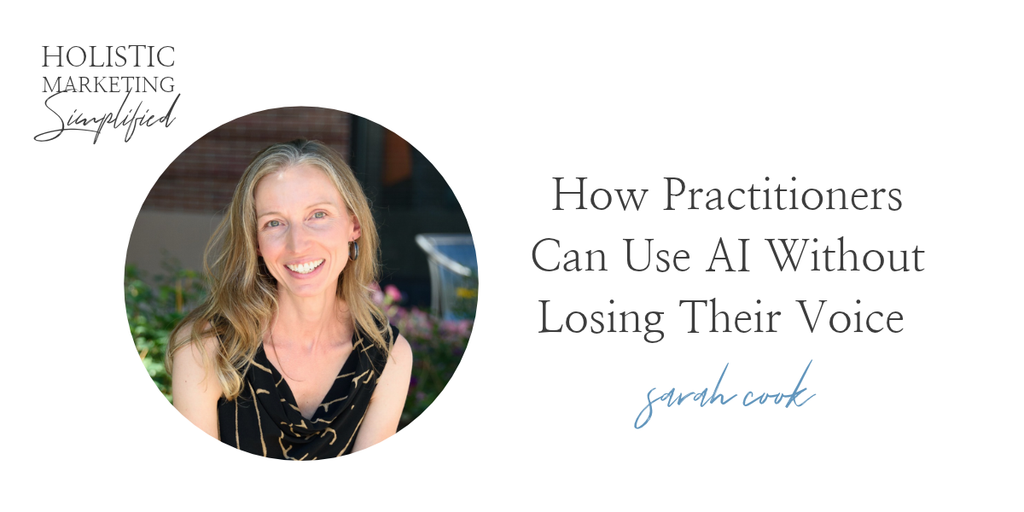
How Practitioners Can Use AI Without Losing Their Voice with Sarah Cook [Episode 184]
Subscribe on Your Favorite Podcast Player
Apple Podcast App | Spotify | Stitcher
AI is changing SO quickly that sometimes I feel like I need a full-time job just to keep up with what’s happening.
And I’m someone who actually uses AI in my business!
But here’s what I keep coming back to: just because AI can create your Instagram posts, write your emails, and practically run your marketing doesn’t mean you should hand over all your thinking to it.
That’s why I invited my friend Sarah Cook back to the podcast.
Sarah is a former naturopathic doctor turned copywriter who specializes in helping holistic health and wellness practitioners communicate their expertise. She’s spent the last decade writing websites, sales pages, and email promotions for practitioners, and now she’s helping them use AI without losing the personality, knowledge, and perspective that make their businesses unique.
We talked about what’s changing with AI, how patients are finding practitioners differently, and how to use these tools to make marketing easier without sacrificing the trust you’ve worked so hard to build.
And thankfully, you don’t need to become an AI expert to do any of it.
Your Expertise Should Come Before the AI Tools
One of the first things I asked Sarah was how practitioners can keep up when the technology changes every five minutes.
One day everyone’s talking about custom GPTs. The next day there’s a new feature, a new agent, or some completely different way of doing things.
How do you avoid spending hours learning something that might be irrelevant six months from now?
Sarah’s answer was something I LOVED because it’s exactly how I think about AI, too.
Focus on the foundational information that makes your business unique.
Before you ask AI to write anything, it needs to understand who you are, what you believe, who you serve, how you approach your work, and what makes your expertise different from everyone else’s.
Sarah shared an example of an acupuncturist and functional medicine practitioner whose combination of expertise is incredibly specific. They took her existing podcast episodes and used them as source material so AI could understand her approach instead of generating generic wellness content.
And that’s the part that won’t become outdated every time a new feature launches.
Your experience, perspective, and expertise are the foundation. AI is simply a tool to help communicate them.
The Three Things AI Needs to Create Content That Sounds Like You
Sarah calls her approach copywriting co-creation, and she broke it down into three pieces.
The first is your source material. These are your actual ideas, experiences, expertise, stories, and opinions. Instead of asking ChatGPT or Claude to come up with something from scratch, you’re giving it information that could only come from YOU.
The second is your system or instructions. This is where you tell AI how you want something done. Maybe you have a specific format for your weekly newsletter or a certain way you like to structure an Instagram carousel.
The third, and arguably most important, is human review.
You still need to read what AI creates, fact-check it, and decide whether it’s something you genuinely want to put your name on.
This is exactly how we approach content creation in my Instagram management agency. A human works with AI to create the content, reviews it, and then another person on our team reviews every single post before it goes to the client.
Because AI can help you create something faster, but it can’t replace your judgment.
And let’s be real, AI also has a tendency to tell you that every idea you have is AMAZING. Sometimes you need another actual human to tell you that your headline isn’t quite working.
You Don’t Have to Choose Between ChatGPT and Claude
If you’ve been wondering whether you should be using ChatGPT or Claude, Sarah had some reassuring advice.
Pick one and get comfortable with it.
She uses both, but she doesn’t believe practitioners need to constantly switch platforms to keep up with whatever everyone else is recommending.
What matters more is the information and instructions you’re giving the tool.
If you’ve already created your brand messaging documents, gathered your source material, and figured out how you want AI to help you, those things can be useful regardless of which platform you’re using.
And please don’t let the constant stream of AI updates make you feel like you’re falling behind.
I have intentionally removed myself from parts of the AI conversation online because it’s so easy to start feeling like everyone else knows something you don’t.
You don’t need to understand every AI feature. You need to understand how the tools can help YOU communicate with your patients and market your practice.
AI Is Changing How Patients Find Your Practice
This was one of the most interesting parts of our conversation because we weren’t just talking about using AI to create content.
We were talking about how AI is changing marketing itself.
Sarah pointed out that people are increasingly using AI-powered search experiences and chatbots to get information, including answers to health-related questions.
That changes the way we need to think about being discoverable online.
Instead of someone searching Google, clicking through several websites, and deciding which practitioner to contact, they might ask an AI tool for recommendations or information directly.
And those tools may be looking at information about your business across multiple platforms.
That’s why consistency in your messaging is becoming even more important.
Sarah gave an example of a practitioner whose LinkedIn profile describes them as a personal trainer, Pinterest says they’re a health coach, and Instagram says they help moms with nutrition.
If your messaging is completely different everywhere, you’re making it harder for people, and potentially AI-powered search tools, to understand what you actually do.
One simple exercise Sarah suggested is opening a private browsing window, using an AI tool without signing into your account, and asking what it knows about you or your business.
See how you’re being described. Look for outdated information, inconsistent positioning, or areas where your expertise isn’t coming through clearly.
You might discover that a few small updates across your website and social profiles could help create a much more consistent picture of your practice.
Your Marketing Needs to Be More Specific Than Ever
Another thing Sarah and I talked about is how generic marketing messages are becoming less effective.
Think about phrases like “personalized care,” “comprehensive wellness plans,” or “helping women feel their best.”
Those descriptions might be true, but they don’t necessarily tell someone why they should work with YOU.
Especially when people can ask AI for a personalized-looking plan or a list of general wellness recommendations, practitioners need to communicate what makes their actual experience and expertise different.
Maybe you’ve spent ten years working with a particular patient population. Maybe you combine several approaches in a way that’s unusual. Or maybe you understand a very specific frustration your ideal patients experience.
Sarah and I talked about how powerful it is when someone sees a post and immediately thinks, “Wait, how did you know that’s exactly what I’m dealing with?”
I shared an example of seeing a post about being able to poop on vacation. It was so specific to something I experience that I ended up buying the product being recommended almost immediately.
The creator wasn’t simply talking about gut health. She was speaking directly to a very specific experience.
That’s the difference.
And when you understand your ideal patients at that level, you actually have MORE content ideas, not fewer.
AI Should Help You Express Your Ideas, Not Replace Them
I told Sarah about a creator I saw recently who proudly announced that she hadn’t had an original idea in three months because AI was creating everything for her.
And I just kept thinking, is that really something we should be celebrating?
I don’t want to stop having original ideas.
I don’t want practitioners to stop sharing their actual experiences, either.
But I also recognize that writing comes more naturally to some people than others. I’ve always loved writing, so it’s easy for me to say I’d rather write something myself.
Meanwhile, there are brilliant chiropractors, acupuncturists, and other practitioners who are incredible at what they do but struggle to put their knowledge into words.
That’s where AI can be genuinely helpful.
Sarah shared an example of an acupuncturist who told an AI tool a story about something exciting that had happened in her practice. The tool helped turn that story into an email that still reflected her experience, her expertise, and her excitement.
The ideas came from the practitioner. AI simply helped organize and communicate them.
I’ve done something similar when I have an idea for an Instagram carousel. I’ll open Claude, share a stream-of-consciousness brain dump, and ask it to organize my thoughts without changing my words.
That’s a very different experience from asking AI to invent a week’s worth of content without any input from you.
Don’t Forget About Marketing That Happens Offline
With all this conversation about AI, I loved that Sarah brought us back to something incredibly simple: relationships.
You can spend all your time trying to figure out how to get AI tools to recommend your practice, but the technology and the rules around it will keep changing.
What doesn’t change is the value of connecting with actual people.
Sarah mentioned podcast interviews, collaborations, public speaking, community events, and in-person workshops as ways practitioners can build visibility without depending entirely on an algorithm.
She even shared an example of an herbalist hosting a holiday mocktail workshop.
How fun is that?
These are the kinds of experiences that help people get to know you, understand your expertise, and build a relationship with your practice.
And especially in holistic health, where trust is such an important part of choosing a practitioner, I don’t think we should underestimate that.
You Can Use AI Without Becoming an AI Expert
Toward the end of our conversation, I asked Sarah whether she thinks it’s realistic for practitioners to decide they’re simply not going to use AI.
Her perspective was that AI is becoming so integrated into everyday technology that avoiding it entirely may become increasingly difficult.
But that doesn’t mean you need to use it for everything.
Maybe you love writing and don’t want AI touching your creative work. That’s fine! There are still plenty of ways these tools might help with other areas of your business.
Or maybe writing is the thing that takes you hours, and having AI help organize your ideas means you can finally send that email newsletter you’ve been putting off for six months.
You get to decide where it fits.
The important part is remembering that your knowledge, creativity, and relationships are what make your practice valuable.
AI should support those things, not replace them.
Sarah and I actually talked about this topic way back in Episode 103: Embracing AI while Keeping Your Creativity & Authenticity. The tools have changed a LOT since then, but the importance of bringing your own perspective into your marketing hasn’t.
And if you want to start getting more specific with your messaging, Sarah has a free website messaging audit prompt available at Wellness Writer. You can use it with ChatGPT or Claude to identify generic messaging and uncover what makes your practice different.
Because at the end of the day, I don’t think the goal is to have AI create more content just for the sake of creating more content.
It’s to make sharing your expertise easier so you can spend more time doing the work you actually love.
Connect with Sarah
Connect with Molly
Instagram | Facebook | Youtube | Holistic Marketing Hub
The Holistic Marketing Simplified Podcast is brought to you by Holistic Marketing Hub, our hybrid program that supports you with personalized coaching, caption templates, and virtual classrooms. In this program, we teach health and wellness professionals how to fish, but also bait their hook!
Make sure you’ve hit that follow or subscribe button on your favorite podcast player to get notified each week as we air new episodes!
Episode Transcript
Molly: Okay, so today's episode is with my friend Sarah Cook. She's been on the show before. She actually used to be a naturopathic doctor, and then she turned into a copywriter, and now she's using a lot of that experience to kind of, like, really talk about how we can still use AI, but doing it in a way with integrity and without losing trust.
And she is ki- she's like my ... You know how you have, like, that one person you go to about a certain topic where you're like, "Okay, I trust their judgment"? That is Sarah for me when it comes to content creation with AI. Now, she doesn't get into, like, the admin side of AI or, like, here's everything you can do with AI or agentic AI.
That's not Sarah. She's very much in the, like, not losing your voice, harnessing your own unique story, expertise, IP, and just using AI in a way to help you kind of, like, bring that message out, like I said, in a way that's, like, still in integrity, um, because, you know, they say we're in a trust recession now because of all the, of the AI.
What, what's an old lady way of saying that? Um, so yeah. So I think you're really gonna love this episode today. She's kinda taught me a couple things that I didn't know. Enjoy.
Hey, welcome to Holistic Marketing Simplified. This podcast boils down to the fact that we wholeheartedly believe that more humans need to know about holistic health solutions, and you didn't go to school to learn how to be a full-time content creator and show up on Instagram and do all of this marketing stuff all day, every day.
So let's come hang out while we chat all things easing your marketing, and my goal is that you shift your mindset around your marketing from a, quote, "should" to a, "I get to." More dream patients and clients? Yes, please.
Morgan: My name is Morgan Adams, and I am a holistic sleep coach in Richmond, Virginia, and I listen to the Holistic Marketing Simplified podcast.
Molly: All right, Sarah, take two. Welcome to the show. I'm saying take two 'cause, I mean, longtime listeners of He- will know I love filming outside. Um, especially, like, it's, like, October in Ohio, and we don't have many weeks left of where I can do that. And so, of course, the minute I hit record, my next-door neighbor decided to cut his grass, so Sarah, thank you for your patience.
Sarah: All good. I'm so excited to be here.
Molly: Yeah, welcome back to the show. So I've had Sarah on before. I'll have, um, my... I'll have Haylee, my editor, link it in the show notes 'cause it was a while ago.
Sarah: I don't even think we were- Don't even bother linking. Probably whatever we talked about is not relevant anymore. I feel like we went super-
Molly: Wild
Sarah: deep on, like, what is the deal with ChatGPT at that moment in time, so. Oh
Molly: my God, I think we did. It was custom GPTs. I think that's what we talked about, which are gone now. So forget that one. But okay, actually, that's a... Well, first introduce yourself, and that's kind of where I want to start. 'Cause I don't want people to think, "Well, why will I even listen to this?"
'Cause it's just gonna be outdated." But Sarah and I have already talked about that, and this is gonna be, like, a, a, a tran- a transcending... Like, we'll talk about what's the latest, but we'll also just talk about some basics, so.
Sarah: Okay, awesome. So with that. Hi, I'm Sarah. I am a copywriter, uh, for holistic health and wellness practitioners.
I am a former naturopathic doctor, and really, I've, I've made many pivots. I- hi, pups.
Molly: Yep, and the dog's barking now. Go ahead.
Sarah: Many pivots. I've made many pivots over kind of the course of my professional life. But last 10 years have really been focused on copywriting, writing sales pages, uh, writing email promotions, writing websites for naturopathic doctors, functional medicine practitioners, and the like.
And then most recently, I brought AI into my offerings, and so I'm running some programs that really help practitioners create content leveraging AI, but in a way that really keeps them at the center, keeps their human uniqueness at the center, just really trying to leverage these tools that we have available in a way that's not gonna erode trust with their clients or their patients, and in a way that's really just going to save time and help them create content that really feels like it more comes from them.
Yeah, kind of like bridging into this new era together.
Molly: I have so many things I wanna ask you and talk to you about, I don't even know where to start. So I'm gonna start with the fact that it's so funny, I just got back from a retreat in New York with my business coach, and she had a lot of her... It was like 15 of us, I think, her clients out there.
And one of the, one of her other coachees is a copywriter, and I was like, "I am so interested to talk to you about how, how AI has transformed your work, your day-to-day." She's-- I was like, "Do you hate this question?" She's like, "I love this question." Um, because she said she feels like people are actually coming to her.
Like the people that come to her now, she's like, "Are such good quality clients because they see the benefit of, like, having that humanness." And she's like, "It's not like I don't use AI," but it's kind of like with you, it's like there's a way to do it. And do you find that so many people are still just kind of like opening up a chat and going, "Write me a post about XYZ"?
Is that still a thing? I
Sarah: think a lot of people are still doing that, which is- Yeah ... but, but the thing is, I think that the tools have just been changing, developing so fast, that if you haven't been paying attention at all, you don't realize that there's actually ways to bring in so much of your own source content, your background, how you want things done, and you-- there's ways to really, uh, set things up that are so much more customized to you already to n-not be starting explaining your business from scratch every time, and those sorts of things with the, with the ChatGPT or Claude.
Molly: Obviously, I, I wanna ask you about, like, what's new, what's changing, what's the latest. But before we do that, I do wanna, like I said, go back to what we talked about, how you were like, "Don't even listen to the old episode. It's irrelevant." Like, how, how do you stay-- I, who, I was just talking to someone who got, like, an agentic AI certification from Harvard, and she was like- Okay
"Yeah, a lot of the training is on, um..." It wasn't clutter, it was, um, hygiene. Have you heard this term? Basically, it's like, how do you make sure that you're not, like, putting all your eggs in one basket, and you're building this tool that's, like, like custom GPTs, and then they go away, and you're like, "Oh, I've gotta start from scratch," basically.
So it's like, how do we make sure that the foundations that we're learning about AI continue to be relevant as the technology continues to change?
Sarah: I mean, that's a fantastic question. Yeah. I think that that's really, I think, a huge focus of what I am doing with my clients. Because the fact is- I'm not a-- I'm a messaging person, copywriting person first, and I'm bringing the AI tech into it, which is important distinction that it's not the other way around, I think.
You know, I am not super-duper techy. I'm not coming in and, you know, I'm not building out entire agentic operating systems. Like, that's not at all what I'm doing. What I'm doing is really helping holistic health and wellness practitioners leverage the tools in just, like, the simplest ways that we can to make it easier to do things like our messaging, our copywriting.
One of the things, like for example, ChatGPT just released these things called Dots. And so essentially, like anybody can turn on an agent for themselves. Essentially, like, you know, a couple of clicks, and you have your own agent who can go out, work on your behalf, do all these complicated tasks for you.
And the fact is, because AI is becoming so much more... Actually, in that example, that's like actually really, really easy to turn on an agent where it used to be this complicated setup. But to me, that is all the more reason of why it's so important we actually do really foundational pieces first. Because if it's so easy to just turn on an agent and be like, "Hey, go out and figure out my Instagram strategy and create all my posts and schedule them for me and do all these things," but it doesn't have any source foundational material about you to begin with, well, now it's easy to kind of turn something on that's easy to run that runs on generic.
And so yeah, I think like a huge piece of what I'm doing with my clients is what is that source material that AI needs? It needs it now, it needs it no matter if we're using custom GPT or a project or a skill or an agent. There's certain information the AI needs to know who we are, what we believe in, what we're about, what our messaging pillars are, what we care to talk about, what our expertise is, what's so unique about us.
Like, we have to get all that in place and then that- kind of source material is gonna be a foundation no matter how the tools change. Mm-hmm. So I think, like, a really great example of this is my client who is a, uh, like, she's a acupuncturist plus functional medicine. She's got this, like, really unique set of skills-
Molly: Mm-hmm
Sarah: between Chinese herbs, functional medicine, acupuncture, all these things. And, like, nobody else can replicate that really unique set of expertise that she has. And so what we did is we take her, she has a bunch of, uh, podcast episodes recorded over the years. She has kind of this baseline of, we took all those podcast episodes, and then we put it in as these context files and information for the AI to know who she is, what her expertise is- Right
what she talks about, right? You know, that sort of kind of gathering your source material is, is just incredibly valuable for the AI so that it's starting from you in start up, instead of starting from generic.
Molly: You know, well, you answered it. Like, how do we do things that stand the test of time? And I think, like you said, it doesn't matter what the latest and greatest, like, feature is.
The thing that stands the test of time is it be- is whichever tool you use, whether it be ChatGPT or Claude or whatever, I don't know if you have thoughts on those, that it's well fed, I always say, and trained on-
Sarah: Yeah ...
Molly: your unique IP.
Sarah: So what I would say, so here, so I call this copywriting co-creation, just that's what I call it, where it's like, oh, we're working together with the AI to create the content.
And with copywriting co-creation, I always say there's these three areas essentially that your AI needs from you, the human. So one is what I just talked about. It's the source material. It's your ideas, okay? Number two is the actual system, so the instructions, how you want it done, or how you want it formatted.
So that's like this is how I want my email newsletter formatted every week, and a lot of times You know, those instructions, again, maybe it will change how we provide the instructions. It used to just be in a prompt. Now it's a lot of times in a skill or whatever it is, but we need to actually tell the AI how we want something done.
And then the final thing is really your human review. It's the standard that you're holding it to at the end to be able to say, "I really want to put my name on this." And I think we always, like, with creating content, with creating copywriting, of course, you always 100% have that human review, not only for, like, fact-checking, like, making sure it's real, but adjusting and making sure it sounds like you.
And so those are really, like, the three pieces where I think the human always has to come in, and those, I think that's going to hold true regardless of how the different tools change and how we use them. We always have to figure out how are we gonna give the source and the instructions, and then that final human review.
Molly: Well, and that's exactly what we do in our Instagram management agency. Like, we're busier than ever. I had a very, very, very AI savvy friend be like, "Oh, well, I just figured, um, that people wouldn't want that anymore." I'm like Oh, they want it now more than ever because it's that hu- like you said, that third piece of discernment, like that human review.
It's like, have we been able to do things a little more, like, efficiently? Yeah. But at the same time, we also... I'm everyone's ideal patient. You know what I mean? So, like, I come at it from a unique lens, and I'll personally review every-- And I have another girl on my team. We literally personally click on and review every single post that a human has created.
So it's like we have, like, two layers of QA, essentially. It's like a human works with AI, as you said, to co-create. They check it. We're a second set of human eyes, and then it goes to the client. So I, I love that you said that, like, human discernment piece.
Sarah: And I think, like, I'm doing this a lot with actually helping practitioners set up their systems with AI, create their content.
But even for them, like that final layer of human review, that's why I do copy reviews all the time for them. Mm-hmm. Because the other thing that can happen, I think, with AI is that it tells you how great it is. It tells you how great your ideas are. You're thinking that what it gives back to you is beautiful, right?
Partly because it tells you it is. It's great. And so, um, I think it's also helpful to, yes, you know, if you're creating your own content, looking at it and doing that human review, but also especially the important pieces, rewriting your website or something big or a sales page, to have another person put their eyes on it as well so that you're not in that feedback loop with your AI thinking- Oh, yeah
all of your ideas are so amazing, right?
Molly: I love when it said, like, "Great. Great work. Smart instincts, Molly. You're so
Sarah: smart."
Molly: Yeah, I know you can train it to be less, like, sycophantic, but-
Sarah: Or it'll tell you, "Yeah, this headline is so great," and then it's, like, not, you
Molly: know? Yeah. Okay. Well, I don't-- I know this is not what I want to spend this interview talking about, but I just know that people will ask.
Do you have a ChatGPT or Claude preference? Do you use it for some different things, different...
Sarah: Yeah. People ask this all the time. Yeah. But here's the thing is that at this point, they both can do all the exact same things. Right. Mm-hmm. Like, they all have all the exact same features. And so I don't have a strong preference.
I'm using both, in part 'cause I wanna be able to help my clients understand both. So no, I mean, I typically just say it is going to be easier for you if you just choose one and stick with it, 'cause then that way you don't feel like you're always bouncing back and forth. And I do think also what is more important is the setup underneath it, right?
As long as you're bringing to it your brand vibe kit, your brand messaging document, you're bringing to it your sets of instructions, your skills, it doesn't matter. Either way is totally fine.
Molly: Yeah, we just added two new Claude skills to the hub, and one of them is, 'cause you and I are both trained on story brand stuff, it's like a very story brand style messaging exercise that interviews them and it's set up for Claude, but we're also like, "If you wanna use this in ChatGPT, like go for it."
Like this is not an AI course. Like you said, I am not an AI expert. I don't even know what dots are. You, you, like I said, I'm not on the forefront of the happenings of AI. I, in fact, have had to multiple times remove myself from that algorithm because you just, it just starts to make you feel like you're the dumbest person who's so far behind and-
Sarah: I think that's right.
I mean, that's what's so, I think, yes, AI is like changing everything so fast, but I think we all just have to find our lane in it, right? And it's like, well, which pieces matter to me at all, right? And it's so, you know, your lane is Instagram for clinicians and chiropractors, and it's like, well, how does AI, how can AI help that?
And like similar for me. It's like- Yeah ... you know, how is AI changing how we have to do the marketing? How is AI changing how we can do the marketing? But like keep it focused on that lane, or else-
Molly: You
Sarah: get so ... here you are. You're just gonna feel like, "I'm 20 light years behind everybody else."
Molly: Even though you and I, like are like teaching this now and adding it to, well, you, you're more than me, me, I'm probably definitely like five steps, 10 steps, 25 steps behind where you are with your AI knowledge, but-
Sarah: It's that bad.
Molly: We, we still, the reason I'm always drawn to you is because you and I think about it, we have the same, I would say, like values around it, that it's like you've still got to have your human IP Front and center. This is all just r- instead of saving you time, it's just wasting you time.
Sarah: I mean, I think for me, and the reason that I've really, like, gone all in on like, yeah, let's bring AI into this, is because I see it actually, it- for the types of practitioners who've always been doing their own content anyway, they've al- they're kind of more solopreneur, solo practitioner, you know, wearing all the hats anyway.
AI actually has made it so much easier to bring more of themselves into their content and, like, you know, that, like, unique IP like you're saying, talk about their methodologies more clearly, like, it actually gives them a leg up they didn't used to have because it used to be, yes, like, they were trying to manage all of this and do all their content on their own, um, and just totally burning out on it, or going six months and not sending the email newsletter because of it.
And now it's like, oh, okay, I actually, I can set up a skill that knows how I want my email newsletter written. You know, I've got all my background information loaded, and I can just pop in and, like, voice memo, you know, "Here's, uh, something happened in the clinic this week. Can you pull this together in a newsletter?"
And it's done in 20 minutes. Like, this is a very, very different situation, having these tools available for that sort of thing. I really think even something where, you know, they're able to bring those types of ideas on the fly, you know, turn it into an email newsletter real fast in a way that they couldn't even do when maybe y- previously working with a marketing person trying to communicate to that person and the back and forth and like
Molly: Yeah.
No, you're so right, and I mean, that's one of my, this is probably, like, an outdated way to do it now. You can give me, like, live coaching but I used to always, like, open Claude or when, yeah, I've been on Claude for a while, and I'd be like, "Hey, I have an idea for an Instagram carousel. Please don't change any of my words, but help me clean it up and organize it."
Yeah. And I would just be like, blah, blah, blah, blah, blah, blah, blah, blah, blah. Like it was st- straight stream of consciousness, and then I was, I was usually, like, pretty, like, I would have to change the hook usually. But for the most part- And it was my words, but it was just cleaned up, you know?
Sarah: Yeah, and if we can use it in these really helpful ways, then great.
Molly: So, okay, so going, like I said, staying on this topic of knowing that it's here, there's nothing we can do about it, what do you find is kind of like the newest, I don't know, what's your new... You talked about the dots. What else is new? What's changing?
Sarah: Well, okay, so I look at what's new in how AI in two different areas.
I think we've been talking more about like, oh, what tools are available for us to use, and that's one area that changes really fast. But the other area that I look at is how is AI actually changing more the bigger picture marketing landscape? How is AI changing, like, how clients and patients find these practitioners?
How is AI changing how, you know, clients and patients find content, connect with their content, all of that stuff. So that's a piece that I think we have to really, really pay attention to, like you and I who are helping with the marketing piece, right? For example, one of the things I would say is, for example, just how practitioners get found.
Google's totally changed, right? Now Google has AI mode, and so we know that as of this summer they were saying that 68% of Google searches end with no click. That's a totally different situation than y- a year ago, six months ago, whatever. Because what's happening is- Oh ... we have Google AI mode. That's kind of the default.
So most people now, if they go to Google and they say, "Oh, what are some homeopathic remedies for pink eye?" Um, you know, it used to be maybe, like, some blogs would come up on naturopathic sites or whatever, right? And now it's just, oh, there's an AI chat starts to tell them like, "Oh, you would use Pulsatilla for this, and blah, blah, blah."
And so yeah, so, like, with Google Search changing so dramatically, I think that's something to think about is huge. Of course- I, I
Molly: didn't know that, by the way, so thank you for... I mean, I knew that Google had AI mode, but I didn't even think about it not leading to clicks.
Sarah: Yeah, and so it's really almost
Molly: become- It
Sarah: makes sense
the same, another version of a ChatGPT. Right. It immediately goes into a chat conversation most of the time, right? Yeah. There's still sometimes it goes to links, but rarely now. And along those lines, similarly, is we know more that it's, I think it was 34% of US adults are asking their ChatGPT health-related questions.
Molly: Mm-hmm.
Sarah: You know, of course, something we didn't ever have before. And so I think this difference is, like, it used to just be, oh, we're, you know, we're trying to get people to find our websites and click to our websites. Well, no, the game's really different now. It's actually getting these chatbots to talk about us and reference us, uh, which is a very, very different thing.
You know, even when you think about, like, email marketing, even Instagram, uh, you probably... I don't know that much about Instagram contributing to Google Search, but I just know you can connect your Instagram- Yeah ... and your Google- Mm ... Search Console. So now, like, the Instagram posts are somehow feeding into this whole bigger picture AI algorithm of search.
And emails. This was bonkers to me. Wait,
Molly: emails?
Sarah: Yeah. Stop it. So because, okay, because there are now multiple different ways people are using AI to help manage their email inbox, so for example, one of these is if you have Gmail, you can turn on some sort of AI mode that's called- Mm-hmm ... Personal Intelligence.
And if you have that turned on, they did this study where it, you would then go to your Google. If you were searching in Google, say you're searching for new shoes. If you had emails from Nike in your inbox, you're significantly more likely to get served Nike in your Google search. Insane, right? So there's like this, to me, all this is kind of like it's actually more holistic.
Like, if you look at your- Mm ... you know, your digital footprint online, these AI tools are, are able to kind of like scan the whole internet in a few seconds, find you everywhere, sum up what you are, and then look in this person's inbox and, you know, see if it's relevant to them. It's this much more like holistic, yeah, search of Yeah, even if you're thinking of practitioners, it's like so different than just being like, "Oh, your About page was found when they searched."
Molly: Yeah. Yeah, and well, you asked about Instagram. This is, it's funny because I've been talking about it in my marketing some, but I should be talking about it more because it's so cool. I'm like, it used to be you posted on Instagram, and if your ideal patient or client happened to be scrolling Instagram and seeing your content, then that's when they saw your post.
Now, it's like you're Googling, you have an Instagram post that happens to answer that exact question, your Instagram post shows up in the Google results. Like-
Sarah: Which is actually
Molly: really, really
Sarah: cool. Yeah ...
Molly: oh, so cool. Yeah, yeah. This is what I'm telling people, and you- well, you just put out a post today about the specificity of your messaging going on all of your platforms, which I think was, which I thought was really cool if you wanna talk about that.
You said like consistency or something across- Exactly ... all platforms. Yeah.
Sarah: So because, okay, and you can do this, you know, little exercise, just ChatGPT yourself basically, right? Mm-hmm. So find an, go to incognito window so you're not influencing the results. Do not log into your ChatGPT, so you're totally going generic, and just ask for your name, right?
Like, "Who's Sarah Cook of Wellness Writer?" And just that exercise, you're gonna see how ChatGPT does almost this sweep of like, I found that somebody had mentioned me on LinkedIn, which of course-
Molly: Wow. Yeah ...
Sarah: I would have no idea, right? And so it kind of does this sweep where it's looking, and the reason it's so important then that you're consistently having the same phrasing.
Like, if you're positioning yourself as it says you're a personal trainer on your LinkedIn profile, it says that you're a health coach on your Pinterest, it says you help moms with nutrition on your Instagram, the AI is going and reading all this. How is it gonna know who to serve, you know, who you are, who to send you out to the people, right?
And so
Molly: that- That's just like the goal. If we were gonna pull a sound bite, that was the one right there that we would pull. That's so good.
Sarah: So ima- you know, I think even that simple kind of a quick cleanup of your own digital, uh, footprint to the extent that you have control over it is really, really useful because these AI tools are looking at all of it and synthesizing it, and you don't wanna create confusion.
Molly: You know what I find funny, though? This has nothing to do, I mean, it has a lot to do with our conversation, but nothing to do with our conversation from the practitioner point of view, is I find if you're, let's say that, like you said, you're an acupuncturist, and you were to ask Google AI mode, um, or ChatGPT, like, "What are some good herbs for XYZ?"
You would like m- probably not completely agree with what it comes back with, right? Like you, yeah. Yeah. You know, you, you might be like, "Ugh," and yet I find that people do that when it comes to things like marketing. They're like, "Well, Claude said that I should do this with my Instagram," and I'm like, "Uh, no."
You know? Like, sh- and it's not me trying to be, "Oh, you must come to me for information." It's just like, I'm only saying that as it's just how funny how there's, like, a double standard sometimes, and you have to be a smart user on either side. You know
Sarah: what I'm saying? I
Molly: think
Sarah: it's happening across all industries.
Yeah. Yeah. And, and this is something that I'm really talking to practitioners about as well, is that their messaging does have to make sense to people who are... We have to assume that people are going to ChatGPT and asking for herbs for this and homeopathics for that, and how do I do my nutrition for this?
We have to assume that. And then the practitioners, we need to make sure their messaging actually speaks to people, um, in a way that would, would make sense even after, maybe after someone has their whole plan they think they need to do from ChatGPT, how do you position yourself as the next best step?
Like, how do you do that? Like- Yeah ... I think every, every industry probably has to, has to deal with this at some, to some extent right now. But for practitioners, I think it's things like, you know, you can't use, you can't keep saying, "Oh, I, I offer a comprehensive, personalized plan. That's why I'm so different than your regular doctor."
And it's like, that's not enough right now. What is it that, yeah, like really it's more like, "Well, I've been working with women with IPS for 10 years, and I have dialed in the exact protocol that works, and I'm gonna tweak it for you until you get your results." Like, that's the type of messaging we have to go into instead of, you know, comprehensive, personalized plan.
Molly: Oh my gosh, I love that you said that. So but I, I just bought, they're still sitting in my cabinet 'cause Probiotics are something that I think get over-hyped sometimes, you know? But I just so happened... It's like, you know, every time I go on vacation my body's like, "Nope, we're not pooping." Like, "No, thanks."
And so I happened to see a, a hook. It was during that kinda chic, uh, trend that went around. Right. And it was like kinda chic to poop on vacation. And within 10 minutes I had added the product she was recommending to my cart, had checked out, and like this thing was on its way to my house. Because it's not like she was like, "I help women with their gut health."
You know? It was so different. So how do you help people draw out that type of specific messaging?
Sarah: This is something that is just, for one, is really specific to each practitioner. I feel like there's this piece of, well, what is it that is so unique about how you do things? How do you do things different than every other acupuncturist on the street?
A lot of times it's a unique combination, you know, like I just mentioned where she's doing Oriental herbs as well as functional medicine tests, right? A lot of times it's like a unique combination. And to your point, the exact example you just gave, that's like the identity of your client is so important.
Like, that post you just said, that was speaking to the identity of your client when they see so chic to poop on vacation, they're immediately like, "That is me," right? And so yeah, it's getting so clear on like really knowing the, knowing the psychology of your, of your ideal clients. I mean, this is a whole, you know, masterclass in and of itself, so.
Molly: Yeah. Yeah. I mean, it's, it's the foundation of what I know in my program and your program. It's like drawing out those, you know, that scene content as they call it. It's like you want someone to be like, "Are you hacked into my Blink camera?" Like, "How did you know that's what I'm experiencing at this very moment?"
And the beauty of being so specific in your messaging is like you will never run out of content ideas ever again. W- I think a lot of people's creativity gets stunted when they go so broad and they're like, "Oh, I help women's health." And you're like, "All right. Now what do I post about? 'Cause I've posted about women's health."
It's like, "Oh, we have about a thousand different things that we could say," you know? Mm-hmm. Okay. Here's like the million-dollar question, and I could see this depending on who you're serving, right? Like, depending on the type of practitioner, but do you think it's realistic for practitioners to decide just like, "I'm not gonna do it.
I'm not using AI"?
Sarah: Okay. I love this question, actually. I just, I have to tell a quick story that to me, I just, it, I cannot stop thinking of it in any other way now. So I, uh, went to view the documentary, it's called The AI Doc. Do you know of it or have you seen it?
Molly: Mm-mm.
Sarah: Mm-mm. Okay. Well, just, it's a documentary that's really just looking at, it has all these AI experts on there, ins- including some of the top ones like Sam Altman, but they're in- interviewing all of these people in the AI space of like what direction is this really going?
Like, is this gonna actually exterminate all of humanity? Or, you know, is this actually going to lead to this, you know, most beautiful planet we've ever lived on? And so it's, it's kind of looking at like w- the big picture of AI. End of the documentary screening, it was kind of with a group that's called the Rocky Mountain AI Interest Group, 'cause I'm here in Colorado.
And so this guy, he takes the mic. He goes, "Well, we're here with Rocky Mountain AI Interest Group tonight, but I was a founding member of a similar group in the '80s, and we were called the Rocky Mountain Internet Users Group." And that phrase just like lives rent-free in my brain since that point, where it's like if we're saying, "Well, I'm not using AI.
I'm, I don't ever have to figure this out," that's like saying, "I'm not gonna use the internet." I think we're already at that point where it's already integrated so much into how we function, and it's going to be more and more to where I don't think it's ultimately gonna be a, a choice to say, "I'm not gonna use the internet.
I'm not gonna use AI." So- Give me the
Molly: Yellow Pages.
Sarah: Yeah. So given that, however, it's like almost kind of what we mentioned already, is like, well, then we have to figure out in our little realm, in our little sphere, like how do we wanna navigate it, right? So for you, like how you're navigating it in creating Instagram content and helping your members do it, and similar for me is like, how do I wanna navigate it with this content creation piece and messaging?
I think everyone has to then, you know, figure out how they're gonna navigate in that, in their sphere. At the same time, we don't need to become AI experts, right? Like, we all use the internet now, and we're not internet experts. And so I think that's the other thing, that AI is getting easier and easier and easier and easier, to the point where we're just gonna be using it.
It's not even gonna be a second thought. I know there's certainly a group of people who are so adamantly against it, but to me, that's not realistic.
Molly: Yeah. Like, you can be against it all you want, but it ain't going anywhere, so. Yeah. I guess that's, like, a perfect segue into my, this question is, how do you find the balance of using AI with integrity and not losing trust?
Because you've heard the tru- that we're in a trust recession, I'm sure. That,
Sarah: yeah.
Molly: Yeah. Exactly,
Sarah: yeah.
Molly: Yeah.
Sarah: Well, it's what we talked about at the beginning. If you're gonna say, you know, if you're gonna create your content, and this, these are probably the accounts that you have blocked, right, that you don't wanna watch.
But the accounts who are saying, "I've turned Claude into doing all of my Instagram, and basically I don't touch it," right? Claude goes out, finds the, the ideas that are going viral, recreates them for me, scheduled them, you know, I don't touch it, blah, blah, blah. Well, that's not how we do things around here,
Molly: right?
Like,
Sarah: that's like, we know how... That is not, to me, that is not, especially, you know, we're working with practitioners who it's, like, so critical that they are building rapport and trust and relationship with their clients. Like, it's just so critical that as we use these tools, we're, we're bringing ourselves into it, and, you know, that's kind of the, we, we already talked about at the beginning, and how, you know, you talked about, oh, you have this idea.
You brain dump it into Claude. This is actually your experience and your thoughts and your ideas going into the caption, and ultimately we have to be careful just not to go down the slippery slope of letting AI take away our actual thinking.
Molly: I, um, exactly what you said, I have blocked... There was a creator I was following 'cause she did, she used to have really good Instagram and sales tips, and she posted a reel the other day, and I just kept thinking to myself, "Surely this is not what she meant to type."
And it literally was like, "I've trained my Claude," blah, blah, blah, and then it said, "I have not..." I just looked it up. That's what I was looking at when you were talking about it. Okay,
Sarah: yeah. "
Molly: I have not had an original idea in three months." That was the hook of her post.
Sarah: That's the hook?
Molly: And I was like, "Honey, I don't think that is the flex that you think it is."
Like Surely that's not what you were, like, trying to say. I just have to keep trying to give her the benefit of the doubt because I'm like, "That can't be what you meant." Like, that's a flex. I haven't had an original idea in three months because Claude is scraping all my coach... It was t- how she feeds her coaching call transcripts and all this.
Ah. And I'm like, "I have no desire to learn from you." Like, I don't want to.
Sarah: Exactly.
Molly: I, I screenshotted it, and I'm not someone who, like, is gonna, like, post it and show, you know, whatever. But I just had to screenshot it to be like, am I the Luddite, and am I the old lady going, "What's this internet thing?" You know?
But, like, I don't wanna not have an original idea for three months.
Sarah: That is terrifying. Oh, one final, one other side comment, which I think is so important right now with AI changing all of these things, is that we also just need to lean into those pieces that's not dependent on AI or the internet.
Molly: Hmm.
Sarah: Like the relationship piece of, especially because, well- You could go all in and try and be like, "I wanna have ChatGPT reference me," and then all the rules change around that in a month, right? And so I feel like we can't be putting all our eggs into just the internet basket of like, "I want AI to find me."
And that's where we have to be incorporating just, like, ways to be visible outside of that. And so podcast interviews, like we're doing, and yeah, like connecting, collaborating, like doing public talks. A lot of times if you're, you know, a local clinic doing, like, live workshops in person, like fun things.
Like, I went to one last year where it was like how to make mocktails for the holidays, and it's an herbalist, and it's like, oh, it draws people in. You're doing something. Fun. Yeah, like I think we need to be doing more of those types of things where it's like you're building community, you're building relationships, you're building visibility that's not totally dependent on, uh, a ChatGPT recommending you.
Molly: Well, so my daughter, who's nine, her babysitter is 19, and she was here the day I got off a discovery call with a new client who moved from a different agency to ours because not only was this other agency charging two and a half times what I charge, but it was like AI clone videos of her talking. And I was just like, f- I was like, "First of all," I was like, "y- I just need to make sure you know that I don't do that.
Like, I'm not interested in making an AI clone." But she was like, "Yes, that's why I'm- booked a call with you," right? My daughter's babysitter was like, "Oh, we hate I- uh, AI." And I just thought that was interesting. Like, she means like AI generated things. Right. And I have found even my nine-year-old going, "Ugh, that's AI.
Ugh." Which is- So I just think that's so interesting to know, like the younger genera- like people c- still are craving humanity, so it's like how do you like exactly what going tying this all together like how do you still use it as a tool? This is something I was telling my husband that I, you know, it's hard to kind of like empathize with someone who has like a very different skill set than you.
Well, I, you and I both like I, my degree is in PR so I was in the journalism school. I wanted to be a writer. Like I, I still wanna write a book one day. I'm a gifted writer. Like that's something I'm good at, right? Yeah. And so it's really easy for me to like poo-poo. I'm like, "Ugh writing, you know, 'cause I, on, with AI, 'cause I'd rather just write it myself because that's one of my talents.
And then I'm like, wait, but there's people who are so genius with their craft, but they're not good copywriters or good communicators, right? Yeah. And so this is helping them, like you said, like get out what is in their genius brain in a way that people can understand, and that was like a big shift for me.
So I don't know if you have anything to say on that.
Sarah: Oh, exactly. Yeah. It's exactly like what, a call we had in my community on Friday, and we were testing this, uh, story email writer skill. And so, like, I built the story email writer skill. It's like the frameworks of how to write a story style email. And then we tested it, and it was this, um, she's an acupuncturist specialized in fertility And the Skill just kind of interviewed her, and she shared like, "Oh, two of my, two of my clients got pregnant this week."
And she just, like she just kind of told the story to the AI, right? And then the AI wrote this email, and we read it out loud, and all of us were just like, "Hit send." It was basically, like it was like did not at all sound like AI, right? It's just like telling her she was really excited to share, and then she connected it to like a teaching moment of how she preps her clients for a couple months, and something that you can do now, and it was like this beautiful flow of...
But it was like totally from her story. And yeah, just like seeing those moments of where like her craft is, the acupuncture, the herbs, helping her patients with fertility, right? And if she's able to voice memo something real fast, and it's immediately turned into this now like marketing email that she can send out, that's exciting.
Molly: Love, yeah. Exactly. That's it. I love it. Okay. So, well, and I'll just say too, we, you and I are only just talking it from like a marketing copywriting standpoint. We're not even going into like the admin stuff it can help you with, and, you know.
Sarah: Right.
Molly: Like, even if you are a super creative person and you're like, "That's kind of my hard line, and I don't wanna use it for X," like you could, there's so many other things that it can help you with, so.
Like-
Sarah: I've been joking recently, I'm like, "Actually, using AI for content is the hardest thing to use AI for." Yeah.
Molly: Like,
Sarah: of course I'm gonna make that my thing.
Molly: Oh, I love, so I use Circle, that where's your community hosted?
Sarah: Kajabi.
Molly: Kaja- Okay, so I'm sure Kajabi has the exact same thing, 'cause they're all the same at this point.
But I wake up, I log into Circle, and it's like, "These 20 members are at risk because they haven't logged in in the last year." And I was like, "I didn't even ask for that. Thanks." You know what I mean? Like, so there's so many good things, like you said.
Sarah: Oh my God, so many fun little tasks I've just handed over to Claude, this and that, like completely unrelated to marketing or anything, and it just makes me realize like, okay, like the nuance of bringing your voice into it and your ideas and your expertise, like that's actually probably the hardest thing to get AI to do, and here I am like making it my thing.
Molly: But yeah, like I think about people who still, like if you're still seeing patients, like I'm sure there's a way to be like, "Hey," well, you can't obviously, you have to, I'm not a PHI expert. And I, but I'm sure a lot of the software now are being like, "Hey, this patient hasn't been seen in X amount of months.
Like, do you wanna contact them?" Like, huge.
Sarah: Well, Nicole Harlow is the one to talk to about that.
Molly: Oh, I just was on her podcast.
Sarah: Oh, you were?
Molly: Yeah, yeah, yeah. She's really cool. I think sh- you connected us, so thank you for that.
Sarah: Thanks.
Molly: But yeah, but I just think, like you said, even if you're kind of like, "Oh, my IP, my creativity is my line in the sand," like, oh my Lord, there's so many other things that you could be doing.
Sarah: Definitely. Yeah.
Molly: Okay. So where do you think it's heading next? We'll wrap up with that.
Sarah: It's going to agents. It's, it's, you know, e- everybody's gonna have an agent, everyone's have multiple agents. But the thing is- Yeah, and it's, it's just gonna actually get easier to use
Molly: How can people find you? How can they work with you?
Sarah: Sure. Um, wellnesswriter.com, that's my website, so everything's always there. There's like a freebie page and Instagram @sarahcook.wellnesswriter.
Molly: So what's kind of your ma- So this will air in two weeks.
Sarah: Okay, perfect.
Molly: So, um, is it-
Sarah: My freebie right now is a, um, a prompt to audit your website messaging.
Molly: Mm-hmm.
Sarah: And so it's looking for that kind of AI proof messaging. It's actually digging for the gold. So it's not only just telling you like, "Oh, this line about a comprehensive plan is generic." It's not just doing that. It's actually mining for the gold to help you find what is that unique message you should be highlighting in your messaging.
So yeah, it's just a prompt. It's like a copy and paste prompt that Claude or ChatGPT will just review your website and give you some ideas.
Molly: I love that. That's wonderful. All right. Like I said, I always look to you to know what's going on, 'cause I trust you and I trust your judgment, so thank you so much for your time today.
Sarah: Thank you for having me.
Molly: Thank you for listening to Holistic Marketing Simplified. And hey, you know how every podcaster at the very end of their episode asks you to rate and review their podcast? Well, that's because it's super important. These podcasts take a lot of time and heart and effort to produce to bring you free information.
So in order for me to be able to continue doing that, we need more people to find out about the show. So if you could, please just take like two minutes out of your very busy day to leave me a rating and share this on your Instagram stories and tag @mollyacahill. That's C-A-H-I-L-L. I would greatly, greatly appreciate your support.
I know your time is valuable, and I can't wait to see you in the next episode.