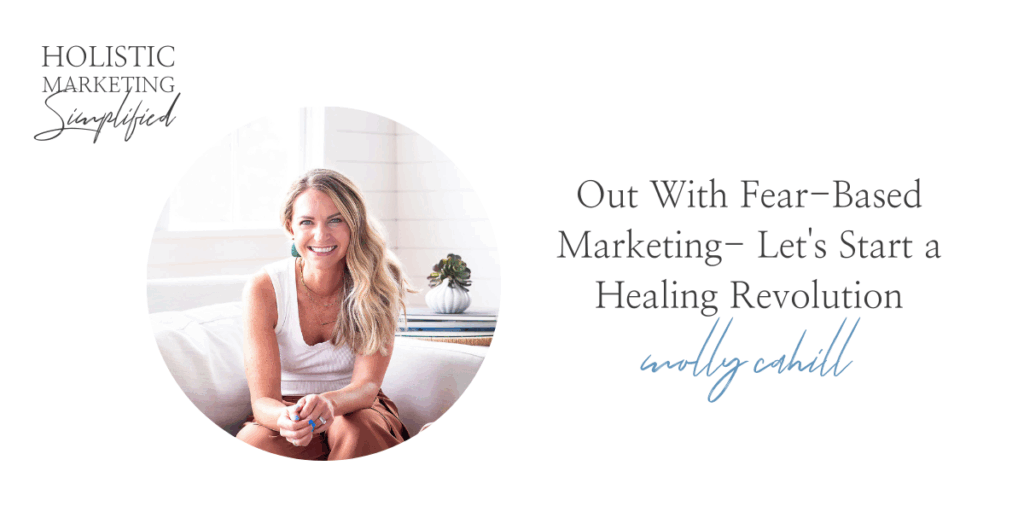
Out With Fear-Based Marketing- Let’s Start a Healing Revolution [Episode 135]
Subscribe on Your Favorite Podcast Player
Apple Podcast App | Spotify | Stitcher
If you’ve ever scrolled Instagram and felt worse about your health after seeing a post, you’re not alone. So much of wellness marketing leans on fear—“hidden dangers,” “toxic truths,” “what’s wrong with you”—and it’s exhausting.
In this heart-to-heart episode of Holistic Marketing Simplified, I’m calling for a shift. It’s time we stop feeding fear and start building trust. Let’s create marketing that supports nervous system safety and actually helps people feel empowered in their bodies.
Why Fear-Based Marketing Doesn’t Work
Fear gets clicks, but it doesn’t create healing. When we constantly frame health with “what’s broken” or “what’s dangerous,” we inadvertently train our patients to feel unsafe in their own bodies. That hypervigilance isn’t health—it’s stress.
And here’s the truth: your patients don’t need to feel “fixed.” They need to feel supported.
Shifting the Language: Before and After
Here are a few real-world examples I shared in this episode:
- Before: “Being tired as a mom is common, but not normal.”
- After: “Being tired as a mom is common (especially when your baby won’t sleep!). But if you’re always feeling drained, even with consistent rest, let’s chat.”
See the difference? Same education, different energy. The second version empowers without shaming.
Another example: when talking about toddlers falling multiple times a day, instead of scaring parents with “spinal misalignment” warnings, try:
“Kids are resilient. Falling is part of normal development. Regular chiropractic care helps keep their bodies flexible and strong.”
A Ripple Effect of Healing
This is bigger than marketing. The language we use ripples out into how people feel, behave, and interact with others. If your posts leave someone feeling safe and supported, you’ve already created positive change—not just for them, but for every person they interact with.
That’s how we start a healing revolution.
Wrapping It Up
Fear might get attention, but safety builds trust. As holistic practitioners, we have a responsibility to communicate in ways that empower, uplift, and regulate—not in ways that create fear or shame.
So let’s trade in “what’s wrong with you” messaging for “your body is wise” storytelling. Together, we can make marketing part of the healing process.
Connect with Molly
Instagram | Facebook | Youtube
The Holistic Marketing Simplified Podcast is brought to you by Holistic Marketing Hub, our hybrid program that supports you with personalized coaching, caption templates, and virtual classrooms. In this program, we teach health and wellness professionals how to fish, but also bait their hook!
Make sure you’ve hit that follow or subscribe button on on your favorite podcast player to get notified each week as we air new episodes!
Episode Transcript
Welcome back friends. So I've got a little bit of a like heart to heart episode for you today. It's definitely going to be like practical, like there's gonna be tangible things and that you can take away from this. I am just, uh, I'm recording this in the wake of everything that happened in Minneapolis last week, and it's just like, yeah, I just can't even talk about it yet.
Besides feelings of rage and sorrow and. Angst and fear and all of that. I feel compelled like, like our community, based on the number of downloads I get every week and followers I have and email lists and all of that, I think we can, we can start a little revolution in a good way and I wanna talk about that today.
This is gonna sound so like, I almost didn't record this 'cause I thought this is gonna, Molly, this is so silly. Like this is. This is gonna sound ridiculous. Do you really, like of course, I had those little monsters in my head, like, do you really think you're gonna make a difference? Do you really think this is gonna make a difference?
The things I'm gonna talk about today, and you know what I do. Um, so we're gonna talk about, I promise, like I said, if, if you're rolling your eyes and you're like, how does, how do these two things connect? We're gonna talk about. The language you use in your marketing and how I think that as wellness professionals, so many and, and I don't, I don't wanna say you because a lot of my audience actually I find don't fall into this camp.
So kudos to you, but I still think it's an important topic to cover and it's that fear-based, something's wrong with you, your inherently broken language that can be used in so much wellness, marketing. Like I said, this, like my brain at first is like, Molly, this is silly. This is ridiculous. Like you're making light of the situation.
But here's the thing. All of you know so much about the nervous system that you know that when we are operating from a different place, that our interactions in the world are different and better. So I am setting out to try to change people's nervous systems a little bit at a time. Not me having, uh, any credentials behind my name to do so, but to teach you how to just change your marketing in a way where you're instilling a sense of safety with people.
And therefore, I just really have, like, if you think about it, like think about my followers alone. Like I have 7,000 plus followers, right? It's like if 7,000 people just felt a little better about their day every day, and were just a little kinder to one more person. And then that person was a little kinder to one more person, and then that person was a little kinder to one more person.
Y'all can make fun of me roll your eyes and say, I'm being rah rah, all you freaking want, but I don't care because I think it makes a difference. So I'm gonna give some actual specific examples and not just try to make this obtuse and, uh, like I said, like a little armchair rant. But I really think it's an important, important conversation to have because I am absolutely.
Over fear-based marketing. I think some things that you might not even think about as being fear-based that you're putting out there are probably still giving people the sense of unease in their bodies. And like I said, from a like micro level, do I think it's like, oh, Molly is me saying this, this headline, like for example.
When I saw the other day that I immediately like blocked and unfollowed was like the hidden dangers of your child's picky eating. I'm like, oh, do I think like something like that's gonna turn someone into a, a psychopath who does unspeakable things like, no. But like I said, I've just decided to kind of push through that little person on my shoulder saying, Molly, this is silly.
This isn't gonna make a difference. Because like I said, I really think. The mass message that we're putting out and people, so many people are consuming what we say on social media that it can really make a difference. I hope this intro is not too obtuse and actually, like, I tried to outline this yesterday and I was just like, I can't, like, I just, I just gonna have to speak from the heart.
So let's get into it. Friends.
Hey, welcome to Holistic Marketing Simplified. This podcast boils down to the fact that we wholeheartedly believe that more humans need to know about holistic health solutions, and you didn't go to school to learn how to be a full-time content creator and show up on Instagram and do all of this marketing stuff all day, every day.
So let's come hanging out while we chat. All things ease in your marketing and my goal is that you shift your mindset around your marketing from a quote should to a I get to more dream patients and clients. Yes, please. Hi, I'm Dr. Amy Forrester and I'm a chiropractor in Kenosha, Wisconsin. And I listened to the Holistic Marketing Simplified podcast.
Okay. So I recently posted something, uh, I posted a story on Instagram about how this was a couple weeks ago, and I got six times my normal story views about how I am just so over like I unfollowed so many. Biohacking. I don't wanna lump all functional medicine in there 'cause there's a lot of great funked accounts and a lot of you do beautiful work with funked.
But I just mean like anything that made me feel like, hey, I'm actually starting to actually feel pretty good in my body. But then you see language like. The se the secret reason why you're congested? Um, because I'm congested a lot. I mean, I'm just using that as a, I've never actually seen this headline, but what's actually going inside your body that you need to address or like bad things are gonna happen.
Or like, I, I said this example in the intro, the hidden dangers of your child's picky eating. It's like, it's not that all of this information is not helpful, it's just the way that it's being framed is not conducive to actual healing. I don't even think this is an opinion. I would be as so bold to say that it is fact that the reason you see so many quote unquote wellness people who are the sickest people you've ever known is because.
Yes. On one hand, a lot of us come to this work, you know, I, myself personally, came to this work because conventional medicine failed me. It failed my family gravely, and I mean, I have, I, I could, I could take up a whole podcast telling you in the ways that. The medical system failed me and failed my family, and so I, I came to this work because it was something that was really deeply, deeply needed and nobody else was giving me answers.
And I found a lot of answers. And I, like I said, I, I, I found a lot of healing here. But then one day I looked up and I thought, I'm so hypervigilant now. Is that truly healing? Because I just had some lasting chronic things that just aren't or weren't going away. Right. And it was that hyper vigilance because every time you open Instagram, it's like.
Remember a few years ago it was like everybody needs a Burke. And then it was like, oh, because your water is, you know, filled with all of these bad things and are what? What kind of water are you drinking? Like scared to turn on your kitchen tap. And then everybody's like, oh, you gotta get a, and I never had a Burke.
I'm just using this an example. Then it's like, oh my gosh, all these people. Have mold in their Burkes and then like now Burkes being called, and then now there's marketing around, like I've been, I literally saw one that was like, I've been giving my family dead water for five years and our health has suffered and it's because I was giving them dead water and now I found this product and it's like talking about minerals and stuff.
And I'm not saying like, hear me, please hear me when I say that this is not. This is not bad information, right? Like knowledge is power and knowing these things can be really helpful. Like there's still people out there slathering themselves with bath and body work who just don't know any better, and that's fine that we're getting the information out there.
So please don't take this as me saying that you can't teach people things like this. But when I'm begging us, all to do is just start thinking about it and presenting the information. In a different way that leads from a place of, Hey, our bodies are freaking smart and we've got this, you're not inherently broken.
There's nothing wrong with you that needs to be fixed. Or like I said, I think what really, really gets me with a lot of the more sciencey, biohack, funked accounts is they'll take this one simple concept and then try to like, well, then it creates this, this chemical in your body and then this chemical, and then the down receptor of this one is this, and then the down chemical of this is this.
I mean, sure. But I've just done so much of all of the work that I've done, the things that have been the biggest needle movers have been the subconscious work I have done around trusting my freaking body again. And I just want you to sit with that for a minute. And like I said, I promise, I'm gonna give you some really specific examples, but I just.
I follow a lot of marketers and I, I didn't go back and finish the story about the stories I posted. I will in just a second. I follow a lot of marketers who are like, negative framing is in negative hooks are getting, like I saw somebody the other day say they were testing ads and this wasn't for anything health related.
It was business related. But it was like the ad where they were talking, like putting it in a positive light of like, Hey, this is how you're gonna feel when you implement my program, versus, uh, the ad that framed it in a negative light of like showing somebody super frustrated and super like, oh, this is how you currently feel like I can help you type thing.
Like the negative framing is outperforming positive framing. And I get that from a marketing standpoint and like I was even testing with, I have an upcoming masterclass coming out. You can dm me the word masterclass and that'll at least get you, uh, registered for, it's, I can't remember the exact dates, but it's at the beginning of October.
I was testing the language for the masterclass, whether people wanted to hear it as a negative framing of like three mistakes keeping you from getting new patients via Instagram, or how to become the go-to practitioner using Instagram. And they actually, the votes came in about 50 50, so it was super helpful.
So I'm not saying that there can't be a place for like that quote, negative framing, but like I said, it's the fear-based headlines that are just making you feel unsafe in your body and unsafe to live in the world. I think about EMFs for example. It's like, what the hell are you really gonna do? Like really what are you gonna do?
But it's like if you can, I mean, yeah, I know there's like gadgets and devices and you can not use Bluetooth and you can turn your wifi off at night. Like sure, I get all that. And I'm not saying that that's immaterial, but like what if we just had a sense of safety in our body around things like that?
Our actual physiology responds to that, and we know that to be fact. Like this is not some theory, this is not something that I'm theorizing. I know I sound like this. I said this wasn't gonna be an armchair uh, uh, uh, soapbox thing, but here I am. So lemme just give you, like I said, a, a more concrete example.
So I, as you know, we have an Instagram management agency and so yesterday I was reviewing some client content for one of our functional medicine clients. And that's usually how we do it. Like my team creates the bulk of everything. And then myself and one other gal, Kimberly, we are like the qa and we come in and we check everything and put, put like little tweaks on it.
So I'm gonna show you, I'm gonna read you a before and after. And to be fair, the after is a good bit longer than the before, but I want you to just feel the energy difference behind it. And so the post was about, and this is just one line from the post. The post was about more in-depth functional labs that you can run if you're tired all the time as a mom.
And the original line that was written by my team was Being tired as a mom is common, but it's not normal. And there's a difference between the two. As soon as I read that, I was like, I hate this. I hate this because how many times have we seen this messaging in wellness marketing? Blank, blank, blank might be common, but it's not normal, and it makes us automatically go on the defensive and feel like something is wrong with us that need, that we are broken, that we need to be fixed.
Hear me for the 57th time when I say. I am not saying that we just brush it off and say, oh, it is normal. You're a mom and, and, and gaslight people, but there's a way you can reframe it that's a little bit more softer and empowering. So this is how I reframed it. So, okay, lemme read it again. The before Being tired as a mom is common, but it's not normal and there's a big difference between the two.
I'm like, oh my God, there's something wrong with me. Oh shit. The after I wrote was to be fair, being tired as a mom is common, and even I put in quotes normal in some circumstances. Then I put in parentheses like when your baby won't sleep or your older kid is up puking in the middle of the night, but if you're always feeling like someone unplugged you, even when getting some consistent sleep, we need to chat.
That just feels so much different than like, there's something wrong with you. It's common, but you're not normal. So do you see that tiny shift in the language? We're still educating about it, but we're not like saying, Hey, you're not. You're not normal. There's something wrong with you. And let me give you another example.
We have a caption that we use for our clients. Sometimes it's also in the content library inside of holistic marketing hub about how often toddlers fall. I added in this language years ago because like I said, I started noticing this pattern years ago. Um, a lot of content that gets put out around pediatric chiropractic is very fear-based.
Like even things like changing your baby's diaper wrong can cause spinal misalignments. I'm like. What new mom feels, reads that and then feels empowered to like, no, nobody. So I'm like gonna say, I'm not saying you can't give this information, it's just the way it's framed. So, okay. Let me, um, read this caption to you.
I don't remember what the exact before was. I think the before was we just didn't have this line in there. So the caption reads, what's the craziest thing you've ever seen your toddler recover from? Seemingly unfazed when we would be in the hospital, and it's like that crazy face emoji. On average toddlers fall 17 times an hour.
This is C source below. If your busy toddler is moving around on average five hours of the day, the sequels 85 falls a day. So then we add it in. Before, it didn't have a line after that. And it was just like, basically the line said something about this is why they need to go to a pediatric chiropractor because of, you know, blah, blah, blah, and their spine and they're falling 85 times a day and they need to be checked.
And it's like, oh my God. And I'm just like, my God. That's like scary, right? I don't remember, it was, maybe it doesn't sound scary the way I just said it, but it, like I said, I feel like the way it was originally written, there was like no softening, no padding written into the caption. So after I said that the sequels 85 falls a day, this is what we added in.
Kids are resilient and they were designed to fall and get back up again. It's a part of their normal development. But having your child checked and adjusted by a chiropractor regularly helps make sure they're a little flexible, yet tough bodies stay in tip top shape. So, like I said, it's not a shaming.
It's not like your toddlers falling this many times a day and now they're getting their spine out of, you know, I just feel like it's just such a different framing. Let me read you another example. This is a caption again about pediatric chiropractic, about why does a baby or child need chiropractic care?
And it's like the process of being born is super tough on mom, but also on baby. And then I have, according to Pathways Magazine, 90% of newborns suffered the effects of birth trauma associated strain through the neck and cranial areas, areas following birth. And so then we added in this line, we don't mean to imply that babies are fragile and we are inherently in need of being fixed.
A little tuneup definitely helps their little nervous, but a tuneup definitely helps their little nervous system get off to a great start. It's like I said, it's, it's not like 90% of babies have birth trauma and like, like then just like going straight into it. Um, so like I said, I hope you're actually seeing like, like kind of hearing and seeing these differences here.
I'm gonna give you one more example. We have a carousel. Again, this is also all available inside of the holistic, my holistic mug, holistic marketing hub, content library about Tylenol, the use of Tylenol during pregnancy. Originally the slide just said Tylenol during pregnancy, and then one of the girls was like, well, what if we said, what researchers are saying about taking this common medication during pregnancy?
And I'm like, I even think that's like a, a teeny bit. Like I, I don't wanna read that. 'cause I'm like, oh my God, are you gonna tell me I did something bad? I took Tylenol when I was pregnant. So instead I was like, how about we do this? The cover slide of the carousel says, if I'm in pain while pregnant, can I take Tylenol?
This shame-free post breaks it down. Like I said, I just feel like that is just so much more, I don't know, it's just like. Less fear-based. And then the, let me just redo the caption really quick so you can see where we've padded this even more inside the actual caption. So we kind of talk about the data.
How Tylenol, Tylenol is long since thought to be safe option during your pregnancy. But now re researchers are warning it could affect fetal development. We padded it with this before you panic. Know that the study cited by the statement are not conclusive evidence, but there's enough research to take precautionary measures.
So again, this is, science is constantly evolving and we are a shame-free zone and we are where we just do our best and don't stress about the rest. So, like I said, it's, it's not like. Just this hard hitting, hammering stuff. Okay. I think I'm just gonna end here by saying that of all the things I've done, have the supplements helped me?
Yes. Do I get adjusted weekly? Yes. Do I go to acupuncture? Yes. I do so many external things, but I also know that, like I said, I know I've said this before, but I'm just feel like it's so important, the sense of feeling safe in my body and trusting my body. Trusting that my body is gonna figure it out. Like I said, I'm not saying I don't still take action steps, right?
Like I'm on a, um, protocol for h pylori right now. I'm not just like saying, Hey brain, you know. But it's still a sense of like, oh no, my body went haywire against me and now I've gotta kill off all this bad bacteria. That is not how I'm coming at this. I'm coming at this as like, Hey, my body clearly was doing this as some type of protective measure, and now we're just gonna, you know, do a couple supportive things and I know my body is strong and we're gonna figure it out.
And it just feels different. It just has a different energy about it. So going back full circle, just how I even started this, the, the stories that I posted a lot of you saw was I said like, I've been having this upper GI pain since like January, so like nine months. I finally like stopped taking like 90% of my supplements.
I started unfollowing all these, like I said, biohacking type accounts and everything. And darned if my stomach pain, it's not gone, but it's like never past a three outta 10. Like it's very low. And like I said, now we have more. I have more like to see. Yes, like I've got some lingering h pylori and some other Ella, some like other opportunistic bacteria hanging out in my gut.
And so, like I said, I'm not saying there's not a time and place for supplements and whatnot, but I just more of my overall point is that I kind of just had to let go and stop looking for all of these external fixes. Like, oh, I have this symptom. What do I need to reach for now? Or like. Oh my God, I have histamine issues.
What does that mean? Like, you know what I mean? Like making it mean this whole big thing and then going down down a rabbit hole, like, don't even get me started on like support groups for certain chronic illnesses and things like that. Because I think then you become like, you identify with this and it's just, like I said, I think there's a fine line.
You know, a little, another little example I'll give is like I stopped following quote unquote relatable mom content accounts ages ago. Because, yeah, while some of them were funny, and especially when MJ was a toddler, it was like, oh my God, I'm not the only one going through this. Like, it's so hard, but it's like perpetually just makes you see parent like being a parent in this negative light, even though they're using humor about just how hard it is.
How hard it is. How hard it is, how hard it is. This sucks, this sucks, this sucks. Like constantly being bombarded versus like, wow, like there's a lot of really beautiful moments too. As somebody who does run so many Instagram accounts, I'm not logged in obviously to all of our clients' accounts just 'cause I couldn't be.
But the accounts I am logged into if I ever open them to see the difference in everyone's algorithms is staggering. Um, to see like what my husband sees versus what my friends see versus what our clients see. And so. I guess that would be a main, another main point is like, don't become a victim of your algorithm.
Zoom out and be like, okay, what am I training my nervous system right now? Am I training it to be terrified of the world around me and the water and the dyes and the air and the, and the histamines and the this and the that, and it's like the air, you know? And then it's like airway. And then I saw something about light bulbs.
The other, I'm like, I just can't. I just can't. So, yeah, like I said, that was the story I posted was I just unfollowed all these accounts and I'm over the fear-based headlines, and I did the example of what your, the hidden dangers of your child's picky eating. And I, I put, yeah, get fucked. Like, like, like I said, I got over 50 DM replies to that.
So many people on my side, like, oh my gosh, yes, Molly, I'm also over all of this crap. I just wanna live my life. So, yeah, like I said, I'm still gluten-free, you know what I mean? Makes me feel better. Uh, my gut was very angry at gluten. I still eat like 95% of the time, like super healthy foods, just because I don't really have the luxury of being able to be like, you know what?
I'm gonna splurge and go get fast food because it just upsets my tummy, like pretty, pretty bad. So, like I said, I'm not saying that I'm like throwing every like. Every thing to the wind. I'm just saying, guys, let's tone it down a little bit and stop making people feel like their bodies are broken and that they're not normal and that something needs to be fixed.
I hope this wasn't too obtuse. I hope this actually made sense. Like I said, I tried in vain to make an outline for this, but I was like, I'm just gonna have to speak from the heart. And I think if one person at a time, we start helping people trust their bodies. Feel safe in their nervous systems and operate day to day from a place of more regulation, then it really does have a ripple impact.
Um, it's like that ripples in a pond analogy. I want us all to be a part of that. I want us to be the catalyst for change, and I did not go into holistic wellness marketing to spread fear-based messaging that makes people feel worse in their bodies. Okay. I know this was a abnormal episode and now I'm going to obsess after I.
Hit end that this actually made sense and translated. So please dear me and let me know if it actually gave you something to think about. All right, friends, thanks for your earbud time. Bye. Thank you for listening to Holistic Marketing Simplified, and hey, you know how every podcaster at the very end of their episode asks you to rate and review their podcast.
Well that's because it's super important. These podcasts take a lot of time and heart and effort to produce, to bring you free information. So in order for me to be able to continue doing that, we need more people to find out about the show. So if you could please just take like two minutes out of your very busy day to leave me a rating and share this on your Instagram stories and tag at Molly a Cahill.
That's. C-A-H-I-L-L-I would greatly, greatly appreciate your support. I know your time is valuable and I can't wait to see you in the next episode.
![Email Marketing 101 for Local Health Pros with Kate Matheson [Episode 124]](https://mollycahill.com/wp-content/uploads/2025/06/Email-Marketing-101-for-Local-Health-Pros-Ep-124.png)
![Inside Your Instagram Content Strategy: What, How, and When To Post [ Episode 123]](https://mollycahill.com/wp-content/uploads/2025/06/How-to-Build-an-Instagram-Content-Strategy-That-Actually-Converts-Ep-123.png)