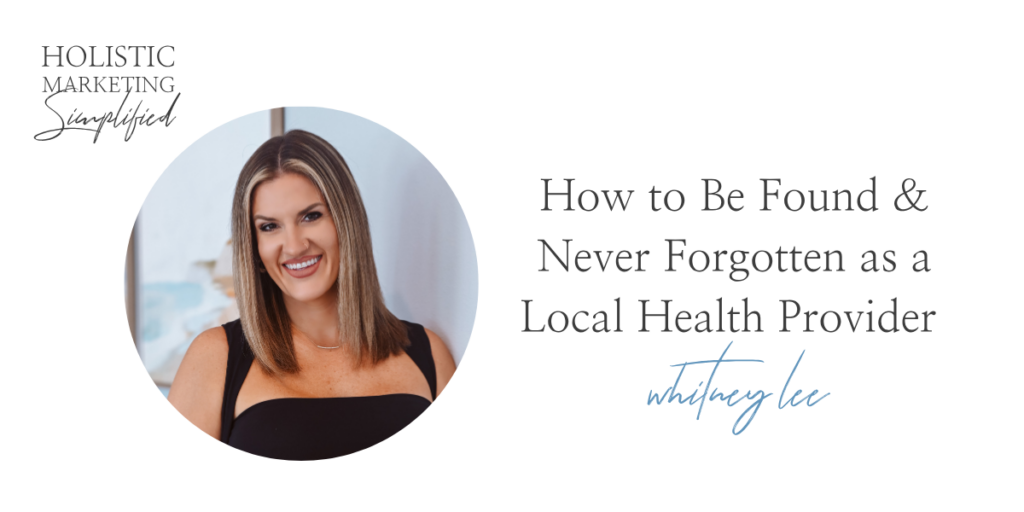
How to Be Found & Never Forgotten as a Local Health Provider with Whitney Lee [Episode 171]
Subscribe on Your Favorite Podcast Player
Apple Podcast App | Spotify | Stitcher
When most people hear the term “PR,” they immediately think of celebrity publicists, red carpet events, or landing a feature on the local news.
But after this conversation with Whitney Lee, I think you’ll see PR a little differently.
Whitney is the founder of True Story PR, an award-winning agency that helps brands “be found and never forgotten.” And honestly, that phrase became the theme of this entire episode.
Because whether you’re a chiropractor, acupuncturist, physical therapist, doula, or any other local health provider, your marketing really comes down to two things:
- How are new people discovering you?
- And how are you staying in front of the people who already know and trust you?
The Two Marketing Problems Every Practice Has to Solve
One of my favorite concepts Whitney shared was what she calls the “one-two punch.”
The first part is being found. If new people are not consistently discovering your practice, eventually your growth stalls. Patients move away, life changes, competitors enter the market, and referral sources shift.
The second part is being never forgotten. Because even if someone already knows, likes, and trusts you, that doesn’t guarantee they’ll stay loyal forever. Another practitioner starts showing up more consistently. A competitor launches a promotion. Someone else appears to specialize in the exact thing they’re looking for.
And suddenly you’re no longer top of mind.
As Whitney pointed out, it isn’t always the most qualified practitioner who wins. Often, it’s the practitioner who stays visible.
That reminded me of a conversation I recently had with a pediatric chiropractor. One of her patients started taking their child to another chiropractor simply because that chiropractor was posting more pediatric content on Instagram. The patient assumed they were the expert, even though my client had significantly more pediatric training and experience.
Visibility matters.
Why Consistency Is Still the Closest Thing to a Marketing Cheat Code
Whitney and I ended up talking about something that comes up all the time inside my programs: repurposing content.
I get so much pushback on this.
People tell me:
“But I already posted that.”
“But my audience has already seen it.”
“But I already talked about that.”
The reality is that most people haven’t. And even if they have, people need repeated exposure before they take action.
Whitney shared that her team constantly analyzes what performs well and what doesn’t. The goal isn’t to create completely new content every day. The goal is to identify what resonates and keep building on it.
That’s such a healthier way to approach content creation because it takes the pressure off perfection.
Instead of trying to create the perfect post, you’re gathering data. Every piece of content becomes one small experiment.
Why “Perfect” Content Doesn’t Work Like It Used To
Another part of this conversation that I loved was Whitney’s perspective on content quality.
A few years ago, brands were spending thousands of dollars on professional photo shoots and highly produced video content.
Now? Some of the most effective content is the exact opposite.
Whitney explained that native content, meaning content that feels natural and organic to the platform, often outperforms highly polished content.
And honestly, that should be a relief. Your audience wants to connect with a real human. They don’t need every Reel to look like a commercial.
Why Organic Social Media Still Matters
One of the biggest myths I hear is: “I don’t get patients from Instagram.”
Maybe. But that doesn’t mean Instagram isn’t helping your business.
Whitney shared a story about a hotel client that lost a huge media opportunity because their Instagram account looked neglected and outdated. A major food writer checked out the account, was underwhelmed, and backed out of a planned visit.
That story perfectly illustrates why organic social media matters. Sometimes people aren’t using your Instagram to discover you. They’re using it to qualify you. They want to know:
- Are you active?
- Are you still in business?
- What do you specialize in?
- What does your practice feel like?
- Do you seem trustworthy?
Your social media presence answers all of those questions before someone ever books an appointment.
Social Media Is Discovery, Not a Sales Pitch
Another point Whitney made that I wholeheartedly agree with is that social media is a top-of-funnel activity.
People aren’t opening Instagram hoping to be sold something. They’re there to learn, connect, be entertained, and discover new ideas.
That’s why every post shouldn’t be:
“Book now.”
“Schedule today.”
“Limited spots available.”
Instead, social media should help people understand who you are, what you do, and whether you’re the right fit for them. The selling happens later. The trust starts here.
Let’s Talk About Paid Advertising
I was very honest with Whitney during this interview. Paid advertising has never been my area of expertise. But she shared a perspective that I think will be helpful for a lot of practitioners.
First, boosting posts and running ads through Meta Ads Manager are not the same thing. Boosting can occasionally make sense if you’re trying to increase visibility around something specific, like a new location or special event. But Ads Manager allows you to do much more sophisticated targeting.
Whitney talked about retargeting, which means showing ads to people who have already visited your website or interacted with your content. These are warm leads who already know who you are. And when those people see a relevant offer, they’re much more likely to take action.
What I appreciated most about this conversation was that she wasn’t talking about massive advertising budgets. She was talking about practical local-business marketing.
Influencer Marketing Isn’t Just for Big Brands
We also talked about influencer marketing, which can feel like a strange fit for healthcare providers at first. But Whitney reframed it in a really practical way.
If your ideal patients are local moms, partner with a local mom influencer. If your ideal patients are runners, partner with someone active in that community.
The key isn’t follower count. The key is relevance.
She also shared some great advice about setting clear expectations and giving influencers talking points so they can accurately communicate what makes your practice different.
Wrapping It Up
This episode is such a good reminder that marketing isn’t about doing one thing perfectly. It’s about creating multiple opportunities for people to discover you, connect with you, and remember you.
Whether that’s through PR, social media, email marketing, paid advertising, collaborations, or patient experience, every touchpoint matters. Because the practices that grow aren’t always the most qualified. They’re the ones people consistently see.
Connect with Whitney
Connect with Molly
Instagram | Facebook | Youtube | Holistic Marketing Hub
The Holistic Marketing Simplified Podcast is brought to you by Holistic Marketing Hub, our hybrid program that supports you with personalized coaching, caption templates, and virtual classrooms. In this program, we teach health and wellness professionals how to fish, but also bait their hook!
Make sure you’ve hit that follow or subscribe button on your favorite podcast player to get notified each week as we air new episodes!
Episode Transcript
Molly: Hi. I'm gonna keep this intro short because it's a longer episode, but today I am interviewing Whitney Lee. She is the founder and principal of True Story, which is a modern PR agency. They are award-winning. They help brands be discovered and never forgotten. So she talks a lot. If you think you know what PR is, I
Really, this episode, I highly recommend you listen to it, 'cause it's gonna be a little different than you're probably expecting. We talk about paid social some. We talk about, like, customer experience. We talk about why organic is super important even if you have a paid strategy, and yeah, I think you're just really going to get a lot of information from this episode.
Hey, welcome to Holistic Marketing Simplified. This podcast boils down to the fact that we wholeheartedly believe that more humans need to know about holistic health solutions, and you didn't go to school to learn how to be a full-time content creator and show up on Instagram and do all of this marketing stuff all day, every day.
So let's come hang out while we chat all things easing your marketing, and my goal is that you shift your mindset around your marketing from a, quote, should to a I get to. More dream patients and clients? Yes, please.
Abby: Hey, I'm Dr. Abby, chiropractor in Apple Valley, California, and I listen to the Holistic Marketing Simplified podcast.
Trust me, you'll love it too.
Molly: All right, Whitney, um, thank you so much for being on the show. I know we've already been chatting for 30 minutes, so it's like y'all are all coming into the middle of our conversation, 'cause I think we could talk forever. Oh, welcome to the party. Yeah. We're so happy to have you.
So tell everybody PR. It's been a long time since I've had anybody talk about PR on the show, and we're gonna talk about PR and paid, some paid advertising stuff, or paid ... What would you say? Paid meta. What are we- Yeah, we can talk about just paid in general. Yeah. Maybe touch on a little influencer stuff.
So this is definitely outside my wheelhouse, as I always tell people. I do these one-hour pick my brain calls, and someone had indicated on their form they wanted to talk about paid, and I was like, we got on the call, go... I said, "All right. Here's your chance to get your money back, because I don't know anything about that."
So like
Whitney: even- Ah. Hey, at least
Molly: you're honest. And she-
Whitney: People
Molly: appreciate the honesty. Yeah, she's like, "Oh, no, no, no, like, it's fine. I know." 'Cause it's like, you know what? If it does well, well organically, it's gonna do better with money behind it, so at least I can help you get to that point, right? Always,
Whitney: and you know what?
A lot of PR agencies don't do any paid aspects. So my agency's kinda unique in that way, and it surprises people when they, I tell them that we have a team that does all the Google search terms, all the meta ads. Gosh, we, we know how to do all the platforms, Pinterest and LinkedIn and all that. But for the most part, like, what we see, especially, like, local businesses, brick and mortars, they're doing a lot of Google ads.
They're doing a lot of paid meta. So- That is kind of, um, something unique about us.
Molly: Well, well, speaking of us, tell us about you.
Whitney: Awesome. Okay. So my name's Whitney Lee. I own, uh, True Story PR. So we are an agency that helps businesses be found and never forgotten. So I always say, number one, people don't really understand what PR is.
They have this, like, glamorized idea. I think they watch Sex and the City or Emily in Paris. And they think, like, my life as a Samantha Jones, like, I'm just wearing these sexy suits and walking down the street and talking on my cellphone and getting invites to exclusive club openings and sipping martinis and giggling.
I wish. No, that's not your life? Oh, darn. Uh, alas, but no. People really don't understand what PR is, and a lot of times they think it's the same thing as marketing, and I always try to stress that PR and marketing, they're cousins, but they're not the same thing, right? So I explain it like this, like, PR is all about visibility.
We are the top of funnel, and again, I hate using jargon, uh, so let's, like, break it down. We are the first way that people hear or discover you usually. Like, we go out and grab the eyeballs, and then we bring them back to your marketing engine, and that's where the marketing engine nurtures them and actually sells them.
So, um, when I talk to potential clients and I say like, I always say, "What would make this, like, you know, this relationship, what would be, like, knock this out of the park for you?" At the end of our relationship you would say, "I am so glad we hired True Story." And if they say, "We get a bunch of sales overnight," I'm like- Mm
"Yeah, this is not a fit." Um, because PR is about visibility. I always say it's, it's the one-two punch of being found. Number one, how are you getting new eyeballs on your business? And for your listeners, your practice, right? How are you getting new eyeballs on your business? Because if you don't, eventually you will die off.
If you just wanna ride the coattails and sell to the same people over and over again, eventually you'll die off because they'll get snatched away by a competitor or they'll age out or whatever. So number one, how are you, what is your strategy for constantly being discovered by new eyeballs? Then on the opposite end of the spectrum, what is your strategy for being never forgotten, right?
Mm. Staying in front of the people that already know and love you, because if you don't, a competitor is going to run a new client or a new patient special. They're gonna be doing something unique that just kinda, like, pulls them away. They're gonna forget about you because their options are endless, right?
Yes, yeah. They're gonna hop on Google and find someone new,
Molly: you know? Someone shiny. This just happened to one of my clients, actually. She-- Well, she's not a consist- She's like, she just did like a one-hour pick my brain call with me, and she said a patient of hers, instead of bringing their children to her, she's a chi- pediatric chiropractor- She's a more qualified pediatric chiropractor than the one down the street.
Her own patient started taking her kids to the chiropractor down the street because the one down the street was doing more pediatric posts on their Instagram. And so the patient just thought, "Oh, well, I should take my kid to them." Yeah. When really the one she was at was the more qualified pediatric. So that's when she h- booked a call with me.
She's like, "Okay." Yeah. "This is my light bulb moment of what you said the one-two punch," the second part
Whitney: of like, "Oh, no." You better stay in front of them or s- or your competitor's gonna come snatch them away, you know? So that's the one-two punch, and that's what we really help our clients with is a strategy for being found and never forgotten.
So, and it, it is something that you gotta stay on top of. So, and also I will say this, it's not always the most qualified or the most educated or the most experienced practitioner that wins the business. Prime example in what you just said is that other person just posted a bunch of pediatric stuff. So in the consumer's mind, she's like, "Oh, they're the, they're the expert at peds."
Mm-hmm. You know? "So I'm gonna take my kid over there." Half the time, the, the people who win in business are just the people who stay consistently out there. They're the best
Molly: marketer. Oh my gosh, yes. I was just had this conversation too with someone else, so like oh, so many parallels. I was talking about how we can post the same exact post for a client two different times, and one time it takes off, and one time it doesn't, and that just infuriates people 'cause they're like- Mm-hmm
"Molly, Molly, just tell me the formula." And I'm like, "God, don't you think I'd be a billionaire if I had a formula?" The formula is consistency. Yeah. That's the only, like, cheat code really. Like, there is no-
Whitney: Yeah. For every- ... to that, you know ... for every single one of our clients, we look at what are their highest performing posts and what are their lowest performing posts, and it changes month to month.
But you gotta take what's performing and continue to do more of that. Yeah. Take the stuff that's not performing and continue to test a little bit here and there, but doing more of what works and less of what doesn't. But you- Yeah ... that, that's, that's the kicker though is that you have to pay attention to these analytics, and people don't like that.
Molly: Well, actually would like to go, we didn't even talk about talking about this, but I think that's really important to go there because so many of my clients, I get a lot of pushback when I talk about, like, reposting or repurposing content. Mm-hmm. And they're like, "But I already said that. But I already said that."
I'm like, "You did? That's cute. Um, I'm glad you said it one time and you think that it, that m- um-" Checked the box. Said it once. And so, but I, I also like to look at it not only do people need to hear things, you know, what it used to be seven, now they're saying way more, to take action. But the other thing is when you start creating content from a place of, like you said, of testing, it's so much less pressure.
Mm-hmm. 'Cause I think I have a lot of perfectionists in my audience who are like, "Okay, I've gotta get this all right into this one post-" And I'm gonna spend hour- like, I have clients who will tell me, "Oh, I spent hours on this." I'm like, "You spent hours on one po- like, no wonder this feels so hard." Right. You have to look at it as one tiny data point in a sea of content.
Yes. So I don't know if you wanna talk about that and testing- Yeah ... and iterating. Well,
Whitney: I, I will say this, people like real. They don't like overly polished stuff. And actually for our clients, that's been such a sigh of relief because, you know, even five, six years ago, like, your Instagram was expected to be, like, so freaking curated of, like, these perfect images and these perfectly curated videos.
And now I can actually prove to clients that the more native, that's the word we use for- Yep, yeah ... casual, taken on your cell phone. I say native. Mm-hmm. Yeah. The more native stuff we use actually performs better. So we were spending thousands of dollars on cinematic photo- uh, videographers and professional photographers, and actually that doesn't even perform as well anymore.
Not at all. But it, uh, we're, the only reason we're able to make these types of pivots and decisions for our clients is because we are the nerds that are looking at every single one of these analytics. Mm. So, like, a lot of people hire a PR agency, and the first thing they say to me is, "Oh, okay, so..." Or I'll say, "Hey, I, yeah, I work in PR."
And they're like, "Oh, you get me on the news then." And I'm like, "Yeah, that, that is like, that is so, like, an ounce of what PR really is," right? There are so many ways that people are discovering brands now far beyond just watching the news. And if you're wa- if you're targeting millennials and Gen Z-ers, good luck.
Yeah. There's no reason for you to be on the news 'cause they ain't watching it, you know? Yeah, yeah. Like, if you're trying to hit boomers, okay, the news is probably a good fit for you, but it's all about how are you being discovered. And then it goes, the second step is so then they measure, like, if their PR company is doing a good job, the only way they can measure is if you're getting a bunch of media stories.
But I beg to differ on that, right? Like, there are other benchmarks that we measure success of PR off of. Like, if, if your PR is rocking and rolling, if, if you have a PR assistant or a PR agency, if they're doing your job, doing their job, and doing it well, it's not just how many times did they get me in the news.
There's so many other benefits that you should be seeing. Number one, your website traffic should go up.
Molly: Yeah.
Whitney: But again, you gotta be looking at your Google Analytics to even know that, you know? Mm-hmm. Your website traffic should be increasing. Your social media numbers should be increasing. Your inquiries from influencers probably will start increasing.
The number of emails in your database will start increasing. Those are the ways that we measure our success. 'Cause again, if we're going out grabbing eyeballs, "Hey, everybody. This is the best chiropractor in town. Best chiropractor," we gotta have somewhere to drive them back to. It's not just like, "This is the best chiropractor.
Book a, book an appointment right now," the end. It's like, "Sign up for our email blast to get three free steps about a, you know, something- Mm-hmm ... something of value." Then the email blast nurtures them, nurtures them to the appointment, right? So we're pushing ... We're getting the eyeballs and pushing them back to those.
So your email list, your website, your social media, those numbers should be increasing if your PR
Molly: is working. It's like a, you know, Kroger puts their logo on the middle of the University of Kentucky football field. Do you think people walk into Kroger and they're like, "I saw your logo on the football field"?
I'm like, you know, that's not really how it works. No. You know, it's hard because it's hard to, to measure specifically, but like you can say, "Okay, I know it got in front of this many, this many people are at the games, and this many people watch it televised, and blah, blah, blah, blah, blah." So I don't know if you also wanna talk about ROI when it comes to like organic social.
How do you usually walk people through ... I mean, paid's different, but with organic social, I don't know if you have something you walk through. Or do you even
Whitney: do- We, we help with a lot of organic social. We have some clients that we manage it for. Um, we are a PR agency by name, but there are some other ... Uh, we do some paid or paid ads obviously.
We do some organic social media and email marketing and things like that. I will say this, you've got to remember that organic social media is also top of funnel. Mm-hmm. Right? Uh, it is the way that people are discovering you. It is not where you sell, sell, sell and cram it down their throats. You know?
This is one really hard thing for us, is that a lot of our clients don't understand social media, and so they want every single post to have a call to action of like, "Book your appointment now. Book your appointment now." And I'm like, "You don't understand. This is a tool for someone to discover us and to scope us out," right?
It's their, their moment to be like, "Ooh, look at them. They specialize in pediatrics. Ooh, look at them. They offer this." Nobody wants to be sold anything on social media. Does anybody freaking open their Instagram app and say like, "I can't wait to be targeted by all these businesses selling me stuff"? No, you're there to, to scroll and enjoy and zone out.
Now yes, we do get subliminally, subliminally sold stuff And also the brands that target me on Instagram, God, they know me so well. It's, like, so spot on for me. But nobody wants to be sold something on social media. It's social media. It's not sales media, right? So it's all about, uh, it's remembering that social media is top of funnel, and you use social media to do exactly what we were just talking about.
Drive them back to your email list. Incentivize them to drop your, their phone number onto your text list. Push them to your website to read a blog, all that good stuff. So you gotta have realistic expectations for organic social. And I also will say this, organic social is im- so important. You've gotta have good, solid organic posts, but it's getting to the point now, especially on Instagram, if you aren't utilizing some type of paid strategy, the algorithm has literally got you by the throat.
Um, you can hope to go viral all day long, uh, but even a really small spend on Meta can really make such a difference.
Molly: Yeah, and that's why I wanted to have you on today because I think it's so, 'cause I, this is something I've always had personally such a block around. I've maybe spent $1,000 in ads in seven years, maybe.
And it's so funny because I've put more of my focus into, like, collaborations and growing that way. It's done well, but I often think, "Man, like, this could just be the thing that takes off." But, oh, before I move on to paid, let me just, I wanna bring back one more thing. Organic social and your current-- You talked about that one-two punch.
We also find that organic social is great for loving on your current people. It's like a continuous, uh- Staying in front of them ... continuing education. Yep. Yeah. Staying in front of them. You, maybe you add a new service. Maybe you bring on a new practitioner. It's like, "Oh," like, and then it helps people feel more like they know you, and you're their friend, and they're like, "I'm gonna keep booking."
Whitney: Oh, yeah. I w- I have a quick story that, ugh, is so painful me to, painful for me to tell this. But I always say, you know, organic, you may not be getting a ton of clients from organic social media. True story, straight up, we do not get clients from organic social media. Our clients are, like, big corporate companies, so it's, like, a 75-year-old man sitting behind a desk, and he is not giggling on Instagram, okay?
Yeah. So we don't get clients from that, but we keep a presence because it's a qualifier, right? Yeah. People scope you out, see your personality, and, and qualify you through that. So we had a hotel client that was launching a new restaurant, and their social media was, uh, really, really bad. I mean, they were having, like, a front desk person that would post, like- A half-eaten bagel from their free breakfast bar, an empty- Yeah
room. It was just very lifeless, and they would post, like, once every three weeks, and, or just like, "Here's a picture of the beach," the end. Like, no, nothing dynamic, and I really pushed them. They wanted to hire us to do PR around the new restaurant and the hotel, and they did not wanna pay us to do social.
And I was like, "Your social is so important. It really is a qualifier." They wouldn't do it. "No, no, no. We, front desk girls got it under control." "Okay, cool. Fine. Got it." So we were getting ready to launch this restaurant, and I had the number one food writer in North America. She writes for all the big names, Travel + Leisure, Food & Wine, Forbes, Southern Living.
She writes for all of them. I, I said, "We would love to have you down to the resort, put you up for the weekend, let you try all the new menu items and everything," and I was just talking it up to her, and actually we- we're pretty close, so we were emailing back and forth about this. And she was like, "Wow, I've never been to that part of, um, that state, and I, I'm interested, and, like, maybe May could work," and we were throwing around dates.
Like, a little while later, I got a text from her, and it was a screenshot of that hotel's Instagram account, and she said, "This isn't the property you're telling me about, is it?" Oh, no. And the whole deal was off because she looked at their Instagram, and she was so underwhelmed that she didn't wanna come anymore.
And I immediately sent that conversation to the VP of marketing, and I said, "I don't know who's the decision-maker about social media, and I know they don't wanna spend money on it, but maybe they need to take into account the, the lo- the opportunity cost- Oh ... that they just lost a huge opportunity."
Because this looks so amateur. Be- because it just looks so, so amateur. Doesn't match the level, the caliber- Of what I was explaining ... of the brand. Yeah, and I was explaining it of, like, "It's beachfront. It's this, it's that," 'cause it is a beautiful property. And I had her on the hook, and the deal was- Oh
because their Instagram was a hot mess. And you know what? Three weeks later, they signed the social media contract, and we took over their pages.
Molly: That's amazing.
Whitney: So, it, but yeah, again, sometimes you gotta lose a huge opportunity like that to be like, "Wow, I really should have invested in this." And sometimes those owners would have never have known about losing that opportunity if I wouldn't have shared that with them.
They were also disappointed in me, 'cause they're like, "Why aren't we getting any good food writers?" And I was like 'Cause you got m- y- I'm trying to do this with one arm tied behind my back.
Molly: Yeah, and a lot of people will come in assuming you're not in business anymore if
Whitney: it's- Mm-hmm ... they're like, "Oh, wait, are they even still in business?
Do I
Molly: even..."
Whitney: Exactly. So they want, people wanna work with people they feel like they know, and social media, organic, is so important. So even if you're not, you're like, "We don't get clients from this," I swear to you, it is still so important- Yeah ... just for the qualifier- Yeah ... and the relational aspect to have a consistent presence.
If you can only do two posts per week, do two posts per week, but keep it up.
Molly: Yeah. You know? Exactly. No, I totally agree. Okay, talk to me about paid, because I know I've told you my blocks I have when I open Ads Manager and I'm just wanna shut down, but, uh, a lot of people always ask me is like, is boosting a post the same thing?
So can you explain why they are different- Totally ... and kind of the merits of each? Yes. So
Whitney: I always say boosting is a trap, but I will... There are times that boosting actually isn't the worst thing on the planet, but I do preach that boosting is a trap. That button is so easy- Yeah ... and it's, like, Meta, that's Mark Zuckerberg dangling a carrot in front of you because he knows that most people don't know how to use Ads Manager and it's overwhelming to them.
Mm-hmm. So all you have to do is just hit this little boost button and magically, dopamine, dopamine, dopamine. You get likes- Mm-hmm ... likes, comments, more views. Like, it's easy way for him to get your money, right? Now, again, it's n- if you are just needing some visibility on new location is now open, hitting boost and geo-targeting it within five miles of your new location is not a total waste of money, okay?
But I will just say this. When you have someone that can set up ads for you inside of Ads Manager, there's some wild, amazing things that you can do, and you don't even have to spend that much money on it. We have clients that spend 300, especially if you're in a really small market. I know a lot of y'all are local.
For everybody listening, a lot, a lot of y'all are, like, local brick-and-mortar service-based, so you know, you're, you're just trying to hit your people in your community. You're not even trying to go nationwide. I mean, we have clients that spend $200 a month, 300, $500 a month, and see amazing returns on it.
So I will say this. Some people get in there and figure it out. It always starts with picking an objective. When you open Ads Manager, the first thing it's gonna say before you set up a campaign is what's your objective? Are you trying to, one, drive traffic to your website? Two, sales? Three, leads? Uh, four, awareness?
There's, you get to pick your objective of what are you trying to get people to do, because when you pick that objective, it's gonna show your ad to people who do that the most on social media. So Meta, not to get all, like, weird, but Meta is watching what we do, right? Right. Yeah. It knows that Whitney is a person who clicks through a lot.
I see these ads and I'll, I click through to that dress on Amazon. Ooh, okay. So they categorize me as a traffic person. Okay. I am never filling out a lead form where I drop my name and email, so I, I don't see a whole lot of leads ads because I don't do that. You know what I mean? So it groups us based off of our, our behaviors, right?
So when you as a bus- That's fascinating ... Uh-huh. When you as a business click awareness and you pick video views, it's gonna show that ad to m- people who are, are, who usually sit there and watch videos, you know? Oh, wow. So it's trying to honestly help you out is what it's doing. I don't wanna get too far into the techy side because it really is something that, um, it took me years to learn how to really do paid meta, and my, I sent my team through this whole training process that was a year-long for them to fully learn the capabilities of it, 'cause it does get a little complicated.
But surface level, some of the coolest things that we do for local service providers are traffic to booking, or if you have, you know, maybe a, what we call as, like, retargeting. So we can actually do it to where anybody who has clicked to your website or engaged in any of your social content within this many miles of your office, we'll start retargeting them, but we don't just retarget them with anything.
We retarget them with an offer. Like- Yeah ... a new client special or a flash sale, you know? Ooh, yeah. Um, I love retargeting and social ads because you can run a flash sale for three days, and they can only book it in those three days, and then just cut that off. It's so immediate, you know? So I think retargeting is something that you're only hitting warm leads, right?
If they've already engaged with your page or been to your website, obviously they have some level of interest in you. Yeah. So if you turn around and retarget them with an offer or something, they are already a warm lead and much more likely to take action on that. Yeah. So I, I definitely- And for you to have
Molly: that data, they need to have their pixel on their website, right?
Yes, it's a- Do you have to do it for a certain amount of time, you feel like? Like ...
Whitney: No. Once you set up a pixel, it is there forever. It is a, a, it's, I wouldn't say it's a pain in the butt. You just need to find somebody that can help you do it. Yeah. I would not suggest for people who, I don't even know coding on websites and all that.
That is not, that's not me. Uh, we have someone on our team who knows where to drop that code. It literally takes 30 seconds For somebody to, you give them the code, the code is generated by Meta. They log into the back end of your website. They go into this certain spot and paste the code.
Molly: Yeah. I would think most people who have built your website for you would be able to do that for you- Oh, yes
no problem.
Whitney: And if they tell you that it takes three hours to do that, they are lying. Um, 'cause it literally takes about three minutes. Yes. If you give them the code, it takes them about three minutes. Yeah, yeah. So, but that is magic. You know, you can ... One thing that we like to do is maybe have a hidden offer page.
Ooh. So it's not a page that anybody can find on your website. It's just a hidden page. They have to have the link to get there, so maybe you have an email list. You send this special offer to the email list and get them to click through to your website for more details, and then we have the pixel on that page, so then we start retargeting them with ads.
Yeah. You know, so we know the only way that they got to that page was through the email blast. So that's kind of a- But it's the same, it's
Molly: only
Whitney: one
Molly: pixel though, right? It's the same- Mm-hmm.
Whitney: Yeah. So, um, but you do track it from that one specific page. So there's some really cool things. Also, if you do an influencer campaign, putting some money behind that will help elevate your page and theirs, which is really exciting as well.
So there's a lot of really cool things. Last thing I'll say about paid meta is if you have an email list, we do this all the time, if you have an email list, you can take that list and make an audience inside of Ads Manager. So even if they don't open their emails, they will start seeing the ads for you on social media.
Yes. And people are like, "Wait a minute, what if it's not the email associated with their Facebook or their Instagram?" And you're like, "Meta can get through that."
Molly: I'm sure they figured that one out.
Whitney: Yeah. Isn't that crazy? Because my Meta, my Facebook is, is my personal Gmail, but let's say somebody got ahold of my True Story email.
Meta can still pull that and associate it with my Facebook and target with me. So- Wow ... I don't wanna get too heavy techy on all that back end stuff. But boosting is not the devil. If you just need, hey, new, new location is open, or if you do, like, a, an amazing interview or a podcast that, you know, really positions you as an expert, putting some money behind that, as long as there's a call to action on it, right?
Like, they watch this little snippet of you, and then it's like, sign up for my email to learn more about, you know, whatever, osteoporosis. So I, I think, you know, boosting will get you more views. You're just ... There, there's a lot of opportunity out there that people don't realize.
Molly: Yeah. Okay, so we've talked some about paid.
Talk to me about influencers. Oh, my gosh. 'Cause I think it's this sticky area when it comes to service-
Whitney: God ... providers. We have a lo- everybody has a love/hate with influencers. I will say it's the cheapest form of advertising you can do I will say this, finding somebody who is your target audience is a great fit.
Somebody in the community. If you serve women or moms, find a mom, right? Because that's who's gonna be following her. We follow people who are like us or who have similar interests. So f- if you're targeting moms in their 30s, find a mom in their 30s. Here's where I think the most important part of influencer work needs to happen.
You want it to be real, and you want it to be authentic, right? But you gotta set up expectations. We actually have a contract that we do with influencers that s- that clearly states, "We are giving you A, B, C. In return, you will be giving us X, Y, Z." One-- And you need to dial it out. One reel, X amount of stories.
You'll tag us in every story. You'll use this link. You know, being very, very clear on what both sides of the relationship are getting, 'cause a lot of people are like, "Well, I had this influencer, and then all I got was a stupid story over it." And I'm like, "Well, what did you negotiate?" And they're like, "Well, I just n- I just told them to-- we would come in if they posted about us."
But saying, "Just post about us," is not clear. It's- It can mean a lot of
Molly: different things.
Whitney: Yeah. We have a contract that says, "And within X days of your visit, you must post this many stories, this many reels, tag us," blah, blah, blah. I love doing giveaways with influencers too. If you have an opportunity to do a giveaway where they have to like both of your pages, comment and tag a friend, share to their stories, then you can put a boost behind that.
I'm gonna say that's a good opportunity where you can just boost, and that'll help that post get more visibility. But the biggest part is really just hammering out the expectations. And before they come in, this is, like, super important, we like to give them talking points. And I always say, "We are not telling you what to say at all, but here's the background of our practice.
Here's what we want to be known for. Here's what, uh, we're, we're trying to push right now. We just launched memberships or this or that." Give them some talking points. And I even say to them verbally, "We're not demanding you to, to feature all of this. I just wanna give this to you for sheer education." And usually the influencer is like, "Oh my gosh, thank you so much.
You're making my job a lot easier." Mm-hmm. And then they usually use what I tell them to talk about. They want to be educated. They don't wanna get on and just, like, think of something to say, you know? But it's on you to provide those talking points. And it doesn't need to be like 16 paragraphs. Give them the top 10 bullet points about your business.
Five to 10 bullet points. How are you different than every other practice in town? What's something special you offer? What are you-- What's new in the business right now that you want their help promoting? What maybe your, if you're the most educated, share a little bit about your education or the history of the practice, right?
Or maybe debunking some things that people think this about acupuncture, but it's not true. Like-
Molly: Yeah ...
Whitney: give them a very quick and dirty list of bullet points, and you would be surprised that they will actually use it. They're happier. You're happier. Like, the relationship has done so much more than just, "Hey, we'll comp your visit if you post for us."
Molly: Yeah, yeah, yeah. That's so, that's clear as mud. That makes perfect sense. So how can people find you? How can they work with you? Oh my gosh.
Whitney: Love that This has been so fun. Thank you. Um, so a couple things. Um, you are welcome to connect with me personally on LinkedIn. It's Whitney Lee, or you can find me on Instagram.
It's thewhitneylee. I love to connect personally with y'all. If you wanna read about the agency, truestorypr.co, not .com, .co, so truestorypr.co. Um, and also, I have a podcast where we talk all about this, so if you wanna hear me ramble some more and get all the free advice, I, I love it. The podcast is such a joy for me, so check out Brand Rescue.
Uh, it is ... We've been doing it for over three years, and it's full of free advice for small businesses that are just trying to figure it all out.
Molly: Brand Rescue. Okay. Awesome. We'll make sure that's all linked to the show notes, and you've got me now where I'm like, "God, I've gotta start doing paid."
Whitney: Ah. It is so
That's when you really see takeoff in social media. Yeah. The organic side is so important, but even sprinkling in 2 to $500 worth of paid every month, y'all, you're gonna see a big jump.
Molly: Oh,
Whitney: thank you for that. All right,
Molly: and thank you so much for your time, Whitney. All right. Thanks, Molly. Thank you for listening to Holistic Marketing Simplified.
And hey, you know how every podcaster at the very end of their episode asks you to rate and review their podcast? Well, that's because it's super important. These podcasts take a lot of time and heart and effort to produce to bring you free information. So in order for me to be able to continue doing that, we need more people to find out about the show.
So if you could, please just take, like, two minutes out of your very busy day to leave me a rating and share this on your Instagram stories and tag @mollyacahill. That's C-A-H-I-L-L. I would greatly, greatly appreciate your support. I know your time is valuable, and I can't wait to see you in the next
episode.
![The Non-Fancy Ways I Actually Use AI to Make Social Media Content Easier & Better [Episode 146]](https://mollycahill.com/wp-content/uploads/2025/12/The-Non-Fancy-Ways-I-Actually-Use-AI-to-Make-Social-Media-Content-Easier-Better-Ep-146.png)
![How Wellness Practitioners Can Attract More Local Patients in 2026 [Episode 169]](https://mollycahill.com/wp-content/uploads/2026/05/How-Wellness-Practitioners-Can-Attract-More-Local-Patients-in-2026-Ep169.png)

![How I Get AI to Write Carousels that Sound Exactly Like I Talk [Episode 132]](https://mollycahill.com/wp-content/uploads/2025/08/How-I-Get-AI-to-Write-Carousels-that-Sound-Exactly-Like-I-Talk.png)
![How to Run a Promotion on Instagram for Your Health Practice [Episode 96]](https://mollycahill.com/wp-content/uploads/2024/12/How-to-Run-a-Promotion-on-Instagram.png)